EU Waste Shipment Regulation 2024/1157: What Changes for Scrap Metal Exports, and When?
What Regulation (EU) 2024/1157 changes for metal scrap exports: the 21 Nov 2026 list, May 2027 non-OECD rules and audits, with 2025-26 export data.
Contents 5
You export metal scrap from the EU, trade it, or sell to someone who does, and you have read that exports to some countries will be banned from 2027. The news coverage is about draft lists and votes. This guide goes to the Regulation's own text: which provisions apply to green-listed metal scrap, from which dates, what exporters must do, and how much of today's EU scrap export trade goes to the countries the new rules affect.
Last checked: 8 October 2026.
In short
- Regulation (EU) 2024/1157 replaced the 2006 Waste Shipment Regulation. It entered into force on 20 May 2024 and has applied generally since 21 May 2026, with some provisions on other dates.
- From 21 May 2027, exports of green-listed (non-hazardous) waste for recovery to countries outside the OECD (the Organisation for Economic Co-operation and Development, a group of mostly high-income countries) are prohibited, unless the destination country and the specific waste are on a Commission list. Clean metal scrap in metallic form is green-listed.
- The Commission must adopt that list by 21 November 2026. Countries had to apply by 21 February 2025 to be on the first list.
- Exports to OECD countries such as Türkiye continue under the green-list procedure, but the Commission monitors them and can act if they cause environmental harm.
- From 21 May 2027, every exporter must be able to show the receiving facility manages the waste soundly, backed by an independent audit.
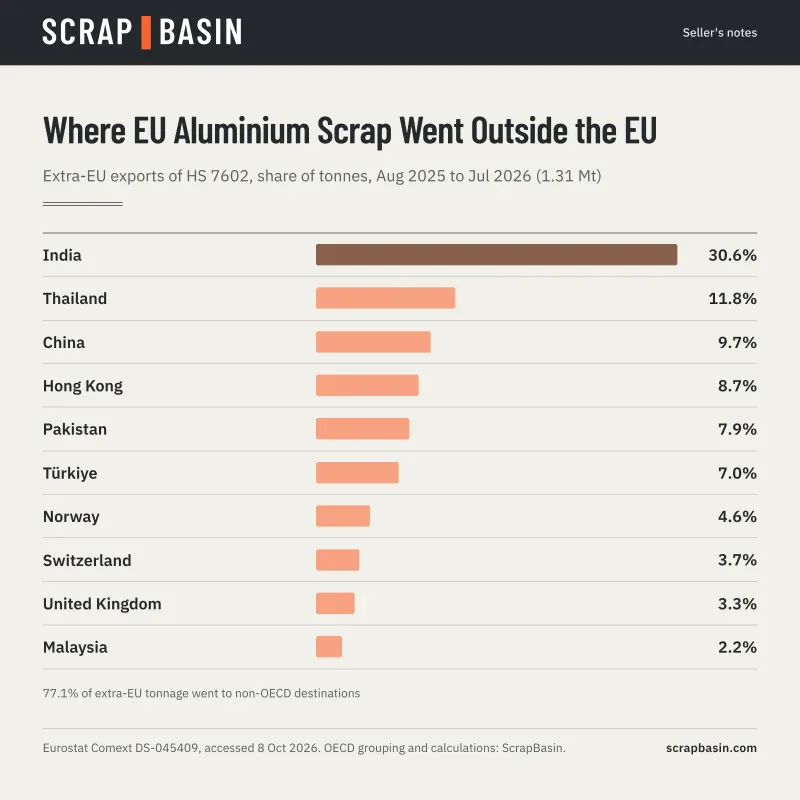
- On data from Eurostat (the EU statistics office) for August 2025 to July 2026, 30.2% of EU extra-EU ferrous scrap exports and 77.1% of aluminium scrap exports went to non-OECD destinations.
The Date Ladder
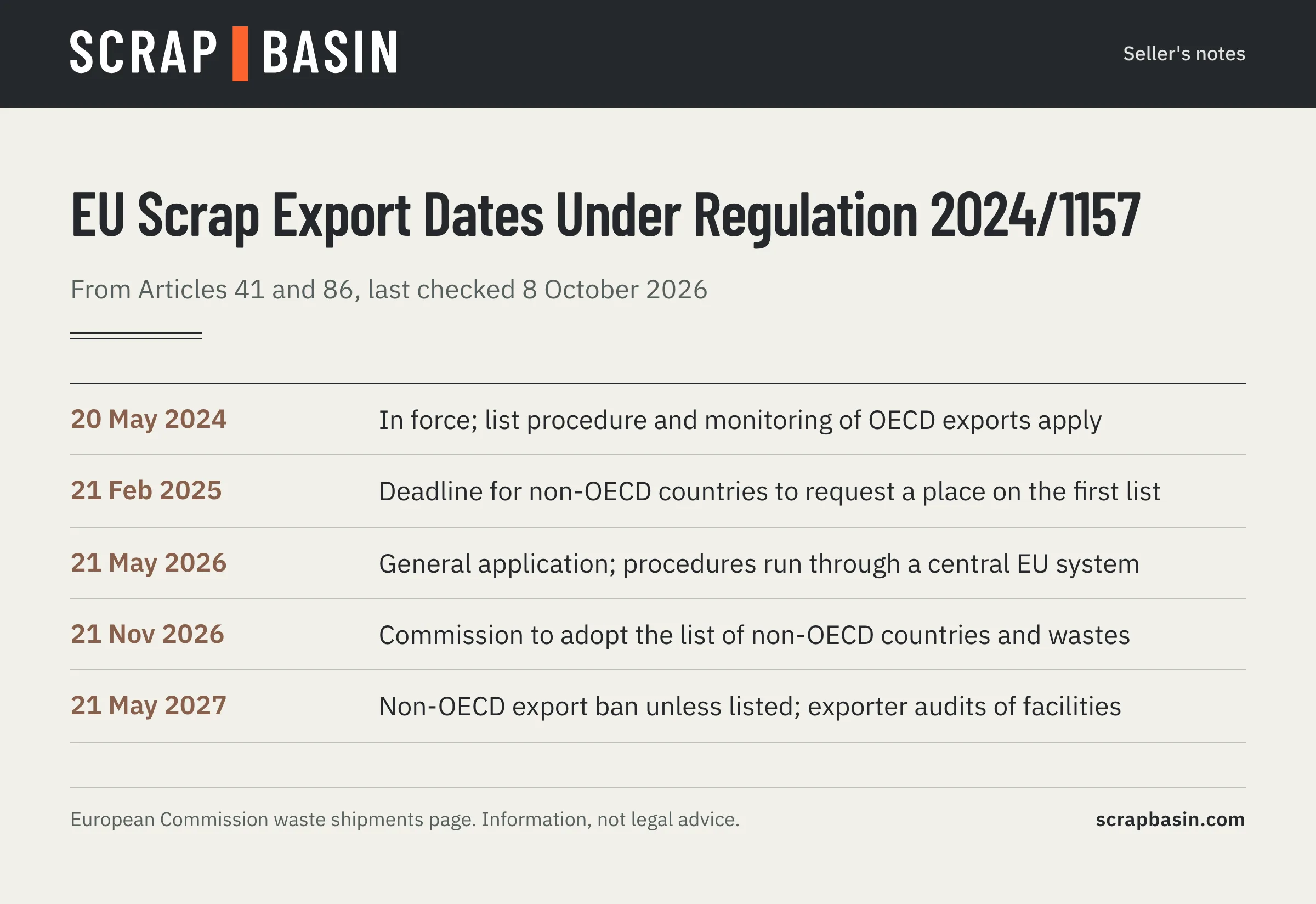
Article 86 sets the dates. The ones that matter for metal scrap:
| Date | What happens | Where |
|---|---|---|
| 20 May 2024 | Regulation enters into force. The list procedure (Articles 41 to 43) and Commission monitoring of exports to OECD countries (Article 45) apply from this date | Article 86(1), (3)(b) |
| 21 February 2025 | Deadline for non-OECD countries to request inclusion in the first list | Article 41(3) |
| 21 May 2026 | General date of application; the 2006 Regulation's procedures give way to the new ones. The Commission says procedures now run electronically through a central EU system | Article 86(2); Commission page |
| 21 November 2026 | Commission to adopt the list of non-OECD countries to which exports of specified non-hazardous wastes are authorised | Article 41(3) |
| 21 May 2027 | Prohibition of non-hazardous waste exports to non-OECD countries (Article 40) and exporters' audit obligations (Article 46) apply | Article 86(3)(d) |
Metal Scrap Is Green-Listed
The Regulation sorts waste into lists. Basel entry B1010 (from the Basel Convention, the international treaty on waste shipments), which the Regulation's annexes carry, covers metal and metal-alloy wastes in metallic, non-dispersible form, naming among others iron and steel scrap, copper scrap, nickel scrap, aluminium scrap, zinc scrap and tin scrap. Within the EU and to OECD countries, such "green-listed" waste moves under the general information requirements of Article 18 (the Annex VII document) rather than prior notification and consent.
Two cautions. Scrap that is contaminated enough to change its risk, or mixed with hazardous material, can fall outside the green list and into stricter rules (Article 39(1)(e) prohibits export of such contaminated green-list waste to non-OECD countries altogether). And scrap that has met the end-of-waste criteria is no longer waste at all; see our guide to end-of-waste criteria.
Exports to Non-OECD Countries from 21 May 2027
Article 40(1) prohibits exports from the EU, for recovery, to countries to which the OECD Decision does not apply, of non-hazardous wastes listed in Annexes III, IIIA or IIIB, among others. That includes green-listed metal scrap.
The exception is the list. Under Article 40(2), the prohibition does not apply to a country included in the Article 41 list, for the specific wastes the list names for that country. Even then, the waste must go to a facility licensed under that country's law to carry out recovery, and not to an interim operation unless every later operation takes place in the same country or another listed one. For wastes in Basel Annex IX, such as B1010 metal scrap, those exports follow the Article 18 information requirements, unless the country has asked for prior notification and consent (Article 40(3)(a)).
To be listed, a country must apply and demonstrate, among other things, a national waste management strategy, a legal framework for permitting and enforcement, and party status to the relevant international agreements (Article 42). The Commission must review the list at least every two years and can remove a country that stops complying (Article 41).
As of 8 October 2026 the list has not been adopted. Trade press reported a draft in September 2026; we have not seen the draft on a primary source and do not name any country as listed. We will publish an exposure table when the list is adopted.
Exports to OECD Countries
For OECD countries outside the EU, the procedure remains close to that for shipments between Member States. Article 45 requires the Commission to monitor these exports, and where there is evidence that a destination cannot manage the waste soundly, or that EU exports cause substantial harm to its own waste management, to request information and, ultimately, to act. The Commission summarises it this way: trends will be monitored, dialogue will follow concerns, and exports can be suspended if waste is not managed soundly.
Exporter Obligations from 21 May 2027
Article 46 applies to exports from the Union generally. The notifier or person arranging the shipment may export only if it can demonstrate that the receiving facilities will manage the waste in an environmentally sound manner; must not export to a facility that fails the criteria in Annex X; and must ensure the facilities have been audited by an independent, qualified third party. In the Commission's words, in the absence of a positive audit, companies must stop exporting to that facility.
For a trader or exporter, that means audits of overseas receiving facilities need to be commissioned and completed before May 2027. For a generator selling to a trader, it means asking where the material goes and whether the outlet will still be usable; it is one of our questions to ask a scrap metal buyer.
How Much Trade Is Exposed
We pulled Eurostat's Comext data on 8 October 2026 for EU27 exports to countries outside the EU, August 2025 to July 2026, and grouped destinations by OECD membership.
| Heading | Extra-EU exports, 12 months | To non-OECD destinations | Share | Largest non-OECD destinations |
|---|---|---|---|---|
| 7204 Ferrous waste and scrap | 16.7 million t | 5.05 million t | 30.2% | Egypt 13.6%, India 5.7%, Pakistan 4.4%, Morocco 3.7% |
| 7602 Aluminium waste and scrap | 1.31 million t | 1.01 million t | 77.1% | India 30.6%, Thailand 11.8%, China 9.7%, Hong Kong 8.7%, Pakistan 7.9% |
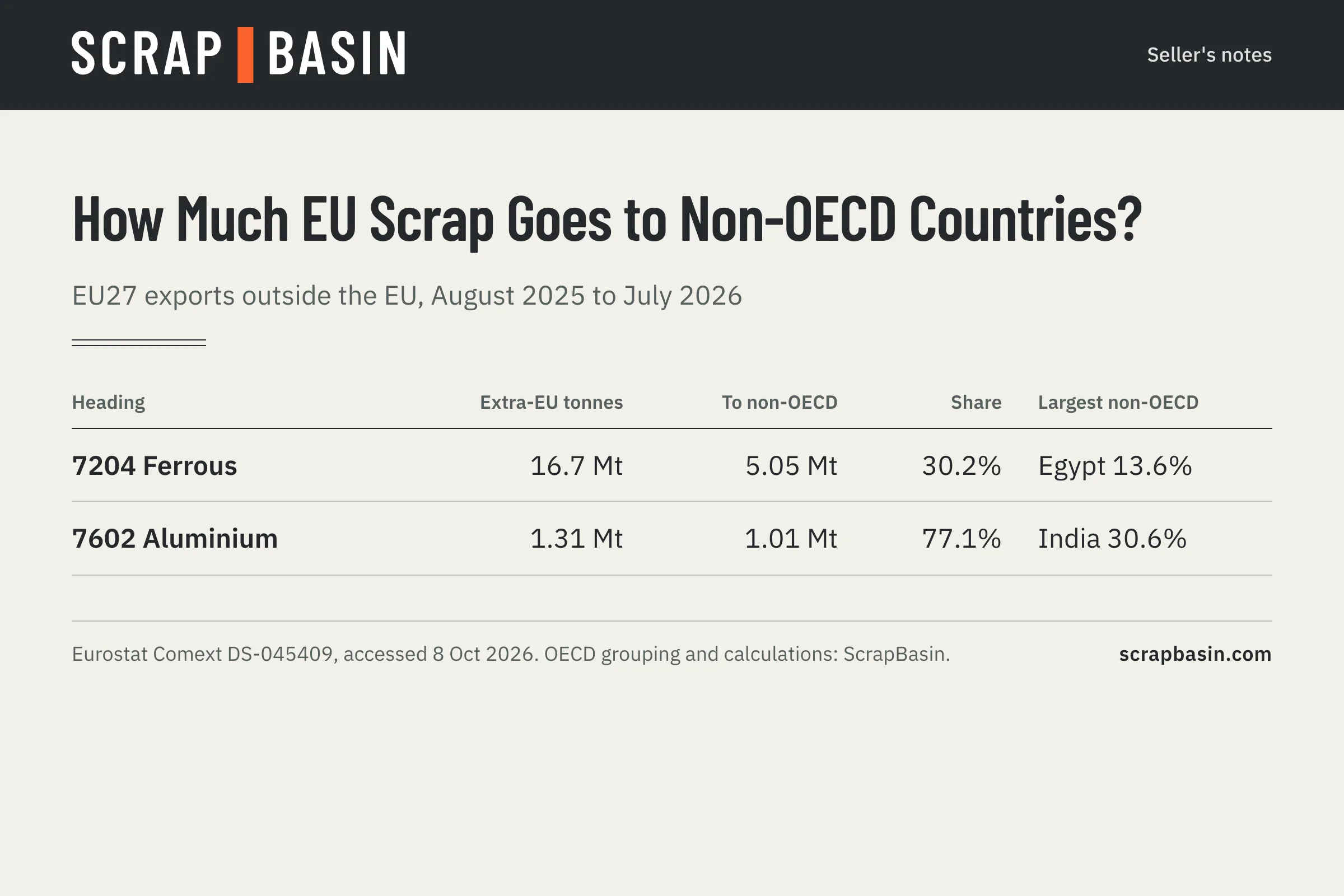
Two readings. For ferrous scrap, the largest destination, Türkiye (62.7% of extra-EU tonnage), is an OECD member, so the 2027 prohibition touches under a third of the trade; the rest depends on Commission monitoring rather than the list. For aluminium scrap, more than three-quarters of extra-EU exports go to non-OECD destinations, so the list decides the market. Our EU27 ferrous scrap exports note and EU aluminium scrap exports tracker have the destination detail.
Caveats: these are customs headings, which include some material that may not be green-listed waste, and some flows that may be end-of-waste product. OECD grouping is ours; check each destination's status yourself. The data is the latest Eurostat had published at the time of the pull. Reuse: Eurostat data are reused under the Eurostat copyright notice (CC BY 4.0; Commission Decision 2011/833/EU), with the source acknowledged. All figures are as declared by the EU27. Eurostat's notice excludes commercial reuse of data for countries outside the EU, EFTA and the acceding and candidate countries; we treat EU-declared exports to such partners as EU data, but check the notice before reusing partner detail commercially.
What the Regulation Does Not Change
Some things stay as they are, and it is worth being clear about them so that the 2027 date is not read as a ban on all scrap exports.
- Shipments within the EU of green-listed metal scrap continue under the general information requirements; the non-OECD prohibition is about exports from the Union.
- Exports to OECD countries are not prohibited by Article 40. Türkiye, the largest destination for EU ferrous scrap, is an OECD member.
- Scrap that has met the end-of-waste criteria is no longer waste, so waste shipment rules do not apply to it, although the exporter must be able to show that the criteria were met.
- Hazardous waste exports for recovery to non-OECD countries were already banned and remain so.
What does change for everyone exporting from the EU is the evidence burden: from 21 May 2027, Article 46 requires exporters to show environmentally sound management at the receiving facility and to rely on an independent audit, whatever the destination.
What to Do Now
If you export or trade:
- Map your destinations by OECD status and by heading, using the scrap metal HS codes your shipments use.
- Watch for the Article 41 list (due by 21 November 2026) and check, country by country and waste by waste, what it authorises.
- Commission independent audits of receiving facilities in good time for 21 May 2027.
- Review contracts for how export restrictions are handled.
If you generate scrap and sell it in the EU:
- Ask your buyer where each stream goes and whether that outlet survives May 2027.
- Expect buyers with non-OECD outlets to revise terms as the date approaches.
If you sell from outside the EU: this Regulation governs shipments from the EU. Exports from Great Britain follow UK rules, which this guide does not cover. Flows from the EU to the UK go to an OECD country.
This is commercial guidance, not legal advice. For a decision about a specific shipment, check the Regulation's text and take advice.
Follow the Data
The ScrapBasin data note tracks EU and UK scrap exports by destination each month from Eurostat and HMRC, with sources and methods on every chart. The October 2026 sample issue is free.
Read the free October 2026 data note
ScrapBasin Plus adds alerts when the list is adopted or a tracked rule changes, and full chart history, for USD 12 a month: see Plus and Pro.
ScrapBasin is an information service. It does not buy, sell, export or broker scrap.
Sources (checked 8 October 2026): Regulation (EU) 2024/1157, https://eur-lex.europa.eu/eli/reg/2024/1157/oj (Articles 39 to 47 and 86; Annex entries), text retrieved via the Publications Office; European Commission, Waste shipments, https://environment.ec.europa.eu/topics/waste-and-recycling/waste-shipments_en; Eurostat Comext DS-045409, https://ec.europa.eu/eurostat/web/international-trade-in-goods/database (Source: Eurostat, accessed 8 October 2026; calculations by ScrapBasin).
Public scrap price indexes for copper, brass, aluminium and steel each month, with the source on every figure.
Get Monthly Prices