Bare Bright vs No. 1 vs No. 2 Copper: What Decides the Grade?
What separates bare bright, No. 1 and No. 2 copper scrap, what the ReMA specification says about wire gauge, and how to keep material in the top grade.
Contents 6
You have copper wire or tube that sits somewhere between grades, and the buyer's view of it differs from yours. Perhaps the wire is slightly tarnished, perhaps some of it is tinned, perhaps there are a few brass fittings in the tube. This piece sets out what the three grades actually are, using the US industry specification that most buyers rely on, how UK and Australian yard names line up with them, which tests move material down a grade, and what that costs. It ends with the preparation that keeps material in the top grade.
In short
- Bare bright, No. 1 and No. 2 are defined by code words in the specifications of ReMA (the Recycled Materials Association, the US industry body): Barley, Berry and Candy, and Birch and Cliff.
- The difference is condition and purity: bare bright is bare, uncoated and unalloyed wire; No. 1 is clean, untinned, uncoated, unalloyed wire, solids and tube; No. 2 is unalloyed copper at a nominal 96% copper content.
- There is no universal gauge rule for bare bright. The specification leaves gauge to agreement between buyer and seller.
- Tinning, paint, burning, solder, fittings and oil are what move copper down a grade.
- Mixing a little lower-grade copper into a load can drag the whole load down. Keep them apart.
The Three Grades Side by Side
The descriptions below are our own summaries of ReMA's July 2026 specifications. The authoritative text is free to read at isrispecs.org.
| Bare bright | No. 1 | No. 2 | |
|---|---|---|---|
| ReMA code words | Barley (wire) | Berry (wire), Candy (heavy solids and tube) | Birch (wire), Cliff (solids and tube) |
| What it is | Bare, uncoated, unalloyed copper wire | Clean, untinned, uncoated, unalloyed wire and cable; clean clippings, bus bar and tube | Miscellaneous unalloyed copper, nominal 96% copper (minimum 94%) by electrolytic assay |
| Typical sources | Stripped cable offcuts, bright conductor | Clean wire, clean pipe and bus bar | Tinned, painted, lightly oxidised or soldered wire and tube |
| Usual UK names | Dry bright wire, millberry | No. 1 copper wire, heavy copper | No. 2 copper, braziery copper (partly) |
| Gauge | By agreement | By agreement | Not the deciding test |
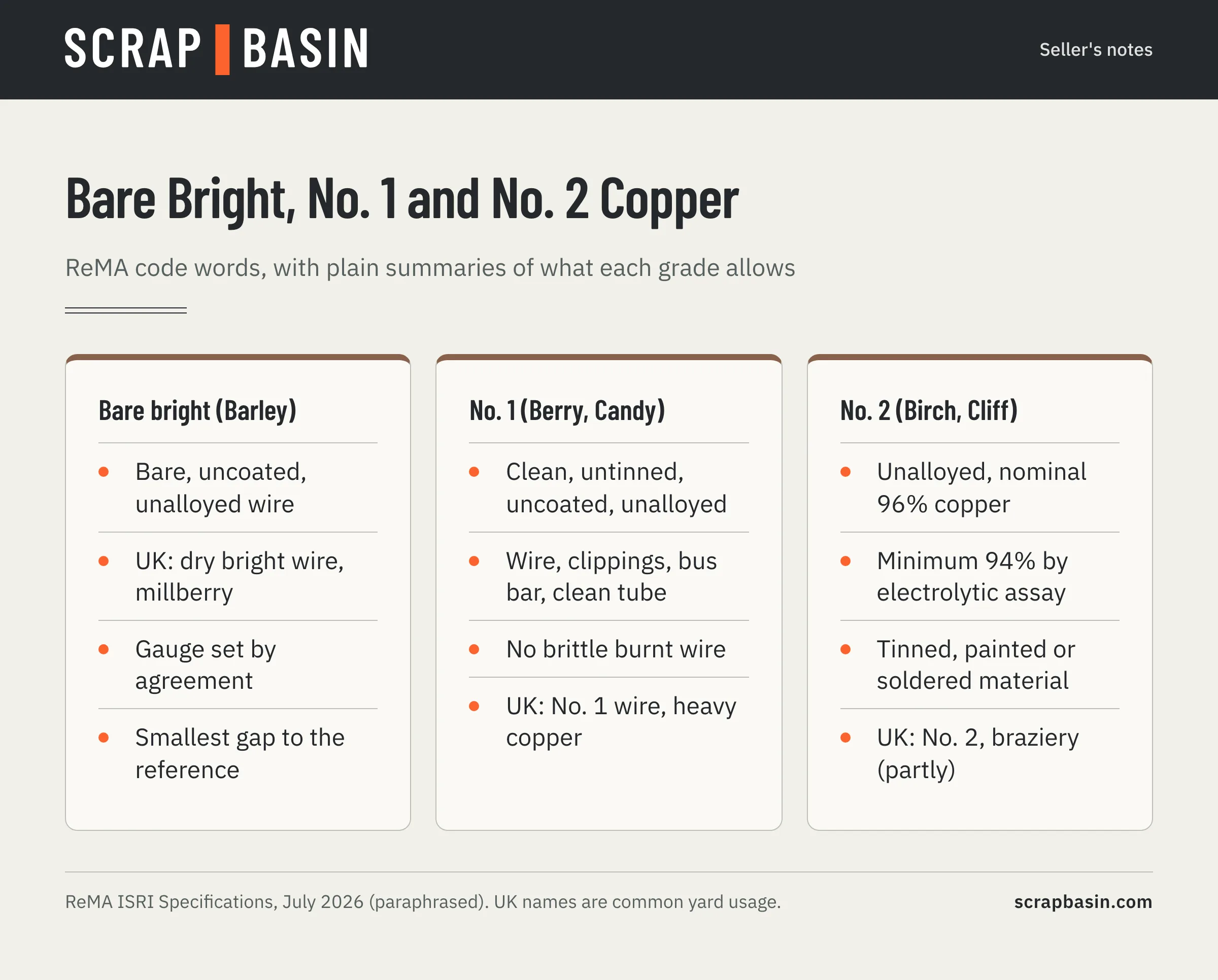
UK and Australian yards mostly use descriptive trade names rather than code words. The match between the columns is approximate, which is the main source of argument. Always agree the grade name and its meaning in writing.
The Gauge Question
Search results disagree on whether bare bright must be 16 gauge or 12 gauge and thicker. The specification itself does not set a single number for bare bright or No. 1 wire: it says wire gauge is subject to agreement between buyer and seller. The No. 16 gauge figure appears elsewhere in the copper section, in the description of insulated copper wire with No. 1 copper inside, and in the description of chopped bright wire nodules, where finer gauges are again a matter for agreement.
So the answer to "is my thin wire bare bright?" is: whatever the buyer's written acceptance terms say. If thin bright wire matters to your stream, put the gauge in writing before you deliver.
Seven Tests That Move Copper Down a Grade
Work through these in order. The first "yes" usually decides the grade.
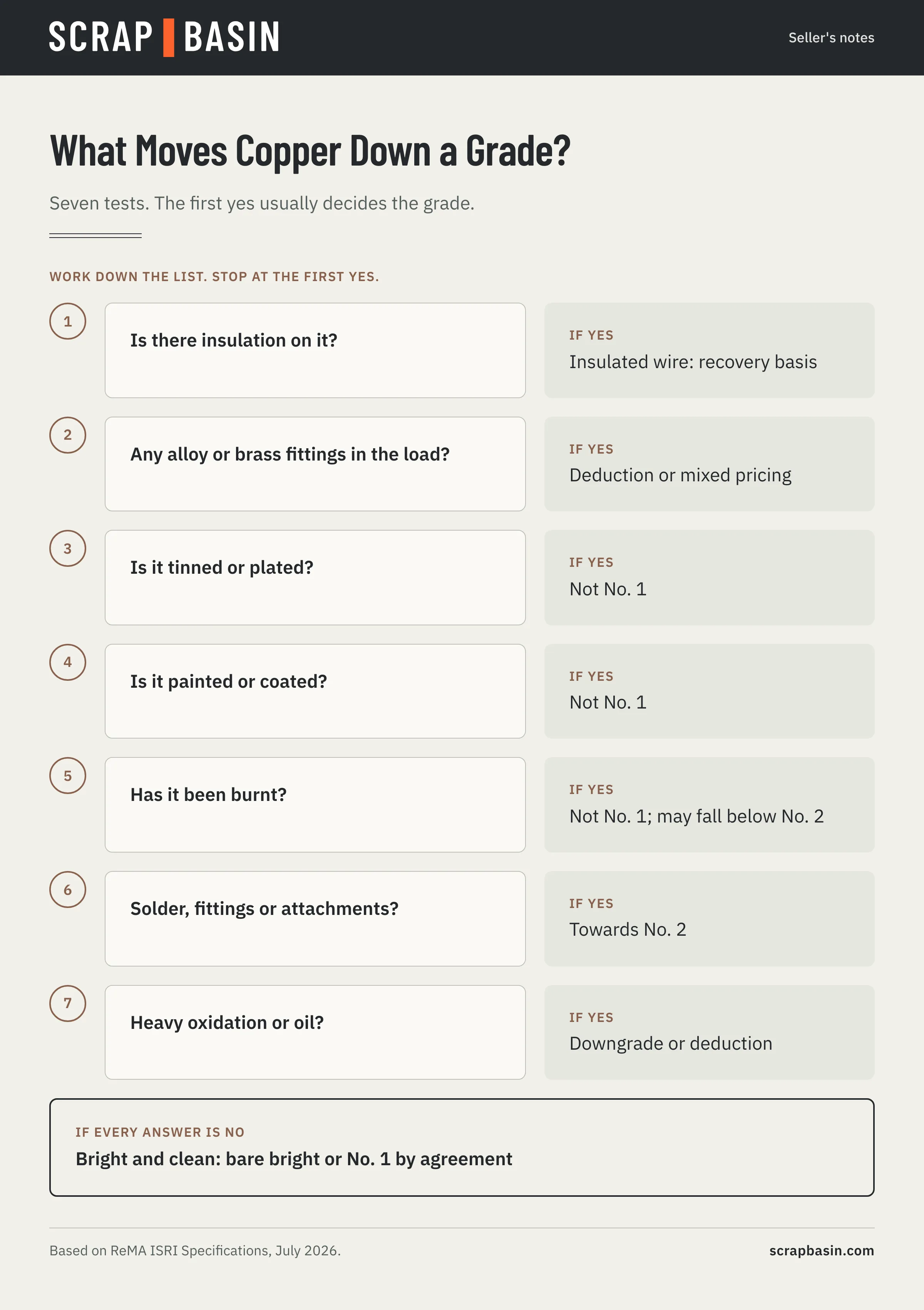
- Is there insulation on it? Then it is insulated wire, sold on a recovery basis, not bare bright. See insulated copper cable.
- Is any of it alloyed, or are there brass fittings? Brass or bronze in a copper load is a contaminant; the buyer deducts it or prices the lot as mixed.
- Is it tinned or plated? Tinned wire is not No. 1.
- Is it painted or coated? Coatings take it out of No. 1.
- Has it been burnt? The specification excludes brittle burnt wire from No. 1, and lists copper wire from burning among the things No. 2 wire should be free of, so burnt wire can fall below No. 2 altogether. Burning off insulation is also controlled or prohibited in many places.
- Is there solder, fittings or other attachments? These push tube and solids towards No. 2.
- Is it heavily oxidised or oily? Light tarnish is usually tolerated; heavy oxidation, green corrosion and oil are not, and green wire in bare bright is a matter for agreement.
What a Downgrade Costs
An electrical contractor collects 200 kg a month of clean stripped wire that would qualify as bare bright, and 50 kg of tinned wire. Both go into the same bag and the yard books all 250 kg as No. 2.
Suppose the buyer's gap between bare bright and No. 2 is 8% of the copper reference, and the reference is 10,000 per tonne. The 50 kg of tinned wire was always going to be No. 2. The loss sits on the 200 kg of bright wire: 0.2 t x 10,000 x 8% = 160 a month, or 1,920 a year, for the cost of a second bag.
The percentage here is an example to show the arithmetic. Ask your buyer for its actual gap between grades; it is a fair question and the answer tells you what segregation is worth.
Keeping Material in the Top Grade
- Strip clean. Bright conductor with no insulation residue.
- Keep tinned and coated wire in its own container.
- Never burn cable. It damages the copper and the price.
- Cut off fittings and soldered joints from tube when the labour is covered by the grade difference.
- Keep it dry and covered to slow oxidation.
- Write the grade on the bag or bin so the material arrives sorted, and describe the material accurately when you ask for offers.
Once the grade is settled, the price follows the mechanism in how copper scrap prices are set. If the buyer deducts weight rather than downgrading, see contamination deductions.
Get the Field Guide
The free field guide has the full copper and brass grade table with US, UK and Australian names and what buyers check for each.
Indicative information, not a price offer. ScrapBasin is an information service. It does not buy, sell or broker scrap.
Sources (checked 8 October 2026): ReMA's ISRI Specifications, July 2026 edition, https://www.isrispecs.org/ (code words and titles cited; descriptions paraphrased by ScrapBasin).
Public scrap price indexes for copper, brass, aluminium and steel each month, with the source on every figure.
Get Monthly Prices