Brass Scrap Grades: How Is Brass Priced?
How brass scrap is priced: copper share, alloy purity and form. Yellow brass, rod turnings, red brass and swarf explained, with public UK export data.
Contents 6
Brass offers vary more than copper offers, and sellers of brass solids and turnings often cannot see why. One buyer pays well for rod ends and badly for turnings; another treats everything as mixed brass. This guide explains the three things that set a brass scrap price (the copper in it, how pure the alloy is, and the physical form) and the preparation that moves each one. It uses public data to show where brass sits against copper scrap, without publishing prices.
In short
- Brass is copper plus zinc, often with lead. The copper share drives most of the value, so brass follows copper but sits below it.
- One alloy kept apart is worth more than mixed brass, because the buyer can remelt it without sorting or averaging.
- Form matters: clean rod ends and solids sit above turnings, and wet or iron-contaminated turnings sit lower again.
- In the specifications of ReMA (the Recycled Materials Association, the US industry body), the two yellow brass turnings grades (rod turnings and mixed turnings) both allow up to 3% free iron, oil or other moisture; rod turnings also cap alloyed iron at 0.15% and tin at 0.30%, and mixed turnings are sold on sample or analysis.
- UK customs data: brass scrap exports averaged 89% of the unit value of refined copper scrap exports over the twelve months to July 2026.
Why Brass Follows Copper but Sits Below It
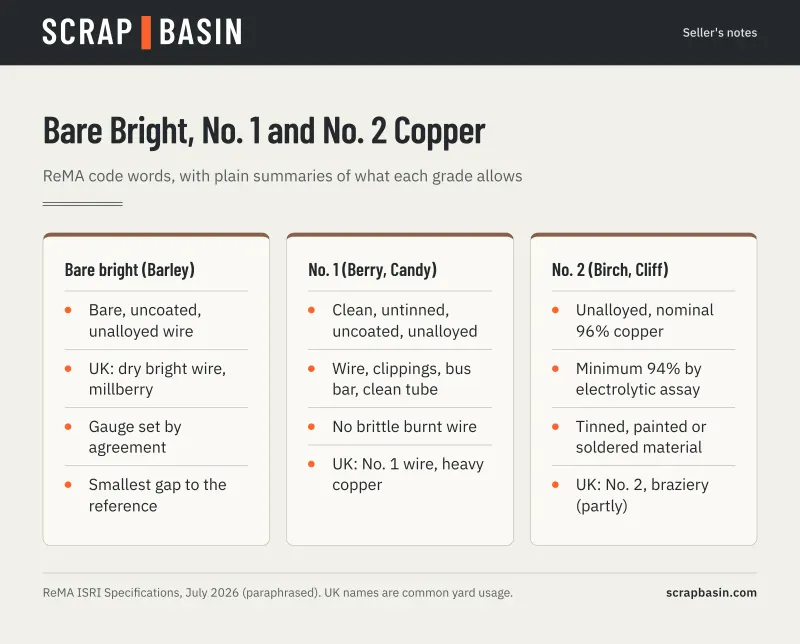
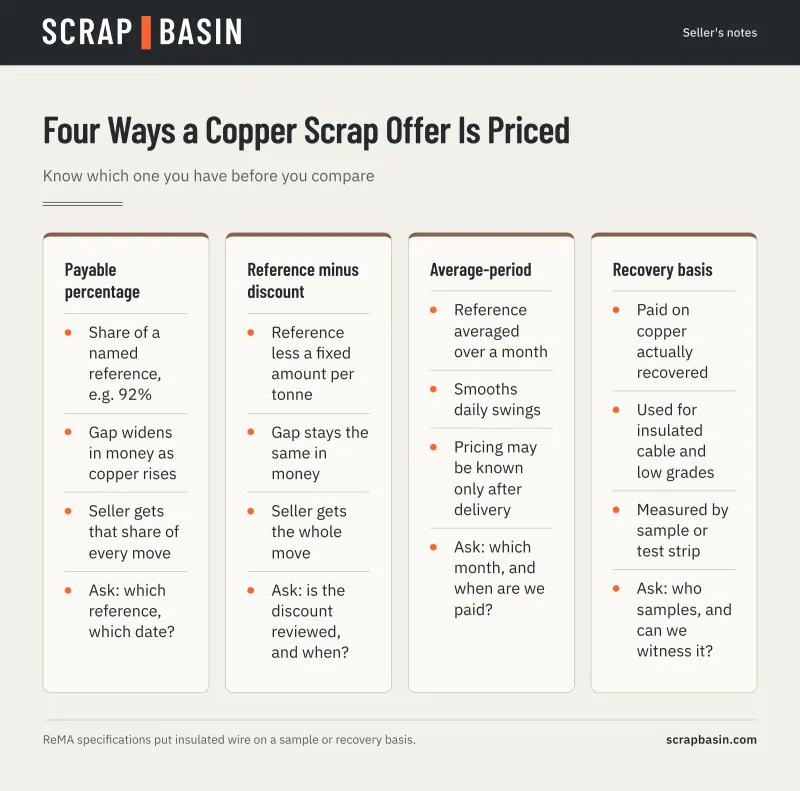
Brass is an alloy of copper and zinc, frequently with some lead to make it machine freely. The copper is the more valuable part, and the buyer pays mainly for it. So brass prices are often quoted in relation to the copper reference, either as a percentage or as copper less a discount, in the same way as copper grades. Our guide to how copper scrap prices are set explains those bases.
Public data shows the link. The US producer price index for yellow brass scrap rose 39.9% in the year to August 2026 (preliminary), close to the 41.2% rise for No. 1 copper scrap. In the UK, HMRC export statistics give unit values by commodity code. Over August 2025 to July 2026, UK exports of brass waste and scrap (commodity code 7404 00 91) totalled 41,566 tonnes at an average GBP 5,970 per tonne, against GBP 6,707 per tonne for refined copper waste and scrap (7404 00 10). Brass averaged 89% of the copper figure. These are export averages across all grades in each code, after exporters' sorting and margin, so treat the ratio as a public cross-check rather than a price relationship you can demand. Our UK copper scrap exports note has the monthly series.
The Brass Grades Buyers Use
The US specification names brass grades with code words. The summaries below are ours; read the original at isrispecs.org.
| Grade | ReMA code word | What it covers | What the buyer checks |
|---|---|---|---|
| Yellow brass scrap | Honey | Mixed yellow brass solids: castings, rolled, rod, tube, including plated brass | Free of manganese bronze, aluminium bronze, unsweated radiators, iron, dirty or corroded material and munitions |
| Yellow brass rod turnings | Night | Rod turnings only | Free of aluminium, manganese and other alloy turnings; up to 3% free iron, oil or moisture; alloyed iron no more than 0.15%, tin no more than 0.30% |
| New yellow brass rod ends | Noble | New clean rod ends from free-turning or forging rod | Tight limits on tin and iron; no naval brass or other alloys |
| Yellow brass turnings | Nomad | Mixed yellow brass turnings | Free of aluminium, manganese and composition turnings; up to 3% free iron, oil or other moisture; sold on sample or analysis |
| Red brass or composition | Ebony | Valves, bearings and castings of copper, tin, zinc and lead | Free of high-lead material and non-metallics |
| Radiators | Ocean | Mixed unsweated auto radiators | Actual iron deducted; no aluminium or iron-finned radiators |
UK yards commonly use descriptive names instead: brass swarf, heavy brass, brass cuttings, mixed brass and gunmetal. The match to the code words is approximate, so agree the grade and its meaning in writing.
Purity and Form: The Two Levers You Control
Copper share is set by the alloy you machine or install. What you control is how pure each container is and what form it is in. The matrix shows how the two combine.
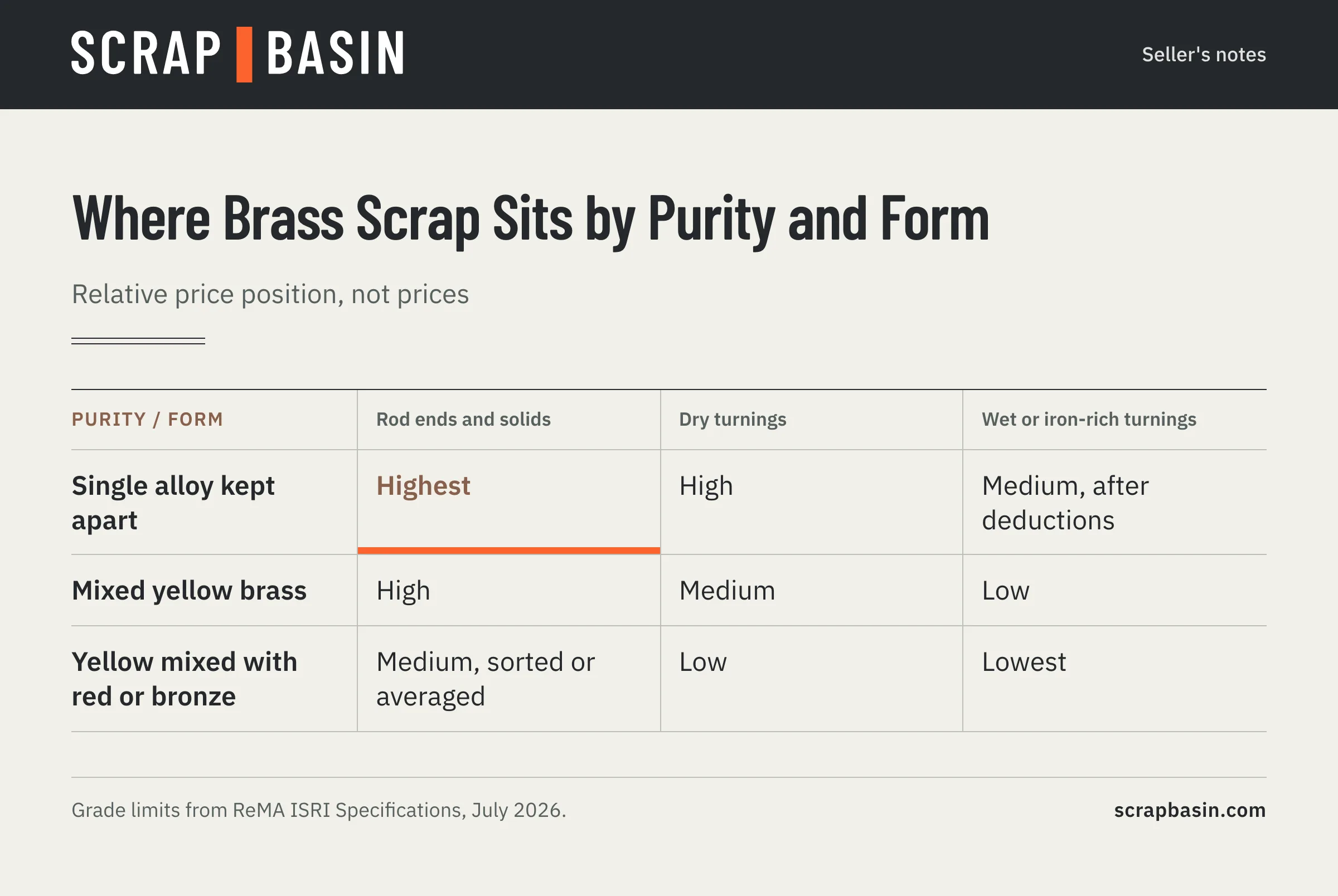
Purity. A single alloy, kept apart by machine or by product line, can go straight into a remelt of the same alloy. Mixed yellow brass has to be averaged. Yellow brass mixed with red brass, bronze or aluminium bronze has to be sorted or priced at the lowest common grade. Each step down widens the gap to copper.
Form. Solids and rod ends melt cleanly. Turnings carry cutting fluid, oxidise more in the furnace and pick up free iron from tooling and floors. That is why turnings are sold on sample or analysis and why buyers deduct for moisture and iron.
Brass Swarf: A Worked Deduction
A machine shop sends 1,000 kg of yellow brass turnings a month. The buyer pays on dry weight and deducts free iron.
| Line | Calculation | Payable kg |
|---|---|---|
| Weight on the weighbridge ticket | 1,000 | |
| Moisture and oil, measured at 4% | 1,000 x 4% = 40 | 960 |
| Free iron, measured at 2% of dry weight | 960 x 2% = 19.2 | 940.8 |
| Payable weight | 940.8 kg |
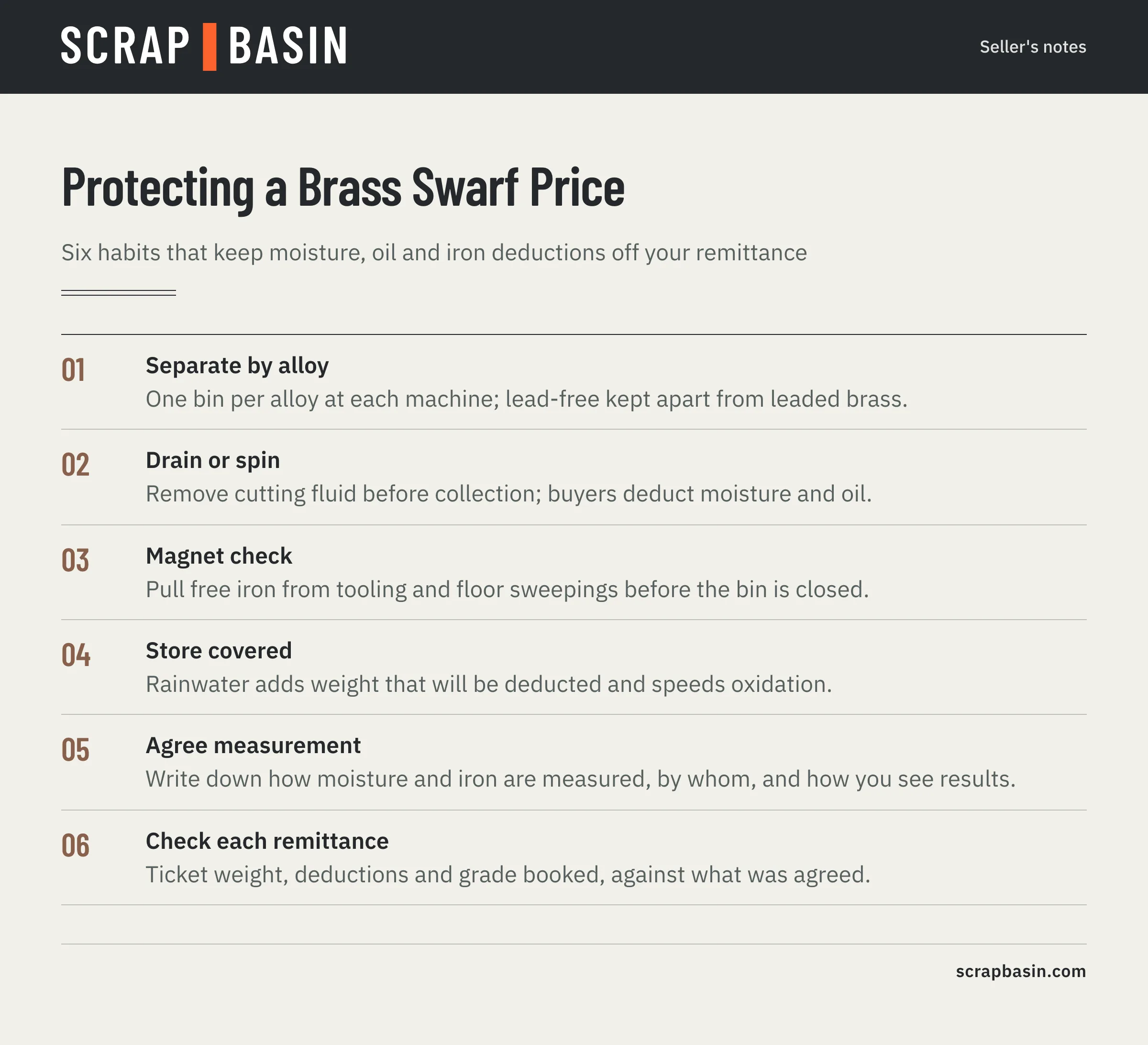
The seller is paid on 940.8 kg, 5.9% less than the ticket weight. Draining the turnings for longer before collection and running a magnet over the bin could bring that close to the dry, iron-free weight. Whether that pays depends on labour and volume; the point is that both deductions are measurable, so ask how and when they are measured, and ask to see the result. Our guide to contamination deductions covers measurement and disputes, and the weighbridge ticket guide covers the weight itself.
Questions to Ask a Brass Buyer
- Which grade will each container be booked as, and what would cause a downgrade to mixed brass?
- Is the price a percentage of a copper reference, copper less a discount, or a fixed price? Which reference and date?
- How are moisture, oil and free iron measured on turnings, by whom, and can we see the result?
- Do you pay more for single-alloy rod ends kept apart, and how much more?
- What happens to lead-bearing brass if we also produce lead-free alloy? Should we keep them apart?
Get the Field Guide
The free field guide includes the full copper and brass grade table with US, UK and Australian names.
Indicative information, not a price offer. ScrapBasin is an information service. It does not buy, sell or broker scrap.
Sources (checked 8 October 2026): ReMA's ISRI Specifications, July 2026, https://www.isrispecs.org/ (code words cited, descriptions paraphrased); HMRC Overseas Trade Statistics API, https://api.uktradeinfo.com/OTS (contains public sector information licensed under the Open Government Licence v3.0); U.S. Bureau of Labor Statistics PPI WPU10230103 via FRED, https://fred.stlouisfed.org/series/WPU10230103.
Public scrap price indexes for copper, brass, aluminium and steel each month, with the source on every figure.
Get Monthly Prices