Scrap Metal Contamination Deductions: How They Work and How to Dispute One
How buyers deduct for moisture, oil, iron and attachments, how each is measured, what written limits look like, and how to dispute a deduction.
Contents 7
A remittance has arrived with a line you did not expect: "moisture 5%", "contamination", "downgraded to mixed", or a load marked as rejected. You need to know whether the deduction is fair, how it was measured and what you can do about it. This guide explains the three ways buyers handle material that does not match the agreed grade, how each kind of contamination is measured, what "clean" looks like when it is written down, and a five-step route for disputing a deduction. It ends with the contract terms that stop the argument recurring.
In short
- A buyer facing non-conforming material can deduct weight, downgrade the lot to a cheaper grade, or reject it. Each needs evidence.
- Most deductions are measurable: moisture by drying a sample, free iron by magnet, attachments by hand sorting, alloy by analyser. Ask which method was used.
- Written benchmarks exist. EU end-of-waste law (the rules for when scrap legally stops being waste) treats steel scrap as clean at 2% or less foreign material, copper at under 2%, aluminium at 5% or less (or 90% metal yield). These are definitions of clean, not deduction rates.
- The trade terms of ReMA (the Recycled Materials Association, the US industry body) provide for an independent surveyor and for limiting rejection to the part that cannot be sorted.
- The best time to settle deductions is before the first collection: which, how measured, by whom, with what evidence, and how disputes are handled.
Three Responses to Non-Conforming Material
| Response | What happens | When it is fair | What to ask for |
|---|---|---|---|
| Weight deduction | A percentage or weight is removed before pricing | Moisture, oil, non-metallics, free iron | The measurement, the sample, photographs |
| Downgrade | The whole lot is priced as a lower grade | Coatings, mixed alloys, attachments throughout | Which test failed, and on what share of the lot |
| Rejection | The load is refused or returned | Hazardous items, sealed containers, gross mismatch | Written reason, and whether only the unsortable part is rejected |
ReMA's nonferrous trade terms, widely used in the US and in export trade, set out this logic in their own words: goods found not to meet the contract by mutual determination are subject to rejection or downgrade; the adjustment is agreed between buyer and seller; either party should have the opportunity to appoint an independent surveyor or representative to verify; and rejection should be limited to the part of the shipment that cannot be sorted. Even if your contract does not cite ReMA, those are reasonable terms to ask for.
Deduction Types and How Each Is Measured
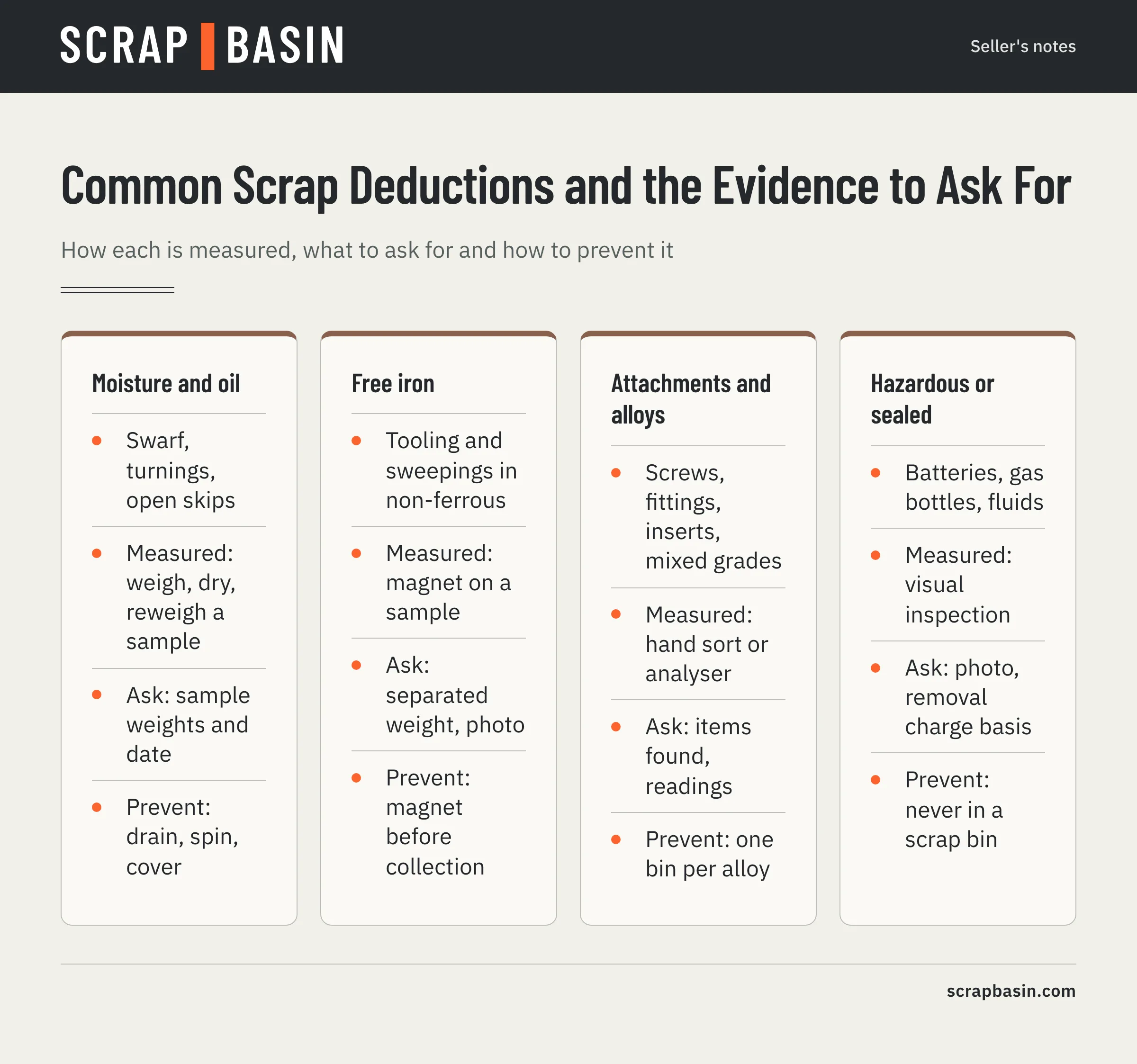
| Contamination | Typical source | How it is measured | Evidence you can request |
|---|---|---|---|
| Moisture and cutting fluid | Swarf, turnings, rain in open skips | Weigh a sample, dry it, weigh again | Sample weights before and after, date |
| Oil and grease | Machined parts, castings, motors | Visual check; for turnings, drying or extraction | Photographs, method |
| Free iron | Tooling, floor sweepings in non-ferrous bins | Magnet separation of a sample | Sample result, photo of separated iron |
| Attachments | Steel screws in brass, fittings on tube, inserts in castings | Hand sorting of a sample, or estimate | Sample weights; which items |
| Non-metallics | Dirt, wood, plastic, insulation | Hand sorting of a sample | Sample weights, photographs |
| Mixed alloys or coatings | 304 with 316, painted aluminium, tinned copper | Analyser readings, visual | Readings by item, photographs |
| Hazardous or sealed items | Batteries, gas bottles, sealed containers, fluids | Visual inspection | Photograph; removal charge basis |
| Radioactivity | Rare, but checked on every load at many sites | Portal detector | Alarm record and follow-up result |
The method matters as much as the percentage. A deduction estimated by eye from the top of a skip and one measured on a dried, representative sample are not the same thing, and you are entitled to know which you got.
What "Clean" Looks Like in Writing
Two published sources show how precisely cleanliness can be defined.
EU end-of-waste regulations (also retained in UK law) set conditions for scrap to stop being waste. Iron and steel scrap: total foreign materials of 2% or less by weight. Copper scrap: under 2%. Aluminium scrap: 5% or less, or a metal yield of at least 90%. All three require the scrap to be free of visible oil except negligible amounts that will not drip, and all three exclude pressurised, closed or insufficiently open containers. See our guide to end-of-waste criteria.
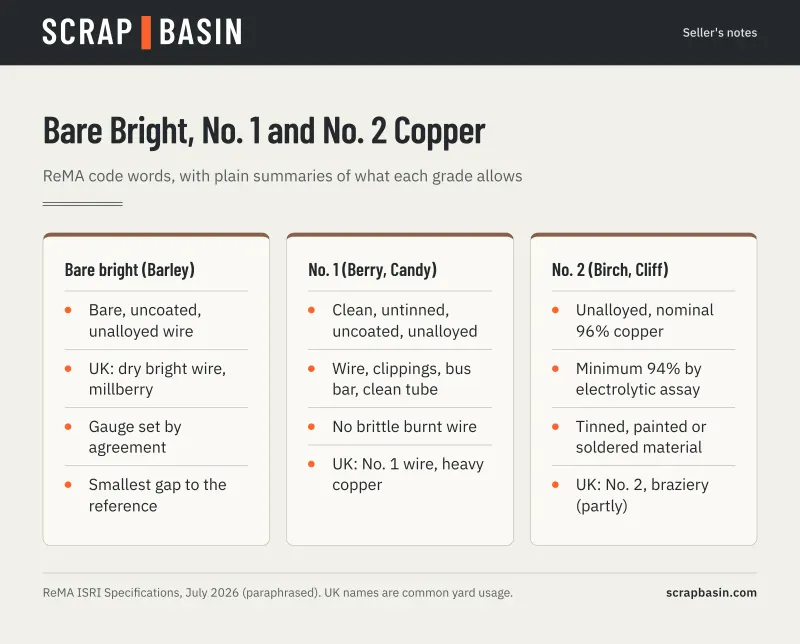
ReMA's grade descriptions set limits grade by grade, for example (in our words): yellow brass turnings with no more than 3% free iron, oil or other moisture, sold on sample or analysis; clean new aluminium clippings with no more than 1% oil and grease; mixed aluminium castings with no more than 2%.
Neither is a deduction rate. They show that "clean" can be put into numbers, which is exactly what you want in your own agreement. Our brass swarf example and aluminium metal yield calculation show deductions worked through.
A Dispute, Worked Through
A machine shop sends 8 tonnes of brass turnings. The remittance deducts 5% for moisture. The shop's own drain test the day before collection, on a sample from three points in the bin, suggested 2%.
| Line | Calculation | Value |
|---|---|---|
| Disputed difference | 5% minus 2% = 3% of 8 t = 0.24 t | |
| Value at an assumed 5,000 per tonne | 0.24 x 5,000 | 1,200 |
| Same gap on 8 t a month for a year | 1,200 x 12 | 14,400 |
One load is a nuisance. The same unexamined deduction every month is a material sum, which is why the dispute is worth having politely and early.
Five Steps to Dispute a Deduction
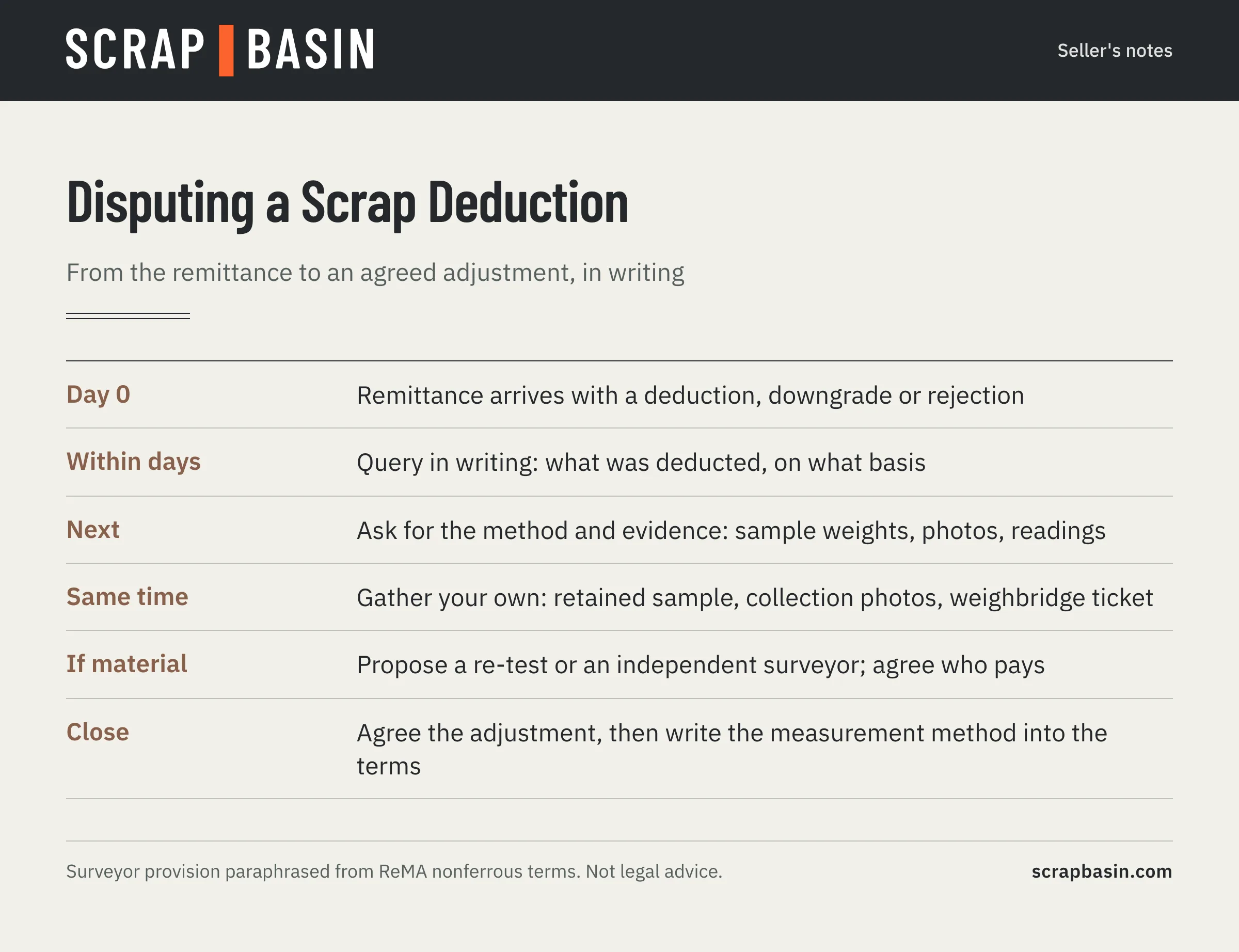
- Query it promptly and in writing. Within a few days of the remittance, ask for the basis of the deduction. Old disputes are hard to evidence.
- Ask for the method and evidence. Sample weights, drying or magnet results, photographs, analyser readings.
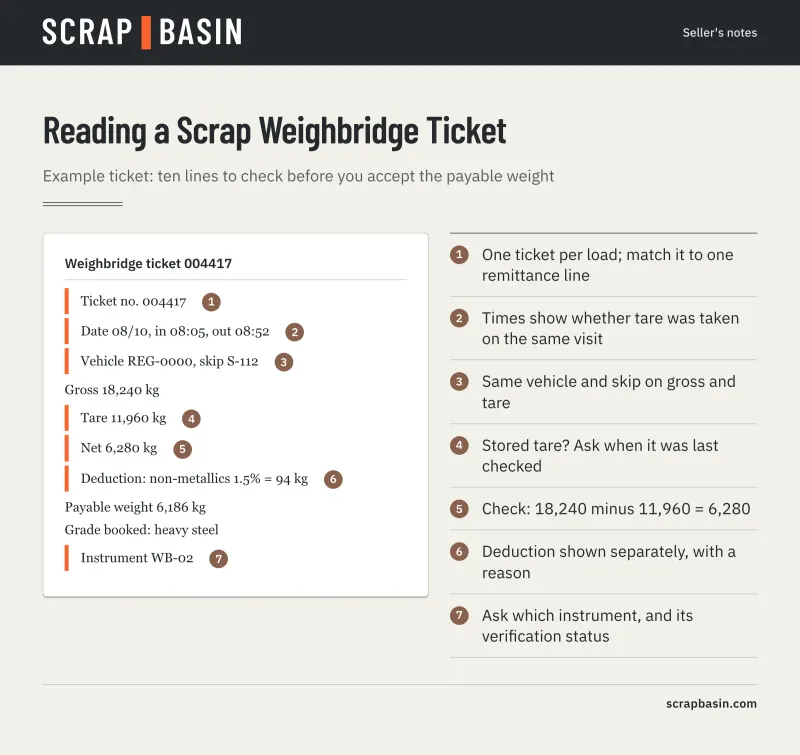
- Keep your own evidence. A retained sample, photographs of the container at collection, and the weighbridge ticket.
- Propose a re-test or an independent surveyor if the gap is material. ReMA's terms provide for this; many buyers will agree for a significant lot.
- Agree the adjustment, then fix the terms. Whatever the outcome on this load, write the measurement method into the agreement so the next one is not argued.
This is commercial guidance, not legal advice. If a dispute turns on what your contract means, take advice on the contract itself.
Terms That Prevent the Argument
Put these in writing before the first collection, or at the next review:
- Which deductions can apply to each grade, and any maximum.
- How each is measured, by whom, on what sample.
- What evidence you receive with each remittance.
- Whether you can witness sampling or appoint a surveyor, and who pays if the result moves.
- That rejection is limited to the part that cannot be sorted, and who pays freight on rejected material.
- What happens if you disagree, and by when.
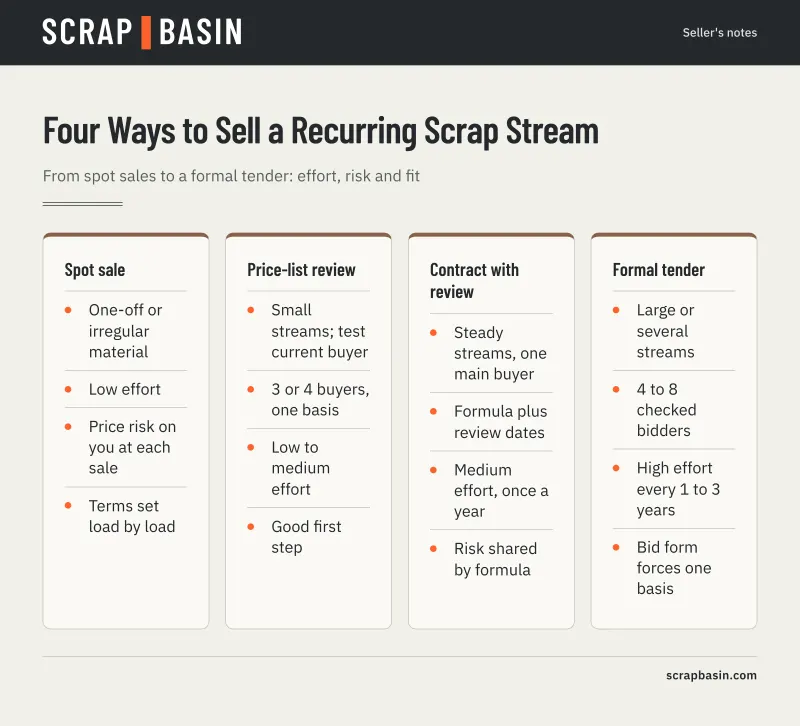
Our questions to ask a scrap metal buyer include these, and if you are inviting several buyers to bid, the scrap metal tender guide shows how to make deduction terms part of the comparison.
Put the Numbers in One Place
Not ready for that?
Indicative information, not a price offer. ScrapBasin is an information service. It does not buy, sell or broker scrap.
Sources (checked 8 October 2026): Council Regulation (EU) No 333/2011, https://eur-lex.europa.eu/eli/reg/2011/333/oj; Commission Regulation (EU) No 715/2013, https://eur-lex.europa.eu/eli/reg/2013/715/oj; ReMA's ISRI Specifications, July 2026, https://www.isrispecs.org/ (terms and grade limits paraphrased).
Public scrap price indexes for copper, brass, aluminium and steel each month, with the source on every figure.
Get Monthly Prices