How to Sell Industrial Scrap by Tender or Price List
How to run a scrap metal tender or price-list review: streams, specification, price basis, terms, bidder checks and a worked evaluation of three bids.
Contents 12
Your business produces the same scrap every month, it has been sold to the same buyer for years, and nobody can say whether the price is good. You want to test it. This guide sets out how to run a competitive process for recurring industrial scrap, whether a formal tender or a simpler price-list review with three or four buyers, so that the bids you receive can actually be compared. It ends with a worked evaluation in which the highest headline bid comes second.
ScrapBasin publishes information. It does not run tenders, invite bidders or take fees from buyers. Everything below is a method you can run yourself.
In short
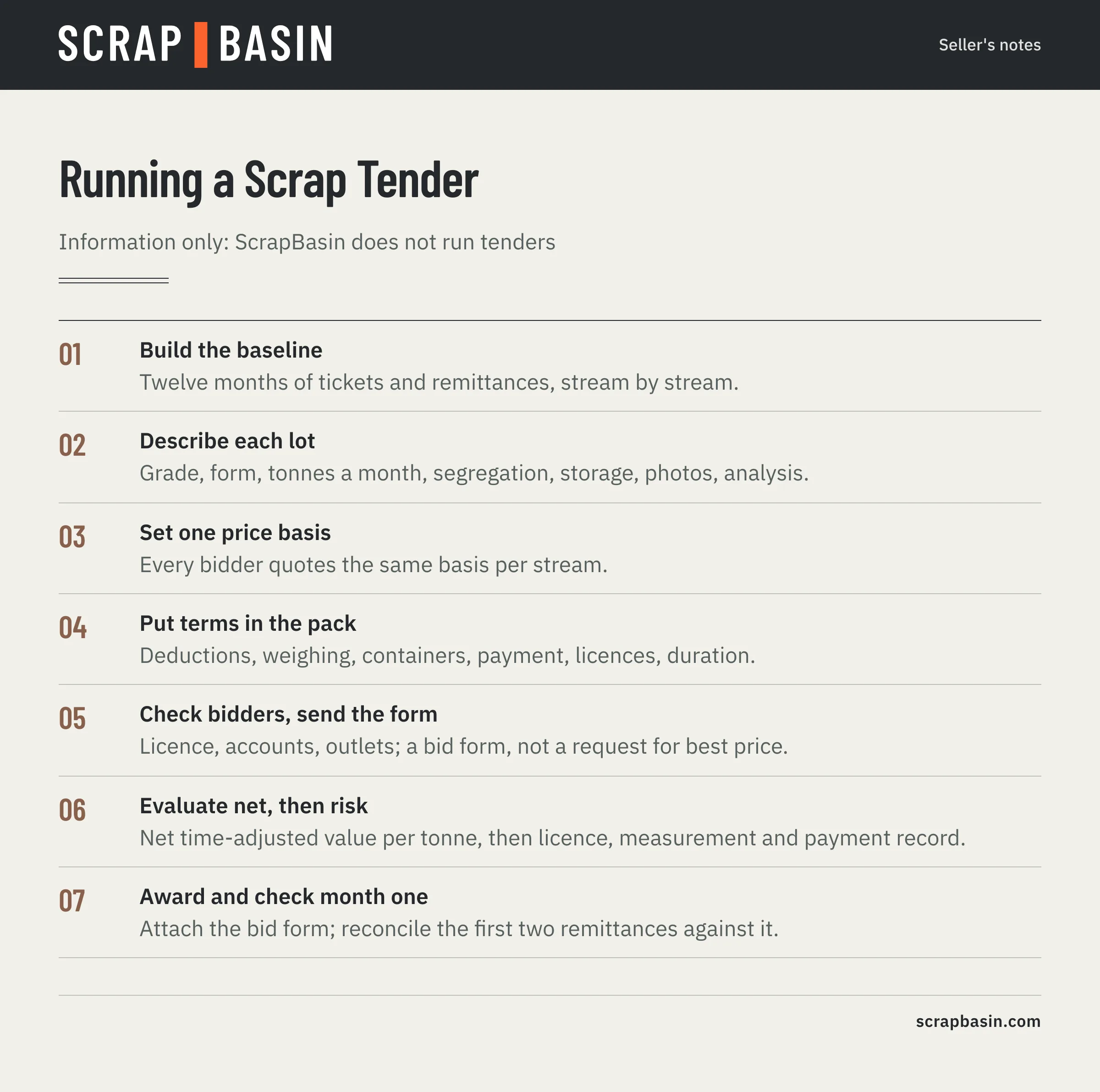
- Start from your own baseline: twelve months of tickets and remittances, stream by stream.
- Describe each lot so a buyer can price it: grade, form, tonnes a month, segregation, storage, and analysis where you have it.
- Ask every bidder to quote on the same price basis and the same terms. Otherwise you will be comparing different things.
- Put deductions, weighing, containers, collection, payment days and licences into the pack, not into the negotiation afterwards.
- Evaluate on net, time-adjusted value per tonne handed over, then on risk. In our example the bid at 90% of reference ranks second to one at 88%.
Tender, Price List or Spot: Which Fits
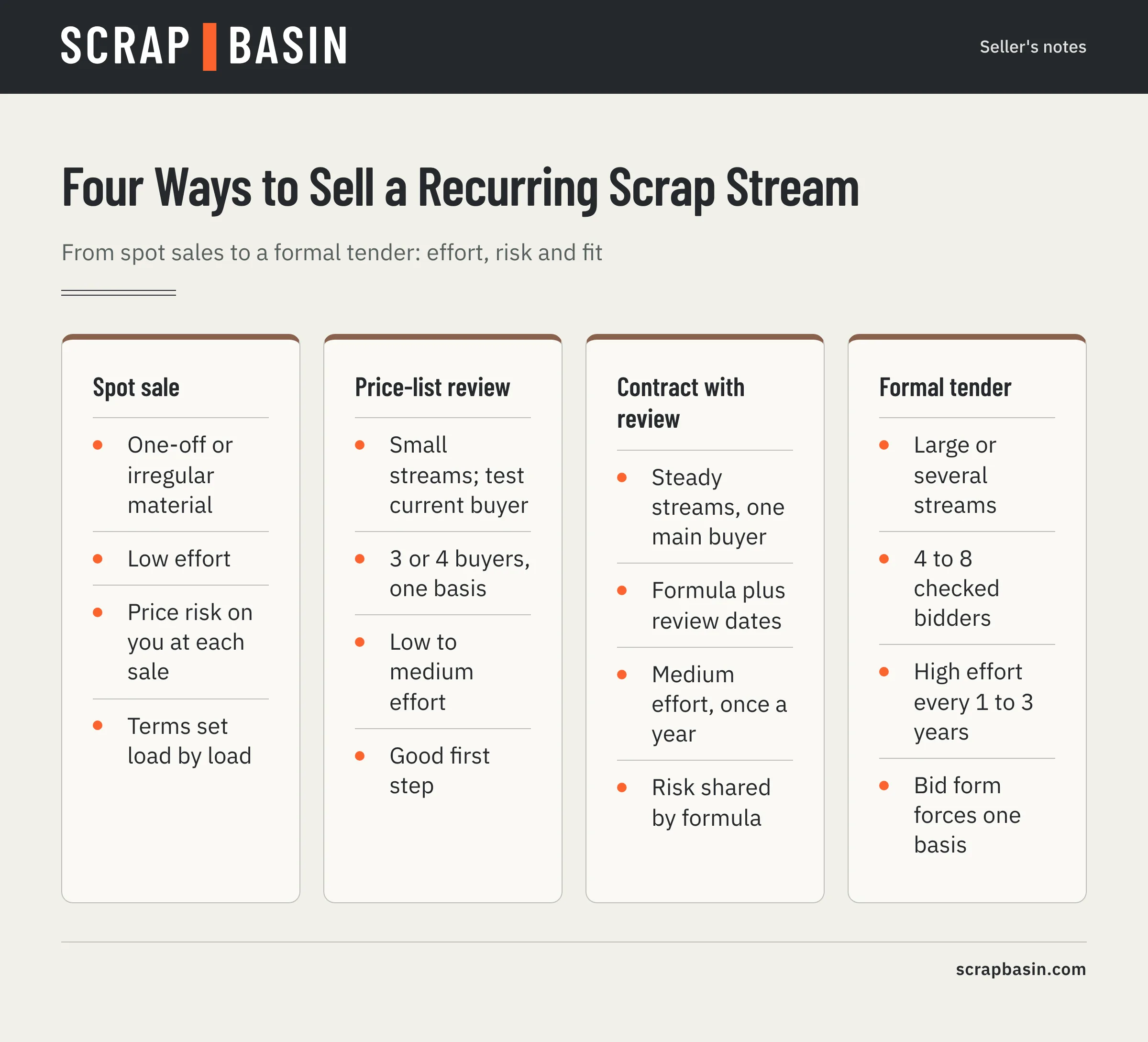
| Route | When it fits | Effort | Who carries price risk |
|---|---|---|---|
| Spot sale | One-off or irregular material | Low | You, at each sale |
| Price-list review | Small streams; testing the current buyer | Low to medium | Depends on the price basis |
| Contract with review clause | Steady streams, one main buyer | Medium, once a year | Shared, by formula |
| Formal tender | Large or several streams; nobody has tested the price in years | High, every 1 to 3 years | Set by the formula you choose |
Public-sector bodies often sell scrap through published tender notices, sometimes as one-off auctions of a stockpile. That model suits a single lot. A manufacturer with a monthly stream usually wants an agreement that runs for a year or more, priced by formula, with terms that protect the net. The steps below are built for that.
Step 1: Build the Baseline
Collect twelve months of weighbridge tickets and remittances. For each stream, record:
- grade as the buyer books it, and your own name for it;
- tonnes a month, and how much it varies;
- the price basis and what you were actually paid per tonne after deductions and charges;
- payment days achieved, not just agreed.
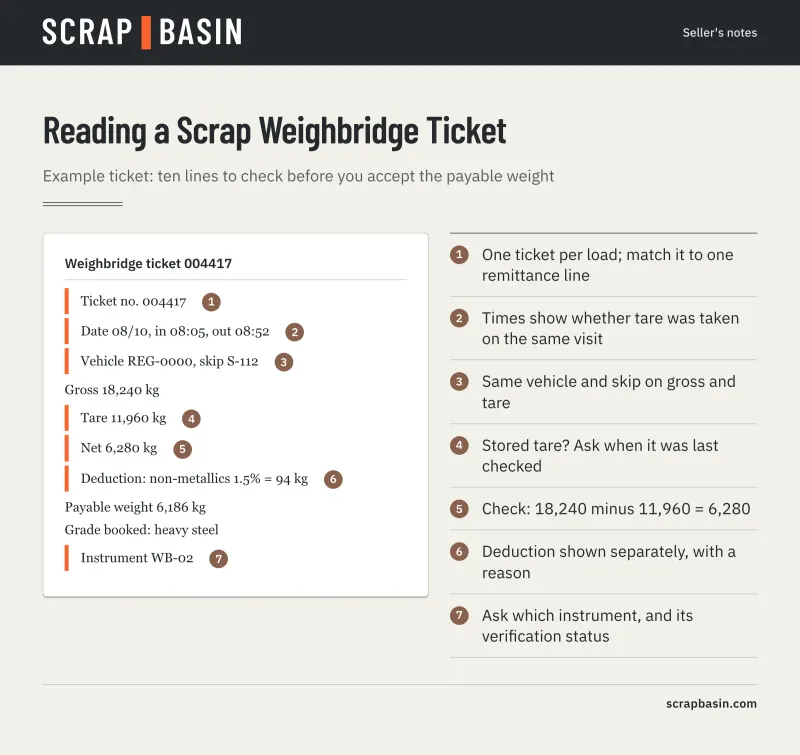
The baseline does two jobs: it tells bidders what you have, and it tells you whether a bid is better than what you already get. Our guides to weighbridge tickets and payment terms cover the reconciliation.
Step 2: Describe Each Lot
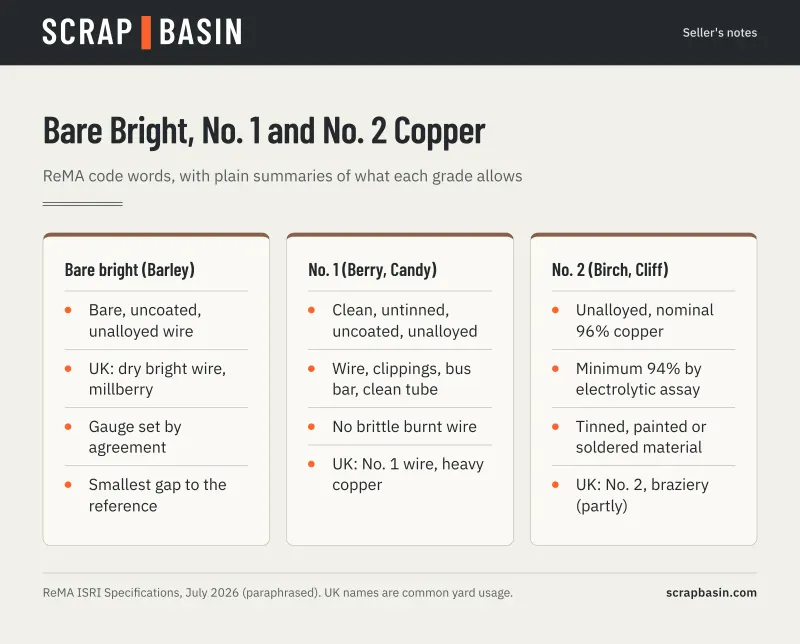
A buyer prices what it can understand. For each stream, give: material and grade (using the buyer's grade vocabulary where you know it), physical form, typical size, tonnes a month, segregation, how it is stored, any analysis or test results, photographs, container type and site access. Our guide on how to describe the material has a ten-field brief.
Do not overstate grade. A lot described as No. 1 that arrives as No. 2 will be downgraded, and the bid will not survive the first month.
Step 3: Choose the Price Basis Bidders Must Use
This is the step most generators skip, and it is why their bids cannot be compared. Choose one basis per stream and require every bidder to use it:
- Non-ferrous (copper, brass, aluminium): a percentage of a named reference for a named period, or the reference less a fixed amount. See how copper scrap prices are set.
- Ferrous: a price per tonne with a monthly or quarterly review, or a formula linked to a published index.
- Insulated cable and low grades: a recovery basis with a stated method.
If you want to test bidders' appetite for different bases, ask for the required basis plus one alternative, never instead of it.
Step 4: Put the Terms in the Pack
Everything that changes the net goes into the tender pack, so bidders price it in:
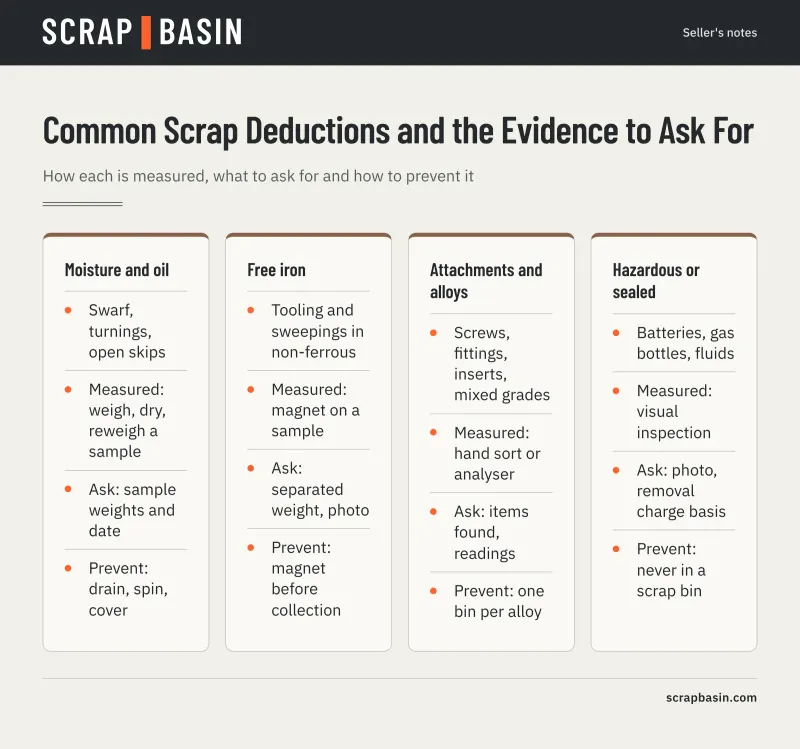
- Deductions: which may apply to each grade, how each is measured, by whom, what evidence you receive. See contamination deductions.
- Weighing: whose weighbridge, a ticket for every load, tare on the same visit.
- Containers and collection: who provides them, rental, collection frequency and response time.
- Payment: days from collection, method, remittance format.
- Licences and permits: licence number and type, waste carrier or permit details as applicable.
- Site rules: induction, insurance, vehicle requirements.
- Duration and review: term, price review dates, termination notice.
Step 5: Choose and Check the Bidders
Four to eight bidders is usually enough. Include your current buyer. Mix types where your streams allow: a local yard, a regional processor, and for larger non-ferrous streams a trader or a consumer that buys direct.
Check each one before you invite it. In England and Wales, anyone carrying on business as a scrap metal dealer must hold a licence under the Scrap Metal Dealers Act 2013, and the Environment Agency keeps a public register for England. (A manufacturer that sells scrap only as a by-product of its own production is not itself a dealer under section 21(3).) Our guide to the Scrap Metal Dealers Act 2013 explains the checks. Then look at filed accounts, how long the business has traded, and who it sells on to.
Step 6: Use a Bid Form That Forces Comparability
Send a bid form, not a request for "your best price". For each stream, it asks for: the price on the required basis; every deduction and how it is measured; every charge per tonne or per month; payment days from collection; weighing arrangements; container provision; licence details; and any conditions. Free-text letters are where incomparable terms hide.
Step 7: Evaluate on Net, Then on Risk
One stream: 10 tonnes a month of brass turnings. Reference 10,000 per tonne in no particular currency. Cost of money 8% a year. Three bids:
- Bid A: 88% of reference; moisture measured on a sample (expected 2%); no charges; paid 30 days after month end (about 45 days on average).
- Bid B: 90% of reference; flat 4% moisture deduction on every load; container rental 150 a month (15 per tonne); paid 60 days after month end (about 75 days on average).
- Bid C: fixed 8,600 per tonne, reviewed quarterly; moisture measured (expected 2%); collection charge 40 per tonne; paid 7 days after collection.
| Per tonne handed over | Bid A | Bid B | Bid C |
|---|---|---|---|
| Headline price at reference 10,000 | 8,800 | 9,000 | 8,600 |
| After moisture deduction | 8,624 | 8,640 | 8,428 |
| After charges | 8,624 | 8,625 | 8,388 |
| Cost of payment days at 8% | minus 85 | minus 142 | minus 13 |
| Net, reference 10,000 | 8,539 | 8,483 | 8,375 |
| Net, if reference falls to 9,000 | 7,685 | 7,633 | 8,375 until review |
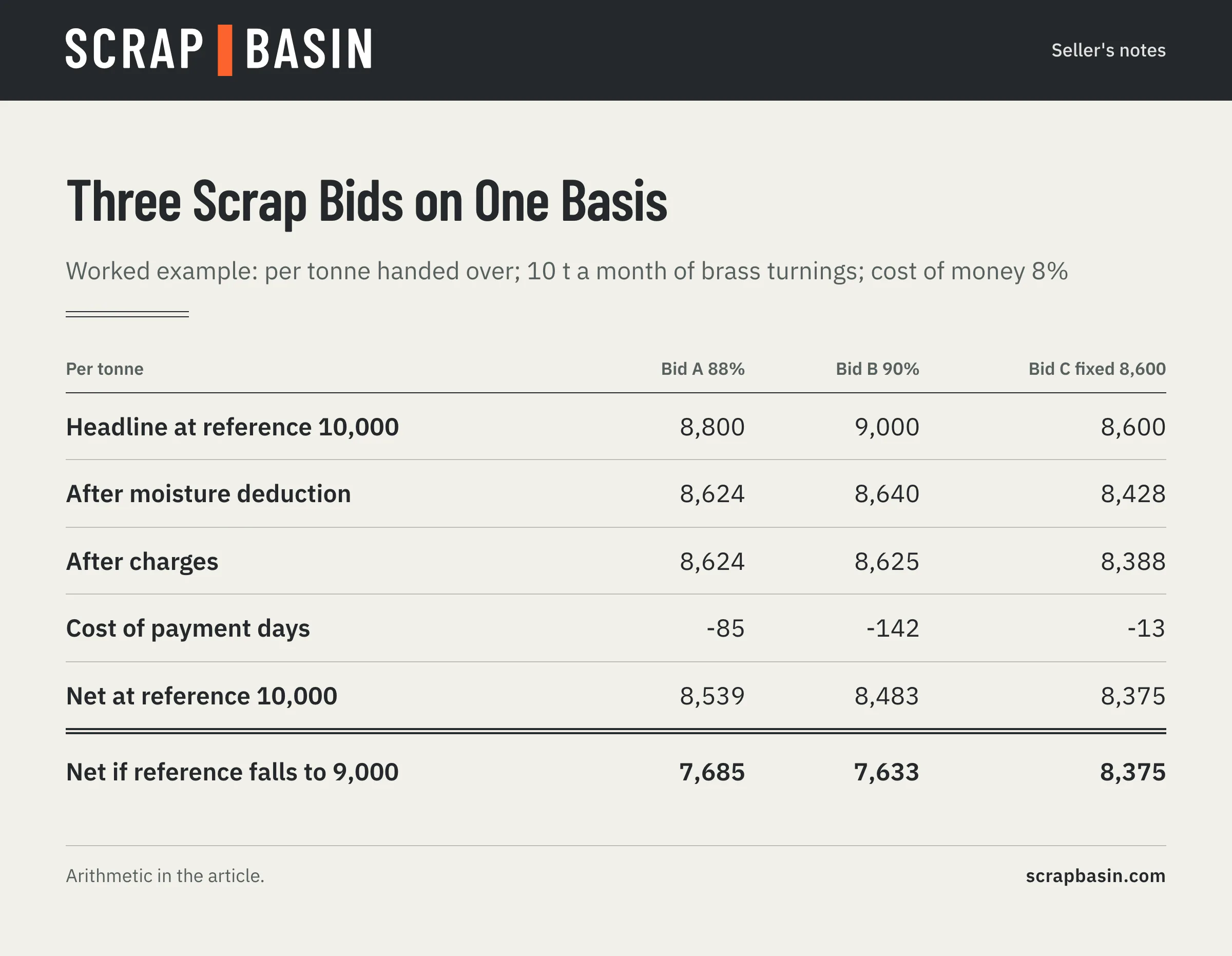
Three lessons. Bid B's 90% is not the best bid: a flat 4% deduction, container rental and 75 days' credit cost it more than its 2-point headline advantage. Bid A wins on net at today's reference. Bid C is a different kind of offer: it pays less today but holds its price until the quarterly review if brass falls, and it pays in 7 days. Whether that is worth 164 per tonne today (8,539 minus 8,375) depends on your view of risk, not on arithmetic. The point of the evaluation is to make that trade-off visible.
Then score risk: the bidder's licence and financial position, how deductions are measured, weighing arrangements, and its record on payment. A bid that is best on net but measures moisture by eye and pays in 60 days is not the same as one that tests a sample and pays in 7.
Step 8: Award, Then Check the First Month
Award in writing, attaching the bid form so the terms are part of the agreement. After the first month, reconcile every ticket and remittance against the bid: grade booked, deductions, charges, reference and payment date. Most problems with a new buyer show up in the first two remittances. If they do, raise them then.
Five Mistakes That Spoil a Scrap Tender
- Asking for "your best price". Each bidder answers on its own basis and terms, and the replies cannot be ranked. Use the bid form.
- Overstating the grade. A lot described generously wins high bids and then loses them at the first downgrade. Describe what you have, with photographs.
- Leaving deductions to "normal practice". Normal practice differs between buyers. Put the measurement method in the pack.
- Comparing headline prices. The example shows how a 2-point headline lead can turn into a lower net. Always compare net, time-adjusted value.
- Not checking month one. The bid is a promise; the first remittance is the evidence. Reconcile it against the bid line by line.
A sixth, quieter mistake is running the process and then not telling the bidders the outcome. A short, courteous award and regret note keeps the unsuccessful bidders willing to bid next time, which is what keeps the next tender competitive.
How Often to Repeat It
A full tender every one to three years is usually enough for a steady stream, with a price review clause in between. Repeat sooner if your volumes or mix change materially, if your buyer's terms drift, or if the market moves a long way and your formula does not follow it.
Before you start, the questions to ask a scrap metal buyer make a good first draft of the bid form.
Normalise the Bids
Indicative information, not a price offer. ScrapBasin is an information service. It does not buy, sell or broker scrap, and it does not run tenders. This is commercial guidance, not legal advice.
Sources (checked 8 October 2026): Scrap Metal Dealers Act 2013, sections 1 and 21, https://www.legislation.gov.uk/ukpga/2013/10/section/21; Environment Agency register of scrap metal dealers, https://environment.data.gov.uk/public-register/view/search-scrap-metal-dealers.
Public scrap price indexes for copper, brass, aluminium and steel each month, with the source on every figure.
Get Monthly Prices