Weighbridge Tickets for Scrap: Are You Paid on the Right Weight?
Read a scrap weighbridge ticket line by line: gross, tare, net, deductions and grade. A monthly reconciliation routine and the trade-weighing rules.
Contents 7
You sell scrap by the load, and you are paid on a weight you did not see measured. The weighbridge ticket is the only record of that weight, and many sellers never check it against the remittance. This guide reads a ticket line by line, shows how a stored tare can quietly cost you money, sets out a monthly reconciliation that takes less than an hour, and explains the rules on weighing equipment used for trade. Check the weight before you check the price: a price is worth nothing on a weight that is wrong.
In short
- Ask for a ticket for every load. Each ticket number should match one remittance line.
- Net weight must equal gross (the loaded vehicle) minus tare (the empty vehicle). Check the arithmetic every time.
- A tare taken from a stored value, rather than weighing the empty vehicle on the same visit, is a common source of quiet error.
- Deductions belong on a separate line with a reason, not folded into the net.
- In Great Britain, weighing equipment used for trade must be passed as fit for use and stamped under the Weights and Measures Act 1985. You may ask which instrument weighed your load.
The Ticket, Line by Line
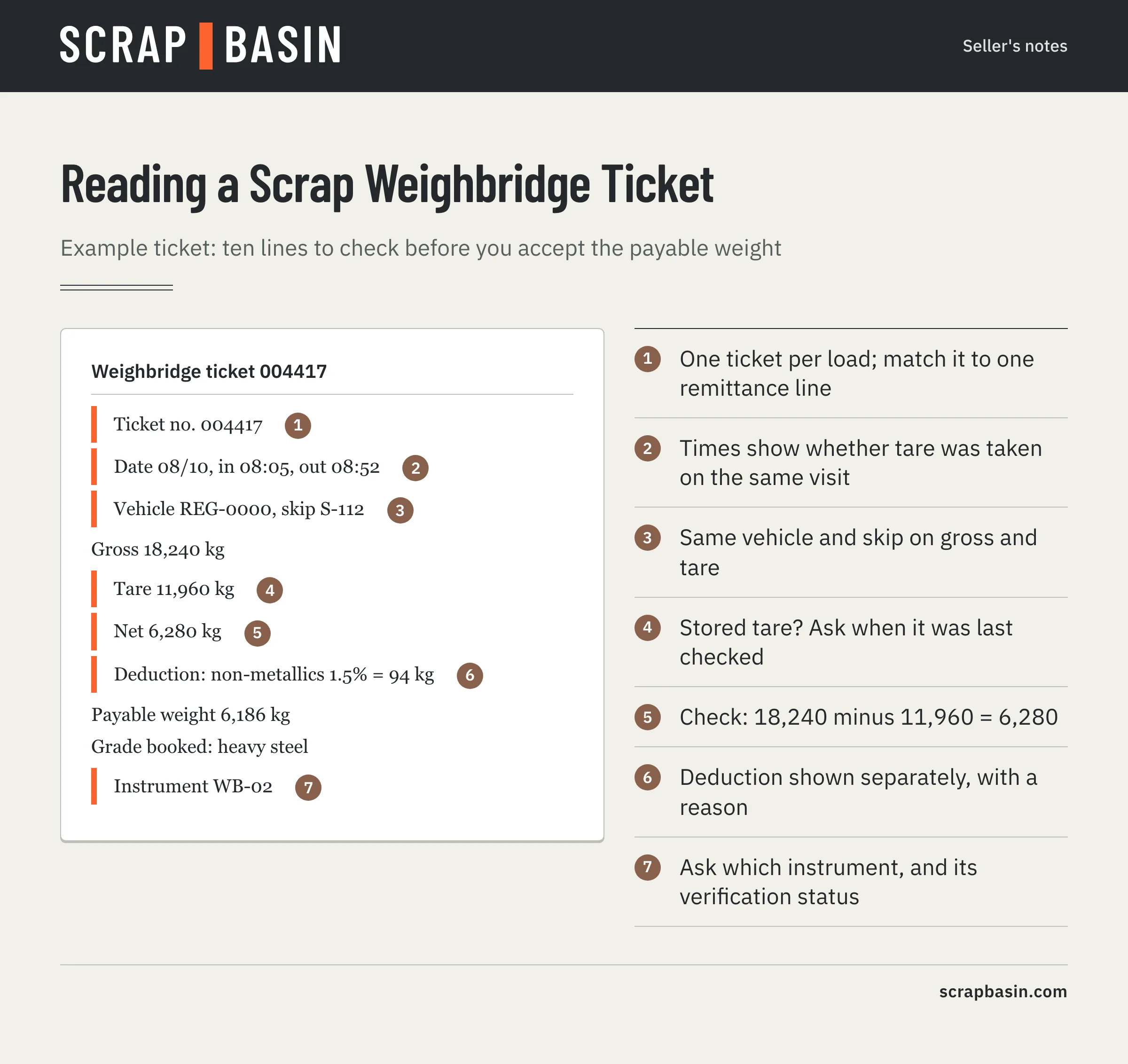
| Line | Example | What to check |
|---|---|---|
| Ticket number | 004417 | Unique; matches one remittance line |
| Date, time in and out | 08:05 in, 08:52 out | Gross and tare on the same visit, or a stored tare? |
| Vehicle and container | Registration and skip number | Same vehicle and container on gross and tare |
| Gross | 18,240 kg | Loaded vehicle |
| Tare | 11,960 kg | Empty vehicle; how was it taken? |
| Net | 6,280 kg | Must equal 18,240 minus 11,960 |
| Deduction | Non-metallics 1.5%: 94 kg | Shown separately with a reason; 6,280 x 1.5% = 94.2 |
| Payable weight | 6,186 kg | Net minus deduction |
| Grade booked | Heavy steel | Matches the grade in your agreement |
| Instrument | Weighbridge ID | Which scale, and its verification status |
The arithmetic check takes ten seconds and catches more than you would think: transposed digits, a tare from the wrong vehicle, a deduction applied twice.
The Stored-Tare Trap
Many weighbridges keep a stored tare for regular vehicles, so the empty vehicle does not have to be reweighed on every visit. That is convenient and legitimate if the stored value is right. It becomes a problem when the vehicle changes: a new body, a crane, a full fuel tank against an empty one, or a different trailer.
A collector's stored tare is 200 kg heavier than the vehicle actually weighs empty. Every load is understated by 200 kg.
| Stream | Loads a month | Weight lost a month | Price per tonne (assumed) | Value lost a month | A year |
|---|---|---|---|---|---|
| Ferrous | 4 | 0.8 t | 300 | 240 | 2,880 |
| Brass turnings | 4 | 0.8 t | 5,000 | 4,000 | 48,000 |
On ferrous the error is irritating; on non-ferrous it is serious. The fix is cheap: ask for tare to be taken on the same visit, or for the date the stored tare was last checked to be shown on the ticket.
A Monthly Reconciliation Routine
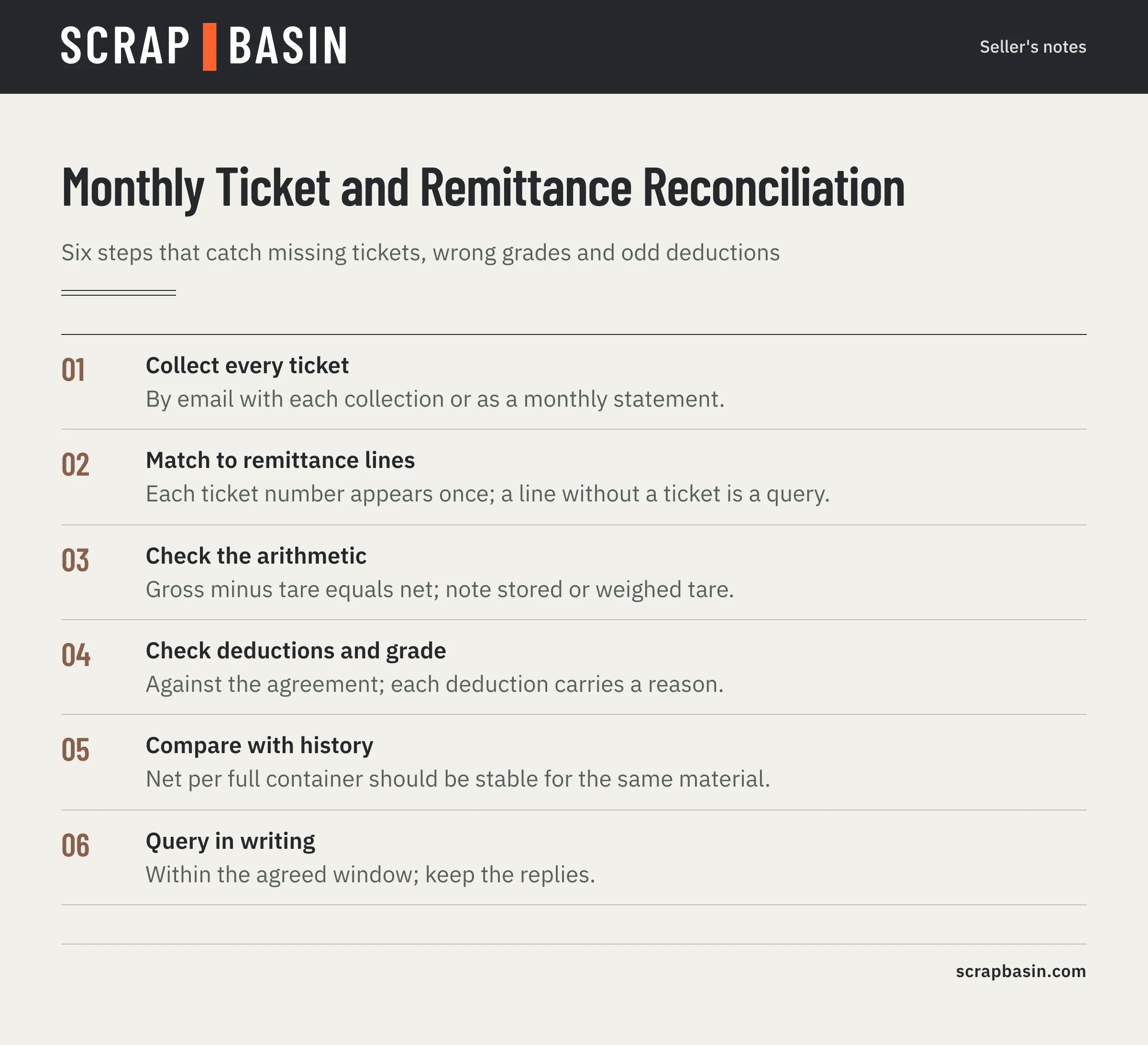
- Collect every ticket. Ask for them by email with each collection, or as a monthly statement.
- Match tickets to remittance lines. Every ticket number should appear once. A remittance line without a ticket is a query.
- Check gross minus tare equals net, and whether the tare was stored or weighed.
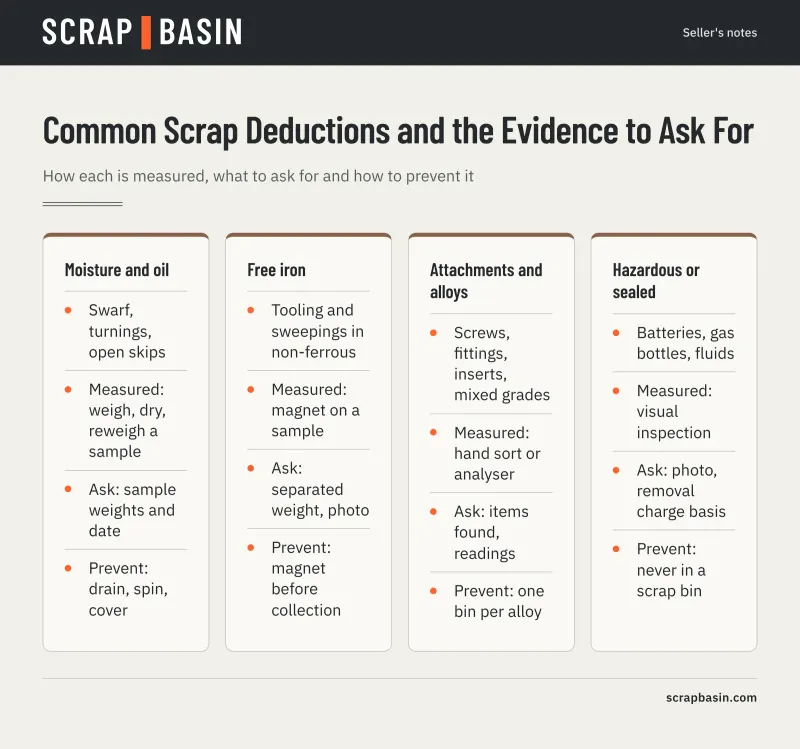
- Check deductions and grade against the agreement. Deductions should carry a reason; see contamination deductions.
- Compare net weight per container with your history. A full skip of the same material should weigh about the same each time. A sudden drop is worth a question.
- Raise queries in writing within the window your agreement allows, and keep the replies.
Do this alongside checking that payment arrived on the agreed day; see payment terms.
Your Own Scale
If volumes justify it, a calibrated platform scale or a check-weigh of each container before collection gives you an independent figure. It does not replace the buyer's weighbridge, but a consistent gap between your weight and theirs is evidence you can put to them. Weigh the same container empty once, record it, and you have your own tare.
The Rules on Weighing for Trade
Great Britain. Section 11 of the Weights and Measures Act 1985 applies to prescribed classes of weighing equipment used for trade. Such equipment must have been passed as fit for use by an inspector or an approved verifier, and must bear a stamp showing it has been passed. Using unstamped equipment of a prescribed class for trade is an offence. Local Trading Standards enforce the rules, and they are the people to ask if you doubt a scale.
United States. NIST Handbook 44 (2026 edition, adopted by the 109th National Conference on Weights and Measures) sets the specifications, tolerances and technical requirements for commercial weighing devices. States adopt it through their own weights and measures law; your state weights and measures office can confirm a scale's inspection status.
Australia. Trade measurement falls under the National Measurement Act 1960 and is administered by the National Measurement Institute.
This is commercial guidance, not legal advice. Last checked: 8 October 2026.
Questions to Ask About Weighing
- Whose weighbridge is used, and will we receive a ticket for every load?
- Is tare weighed on the same visit or stored? If stored, when was it last checked?
- Which instrument weighs our loads, and when was it last verified?
- Are deductions shown separately on the ticket or remittance, with a reason?
- Can we attend a weighing, or check-weigh a container ourselves?
These sit in the wider list of questions to ask a scrap metal buyer. Once the weight is right, scrap metal prices explained covers the rest of the net.
Record It Once
Indicative information, not a price offer. ScrapBasin is an information service. It does not buy, sell or broker scrap.
Sources (checked 8 October 2026): Weights and Measures Act 1985, section 11, https://www.legislation.gov.uk/ukpga/1985/72/section/11; NIST Handbook 44, current edition, https://www.nist.gov/pml/owm/nist-handbook-44-current-edition.
Public scrap price indexes for copper, brass, aluminium and steel each month, with the source on every figure.
Get Monthly Prices