How Are Copper Scrap Prices Set? Reference Price, Payable Percentage and Deductions
How a copper scrap price is built: the reference, payable percentage or discount, grade, pricing date and deductions, with worked arithmetic.
Contents 10
You sell copper scrap, perhaps every month, and the price on your remittance moves in ways you cannot fully explain. You know copper has risen. You do not know whether your price has risen by as much as it should. This guide sets out the five steps that turn a refined copper price into the copper scrap price you are paid, with the arithmetic for each, so you can read an offer, check a remittance and decide which pricing basis suits your stream. It does not publish copper prices: those come from licensed exchange and agency data that ScrapBasin does not republish.
In short
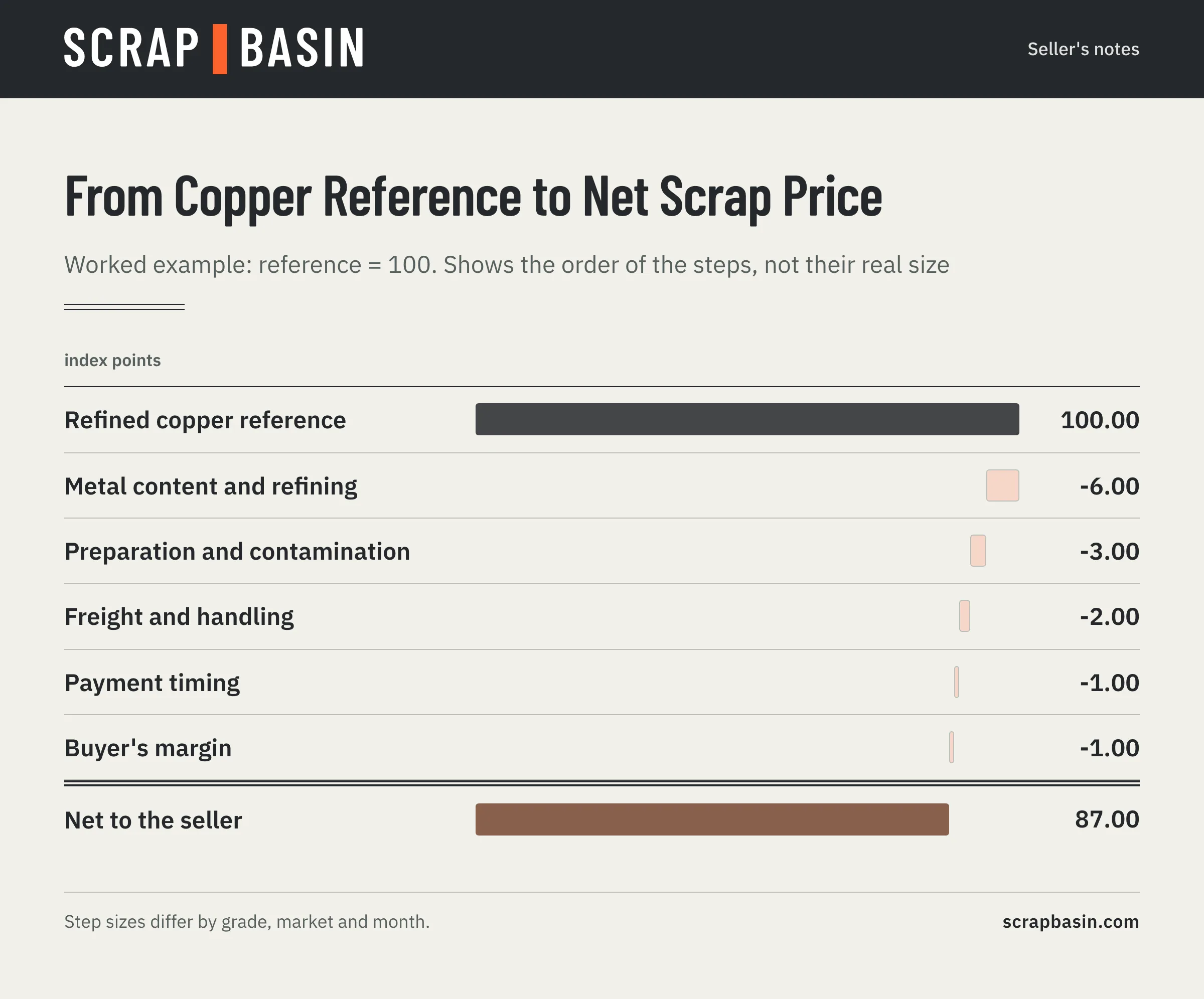
- A copper scrap price starts from a refined copper reference and comes down for metal content, refining effort, preparation, freight and payment time.
- The relationship is written either as a payable percentage of the reference or as the reference minus a fixed discount. They behave differently when copper moves.
- Grade sets the floor of the gap. ReMA (the Recycled Materials Association, whose specifications are the US industry standard) describes No. 2 copper at a nominal 96% copper content and light copper at a nominal 92%; bright wire is unalloyed and uncoated.
- The pricing date matters as much as the percentage. Ask whether the reference is fixed on collection day, averaged over a month, or set later.
- US producer price indexes for copper scrap grades rose between 39.9% and 52.9% in the year to August 2026. If your price has not been reviewed this year, ask how it is set.
Step 1: The Reference Price
A copper scrap offer for anything better than mixed material is almost always tied, openly or not, to a published refined copper price: an exchange settlement (the London Metal Exchange, LME, or COMEX, the New York metals exchange, are the usual ones) or a price agency assessment. Those figures are licensed, which is why you will not find them on ScrapBasin. What matters for you is that the reference is named, dated and shown. If an offer says "LME-related" without saying which price on which day, you cannot check it.
Step 2: The Basis, Payable Percentage or Fixed Discount
There are two common ways to express the relationship.
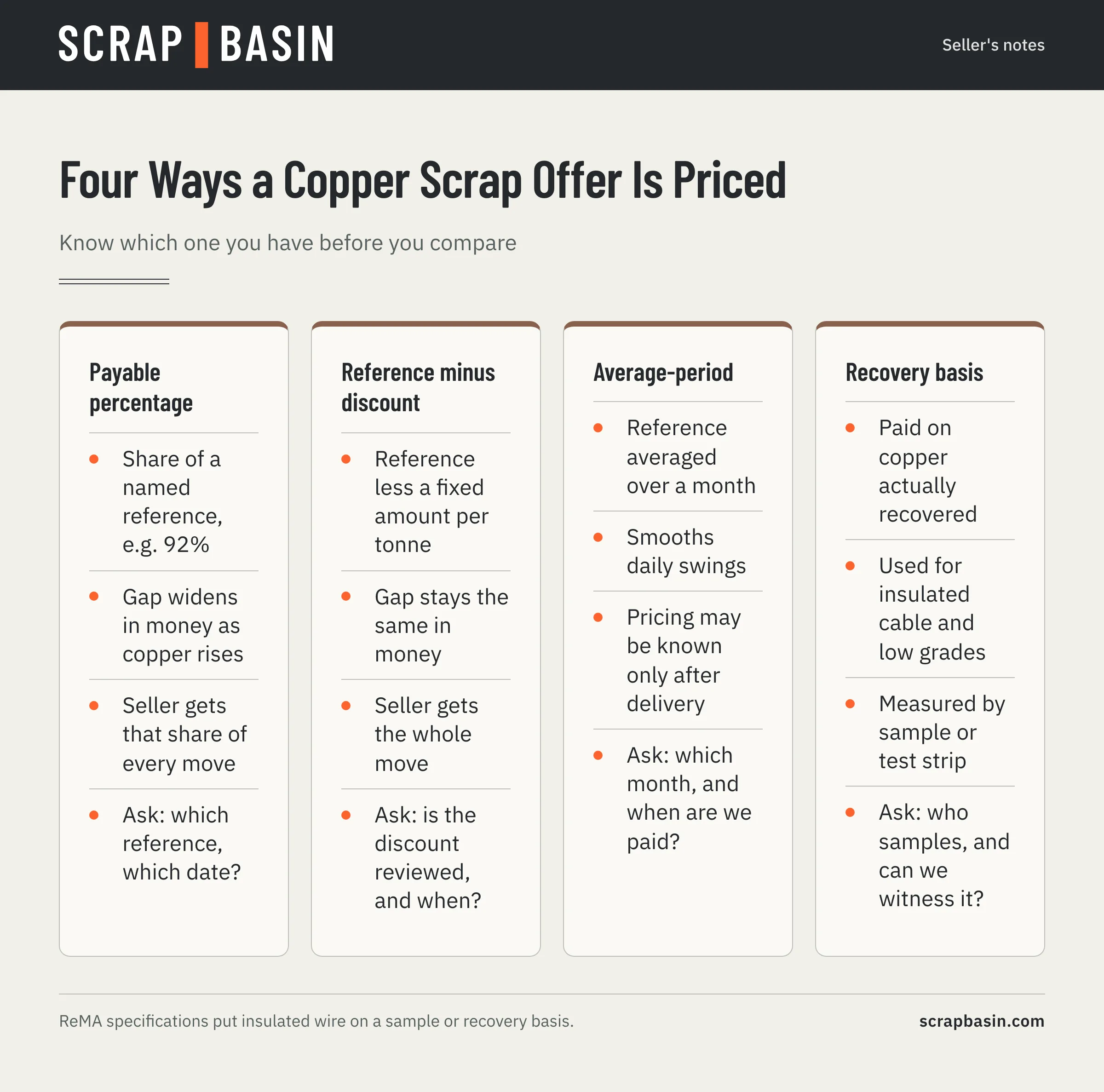
Payable percentage. The buyer pays a share of the reference, for example 92%. The gap widens in money terms as copper rises.
Reference minus a discount. The buyer pays the reference less a fixed amount per tonne, for example 800. The gap stays the same in money terms whatever copper does.
The two can produce the same price on the day you agree them and very different prices three months later.
| Reference per tonne | Basis A: 92% of reference | Basis B: reference minus 800 | Difference B minus A |
|---|---|---|---|
| 10,000 (day of agreement) | 9,200 | 9,200 | 0 |
| 11,000 (copper up 10%) | 10,120 | 10,200 | +80 |
| 9,000 (copper down 10%) | 8,280 | 8,200 | minus 80 |
Under Basis B the seller receives the whole move in copper; under Basis A the seller receives 92% of it. In a rising market the discount basis pays more; in a falling one the percentage basis holds up better. Neither is "right". The point is to know which one you have, and to choose it deliberately for a recurring stream.
Two further forms appear on copper offers:
- Average-period pricing: the reference is averaged over a month, often the month of collection or the month before, and the percentage or discount is applied to that average.
- Recovery basis: used for insulated cable and low-grade material, the buyer pays for the copper actually recovered, measured by sample or test strip. See our guide to insulated cable.
Step 3: The Grade Sets the Floor of the Gap
The buyer is paying for copper it can turn back into metal. The less copper a grade contains, and the more work it takes to recover it, the bigger the gap to the reference. ReMA's specifications (the US industry standard, also used in international trade) make the ladder explicit. In our own words:
| Grade family | ReMA code words | What the specification describes | Effect on the gap |
|---|---|---|---|
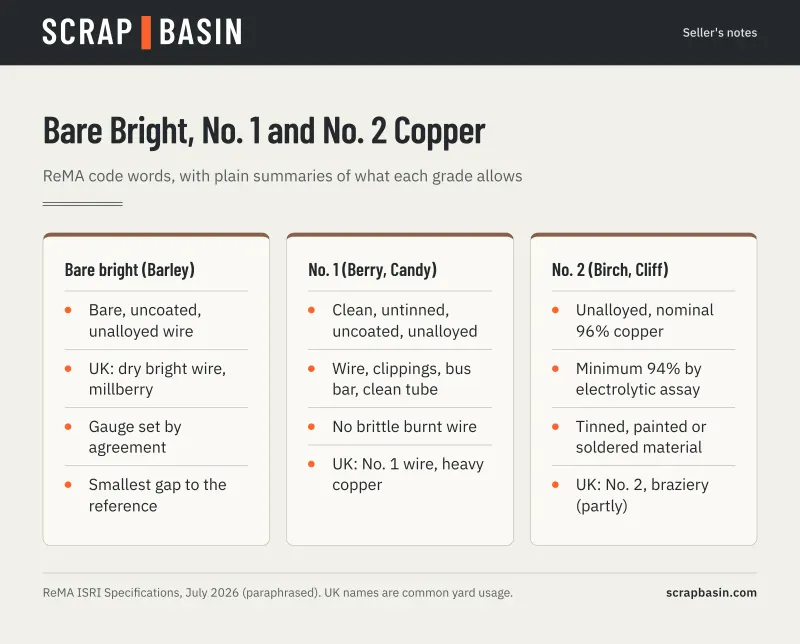
| Bright wire | Barley | Bare, uncoated, unalloyed copper wire; gauge by agreement | Smallest gap |
| No. 1 wire and heavy copper | Berry, Candy | Clean, untinned, uncoated, unalloyed wire, solids and tube | Small gap |
| No. 2 wire and solids | Birch, Cliff | Unalloyed copper at a nominal 96% copper, minimum 94%, by electrolytic assay | Wider gap |
| Light copper | Dream | Sheet, gutters and similar at a nominal 92% copper, minimum 88% | Wider again |
| Insulated wire | Druid, Droid | Sold on a sample or recovery basis | Priced on recovered copper |
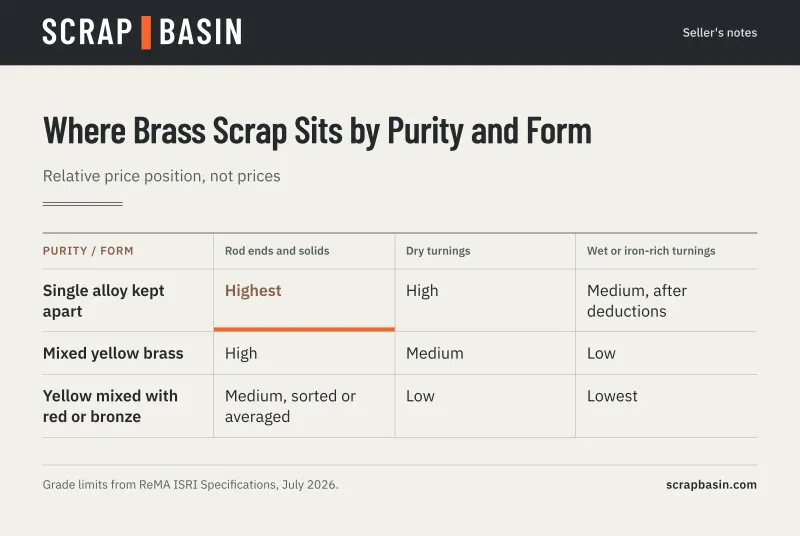
The grade is decided by the buyer at the scale or in the yard. If you think your material is No. 1 and it is booked as No. 2, the price falls by the difference between their gaps, which can be large. Our comparison of bare bright, No. 1 and No. 2 copper sets out the tests that decide it. Brass and other copper alloys follow the same logic with a different starting point: see our guide to brass.
Step 4: Preparation, Contamination and Freight
After grade, the buyer allows for what it must still do and what it must still risk: sorting, removing fittings, drying, shearing, and taking the risk of hidden material. These appear either inside the percentage or discount, or as separate weight deductions and charges on the remittance. The second form is easier to check, which is a reason to prefer it. Our guide to contamination deductions covers how they are measured and disputed.
Freight sits here too. A yard close to its own outlet, or a buyer collecting a full container from you, can afford a smaller gap than one collecting small loads from far away.
Step 5: The Pricing Date and Payment Time
Two dates matter and they are often confused.
- The pricing date fixes which reference applies: the day of collection, an average of the collection month, the month after, or a date you call (sometimes called "pricing on call"). A later pricing date shifts market risk to you; an average smooths it.
- The payment date decides when you have the money. Thirty or 45 days of credit is a cost at your own cost of money, and a credit risk.
A seller ships 5 tonnes a month. On an offer of 92% priced on the average of the collection month and paid 45 days after month end, the seller is exposed to roughly two and a half months of copper movement and credit at any time. The same 92% priced on collection day and paid in 7 days carries far less of both.
What Public Data Shows About Copper Scrap Right Now
ScrapBasin uses public indexes to show direction, not level. The US Bureau of Labor Statistics publishes producer price indexes (PPI, measures of the change in prices sellers receive) for copper scrap grades (public domain). We pulled them from FRED on 8 October 2026:
| Index (BLS PPI, not seasonally adjusted) | Change, Aug 2025 to Aug 2026 |
|---|---|
| No. 2 copper scrap, including wire | +52.9% |
| Copper base scrap (all) | +43.0% |
| No. 1 copper scrap, including wire | +41.2% |
| Yellow brass scrap | +39.9% |
August 2026 values are preliminary and can be revised for four months.
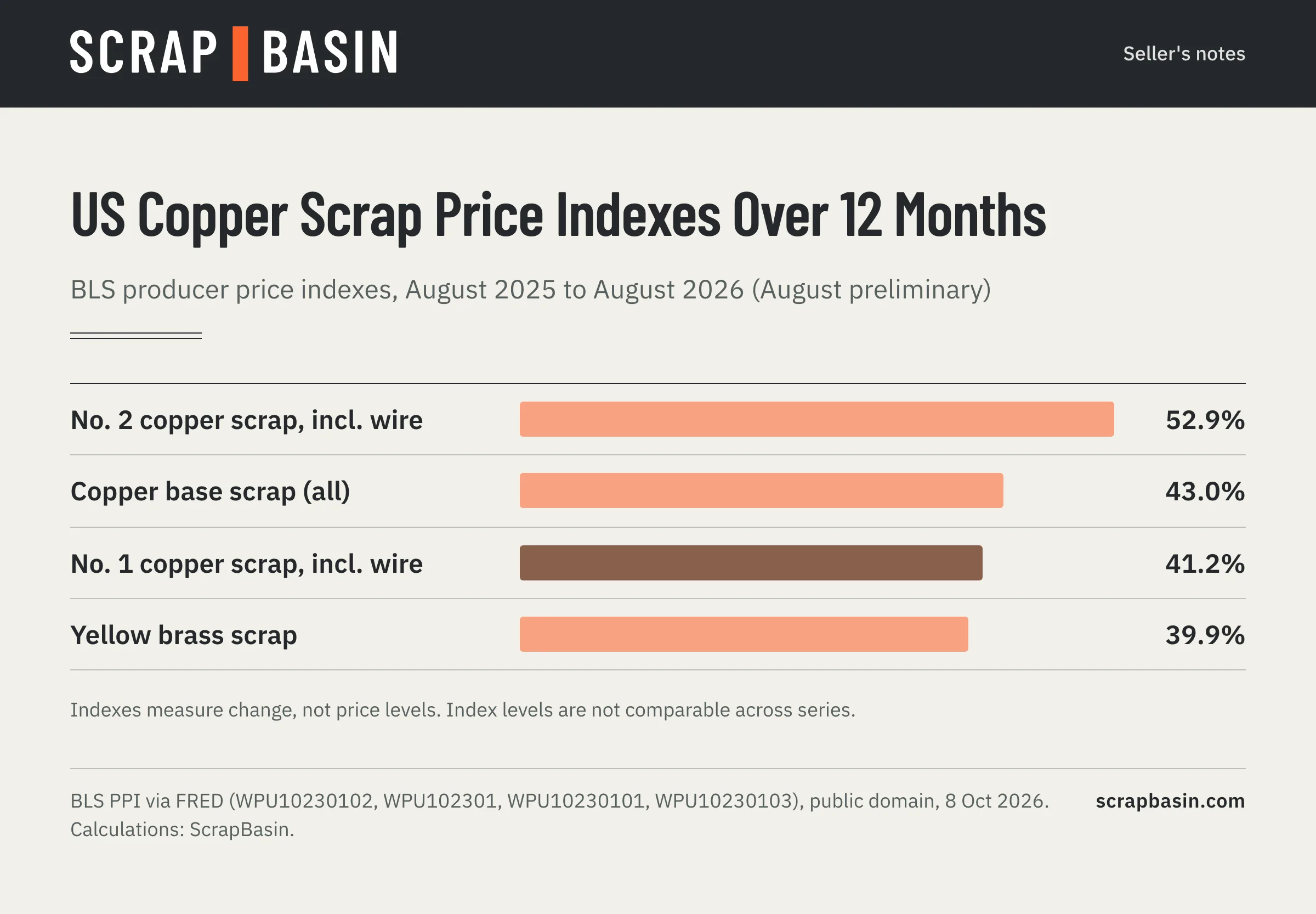
Two cautions. First, each index has its own base, so the levels of the indexes cannot be compared with each other, and a bigger rise for No. 2 does not mean No. 2 is worth more than No. 1. Second, an index measures change across many US transactions; your own price depends on your grade, terms and location.
In the UK, HMRC trade statistics give a different check. UK exports of refined copper waste and scrap (commodity code 7404 00 10) averaged GBP 6,707 per tonne over the twelve months to July 2026 (our calculation from HMRC data, Open Government Licence). That is an export average after the exporter's sorting and margin, so it sits above what generators are paid, but it moves with the market. Our note on UK copper scrap exports has the monthly series.
How to Check a Copper Remittance
- Reference: is the figure and its date printed, and does it match your own source for that date or period?
- Basis: does the arithmetic match the agreed percentage or discount?
- Grade: is each line booked as the grade you agreed? If not, ask why in writing.
- Weight: does the payable weight match the weighbridge ticket less any stated deduction?
- Charges and date: are charges as agreed, and did payment arrive on the agreed day?
If you cannot do steps 1 and 2 because the reference is not shown, ask for it to be shown from the next remittance. That single change makes every later check possible. It also helps to describe your copper accurately before you ask for offers.
Reading a per-Kg Copper Quote
UK yards often quote copper per kilogram, while references are quoted per tonne and US boards per pound. Convert everything to per tonne before you compare.
A yard quotes 8.10 per kg for No. 1 copper wire on a day when the reference it follows is 10,000 per tonne. Per tonne, that is 8.10 x 1,000 = 8,100, or 81% of the reference. A US-style figure of 3.70 per lb is 3.70 x 2,204.62 = 8,157 per tonne, about 81.6%. Expressed this way, two quotes in different units become one comparable number: a share of the reference on the same day.
Two traps. First, a per-kg counter price for a bag of wire is not the price an industrial account receives on a monthly contract, so compare like with like. Second, a quote is only comparable if you know the reference and its date; a per-kg figure from last week against today's reference tells you nothing. For the full set of unit conversions, including the short ton, see scrap metal prices explained.
When to Review a Copper Price
Review whenever copper has moved a long way since the price was set, whenever your stream changes (new machines, new alloy, more insulated cable), and at least once a year. The index changes above are a reason to ask now if your price is fixed and has not been reviewed in 2026. For the general picture of what a scrap price contains, see scrap metal prices explained.
Get the Field Guide
The free field guide sets out the five price bases, copper and brass grade names in US, UK and Australian usage, and a weighbridge ticket you can check line by line.
Indicative information, not a price offer. ScrapBasin is an information service. It does not buy, sell or broker scrap.
Sources (checked 8 October 2026): ReMA's ISRI Specifications, July 2026, https://www.isrispecs.org/ (code words cited, descriptions paraphrased); U.S. Bureau of Labor Statistics PPI series WPU10230101, WPU10230102, WPU10230103, WPU102301 via FRED, https://fred.stlouisfed.org/series/WPU10230101; HMRC Overseas Trade Statistics API, https://api.uktradeinfo.com/OTS (contains public sector information licensed under the Open Government Licence v3.0).
Public scrap price indexes for copper, brass, aluminium and steel each month, with the source on every figure.
Get Monthly Prices