Insulated Copper Cable Scrap: How Is Recovery Assessed and Priced?
How insulated copper cable scrap is priced on recovery: test strips, the grade of copper inside, a sensitivity table, and when stripping it yourself pays.
Contents 7
You collect cable offcuts and strip-out cable, and the buyer pays you a price per tonne that seems to bear little relation to the copper price. The reason is that insulated cable is not paid as cable. It is paid on the copper the buyer expects to recover from it, and that figure, the recovery, is the number to understand and check. This guide explains how recovery is assessed, what each point of it is worth, how to witness a test strip, and when stripping cable yourself pays.
In short
- Insulated copper cable is sold on a sample or recovery basis: the buyer pays for the copper inside, not the weight of cable.
- Value per tonne of cable is roughly recovery x the price for the grade of copper inside, less any processing charge.
- In the example below, each point of recovery is worth 90 per tonne of cable. A 3-point disagreement moves the value by about 5%.
- The grade of the copper inside matters as well: bright untinned conductor is worth more than tinned or coated conductor.
- Sorting by cable type, and never burning cable, protects both recovery and grade.
What the Specification Says
The specifications of ReMA (the Recycled Materials Association, the US industry body), a reference widely used in international trade, put insulated copper wire on a sample or recovery basis by agreement between buyer and seller. In our words:
- Druid: insulated wire with No. 1 bare copper inside, not finer than No. 16 gauge unless agreed.
- Droid: insulated wire with No. 2 copper inside; jelly-filled wire by agreement.
- Zeyda: shredded insulated copper wire, designated by its approximate copper and other-material content, for example "45/3".
- Clove: chopped bright wire nodules of at least 99% copper, the product of granulating clean cable.
The point for a seller: there is no single "cable price". There is a recovery, applied to a copper grade.
The Valuation Formula
Value per tonne of cable = recovery % x price for the copper grade inside, less processing charge.
Assume a copper reference of 10,000 per tonne, a buyer paying 90% of it for the No. 1 copper recovered (9,000 per tonne of copper), and a processing charge of 150 per tonne of cable.
| Recovery | Copper per tonne of cable | Copper value | Less processing | Value per tonne of cable |
|---|---|---|---|---|
| 40% | 400 kg | 3,600 | 150 | 3,450 |
| 50% | 500 kg | 4,500 | 150 | 4,350 |
| 58% | 580 kg | 5,220 | 150 | 5,070 |
| 60% | 600 kg | 5,400 | 150 | 5,250 |
| 70% | 700 kg | 6,300 | 150 | 6,150 |
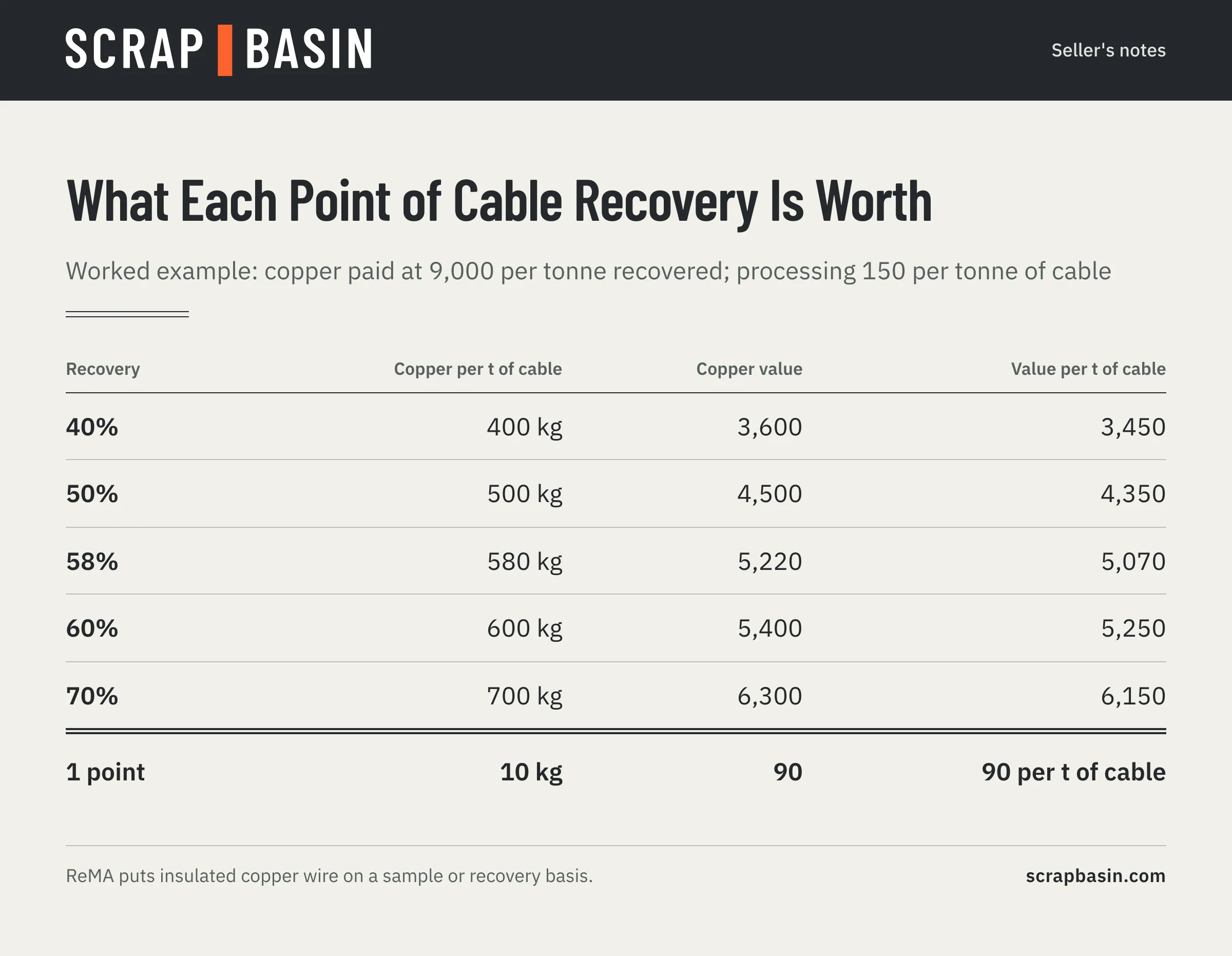
Each percentage point of recovery is worth 1% of 9,000, which is 90 per tonne of cable. If you believe a lot recovers 58% and the buyer settles at 55%, the gap is 3 x 90 = 270 per tonne, or 5.3% of the 5,070 you expected. On 10 tonnes a year that is 2,700. That is why recovery is the line to check.
How Recovery Is Assessed, and How to Witness It
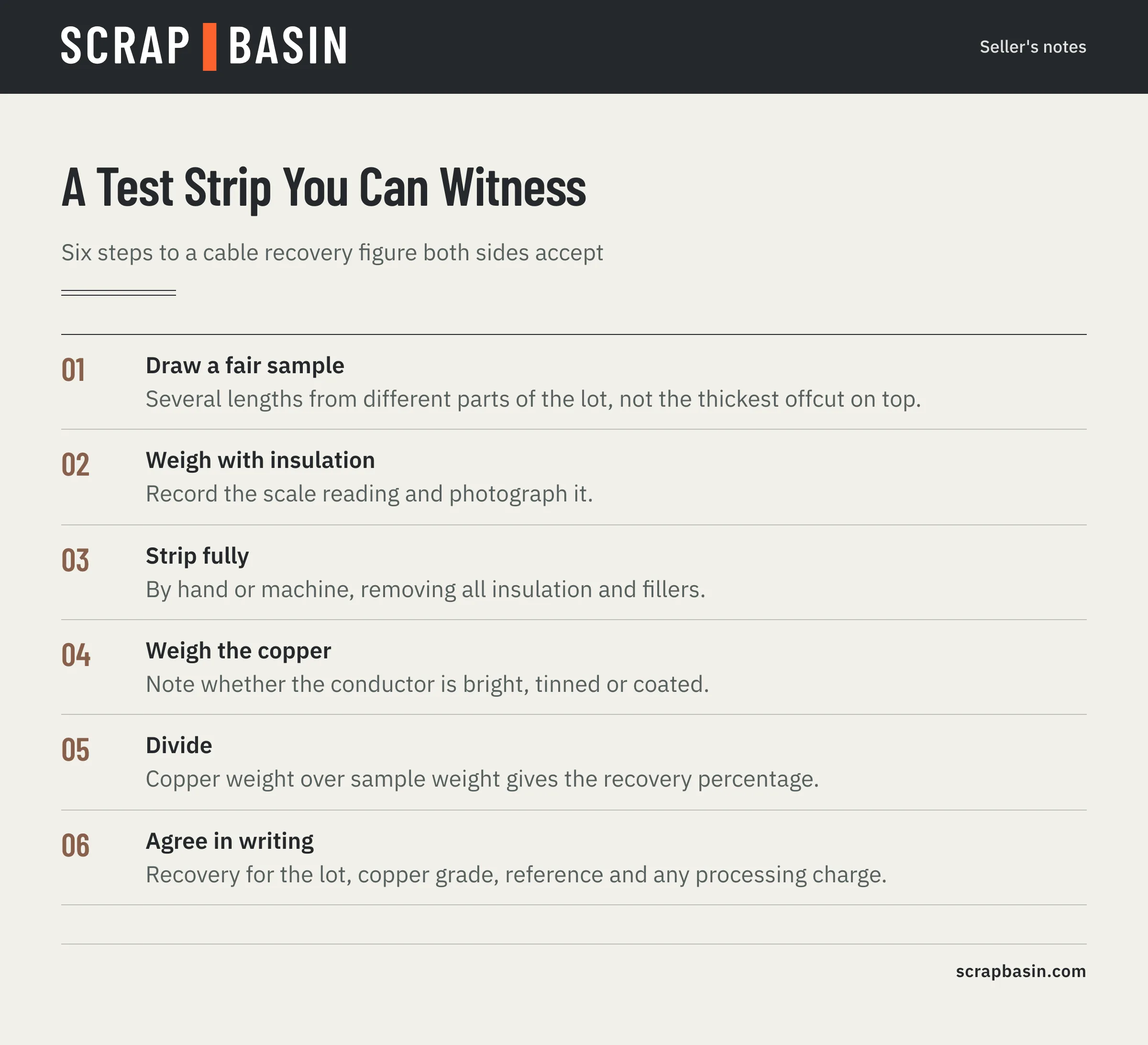
Buyers estimate recovery by eye for small or familiar lots, and measure it for larger or disputed ones. A test strip is simple enough to witness:
- Draw a representative sample: several lengths from different parts of the lot, not the thickest offcut on top.
- Weigh the sample with insulation on.
- Strip it fully by hand or machine.
- Weigh the copper recovered, and note whether it is bright, tinned or coated.
- Divide: copper weight / sample weight = recovery.
- Agree in writing that the percentage applies to the lot, and record any processing charge.
Ask whether you can be present, or receive photographs of the sample and the scale readings. For granulated material, buyers may instead use a melt or assay; ask which method applies and who pays if you dispute it. The lot weight itself comes from the weighbridge ticket, and any further deduction should be stated separately (see contamination deductions).
Why Cable Types Should Be Kept Apart
Recovery varies widely by cable type, so mixing types drags a lot down to its weakest part.
| Cable type | What drives recovery | What lowers value |
|---|---|---|
| Heavy single-core and power cable | Thick conductor, relatively thin insulation | Steel armour, lead sheath, oil or jelly filling |
| Building wire (UK twin and earth, US THHN) | Moderate conductor share | Mixed with data cable; tinned conductors |
| Data, telecom and appliance cable | Thin conductors, high insulation share | Plugs, connectors, very fine wire |
| Tinned or coated conductor | Same recovery, lower copper grade | Booked against No. 2 rather than No. 1 |
Keep at least three containers: heavy power cable, general building wire, and data or appliance cable. Keep anything armoured, lead-sheathed or oil-filled apart and declare it.
Strip It Yourself or Sell It Insulated?
Stripping turns insulated cable into bright copper, which is priced as a copper grade rather than on recovery. Whether it pays depends on your labour, not just the copper.
Continue the example scenario above: a tonne of cable at 58% recovery sells insulated for 5,070. Stripped, it yields 580 kg of bright copper. If the buyer pays 94% of the 10,000 reference for bright wire, that is 0.58 x 9,400 = 5,452. Stripping adds 382 per tonne of cable. At a labour cost of 25 an hour, stripping pays only if a tonne takes less than 382 / 25 = 15.3 hours, before any machine cost or the cost of disposing of the stripped insulation. For heavy single-core cable on a stripping machine that may be achievable; for thin data cable it rarely is.
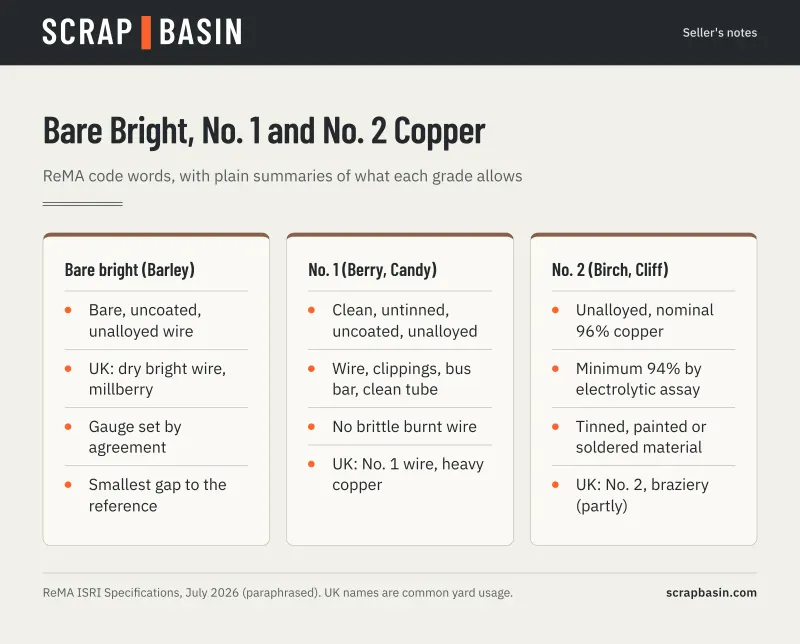
Never burn insulation off. Burning is controlled or prohibited in many places, it damages the copper, and buyers discount burnt wire: ReMA's No. 1 copper wire grade excludes brittle burnt wire, and its No. 2 wire grade should be free of wire from burning. Our comparison of bare bright, No. 1 and No. 2 explains why.
Questions to Ask a Cable Buyer
- Is the price on a recovery basis? What recovery have you applied, and how was it measured?
- Which copper grade is the recovered copper priced as, and at what share of which reference? See how copper scrap prices are set.
- Is there a processing charge per tonne of cable?
- Can we witness the test strip or receive the sample readings?
- Do you price heavy power cable, building wire and data cable separately?
Get the Field Guide
The free field guide includes the cable and wire table and a worked recovery calculation.
Indicative information, not a price offer. ScrapBasin is an information service. It does not buy, sell or broker scrap.
Sources (checked 8 October 2026): ReMA's ISRI Specifications, July 2026, https://www.isrispecs.org/ (code words cited, descriptions paraphrased).
Public scrap price indexes for copper, brass, aluminium and steel each month, with the source on every figure.
Get Monthly Prices