Scrap Metal Payment Terms: How Much Credit Are You Giving Your Buyer?
How much credit you give a scrap buyer, what waiting costs, the checks to run, and UK rules on cashless payment and late payment interest.
Contents 7
If you sell scrap on account, you are lending your buyer money between collection and payment. On a recurring non-ferrous stream that loan can be larger than many trade debts a finance team watches closely, and it is rarely credit-checked. This guide shows how to size the exposure and the cost of waiting, which checks to run on a buyer, what a good remittance contains, and the UK rules on how scrap must be paid for and on late payment.
In short
- Peak exposure depends on both the payment days and when the clock starts. "45 days after month end" can mean two and a half months of material unpaid at once.
- Waiting has a cost at your own cost of money. In the example below, moving from 45 days after month end to 7 days after each weekly collection saves about 13,900 a year on a 1.2 million stream.
- Run the checks you would run on any customer of that size: filed accounts, licence status, payment history, and a credit limit.
- In England, Wales and Scotland, dealers must pay for scrap by non-transferable cheque or electronic transfer. Cash is not allowed.
- If a UK business buyer pays late and your contract sets no interest rate, statutory interest is 8% plus Bank of England base rate.
Sizing the Exposure
A manufacturer sells 20 tonnes of brass turnings a month at an assumed 5,000 per tonne: 100,000 a month, 1.2 million a year. Compare two term structures.
Terms A: paid 45 days after the end of the month of collection. Material collected in March is paid in mid-May. Just before that payment, the buyer holds all of March (100,000), all of April (100,000) and half of May (50,000): 250,000 unpaid at peak, two and a half months of material.
Terms B: collected weekly, each collection paid 7 days later. At most two collections are unpaid at once. Weekly value is 1.2 million / 52 = 23,077, so peak exposure is about 46,154.
The Cost of Waiting
At a cost of money of 8% a year:
| Terms A: 45 days after month end | Terms B: 7 days after each weekly collection | |
|---|---|---|
| Average days from collection to cash | About 15 days to month end + 45 = 60 | About 7 |
| Annual cost: 1,200,000 x 8% x days / 365 | 15,781 | 1,841 |
| Peak exposure | 250,000 | 46,154 |
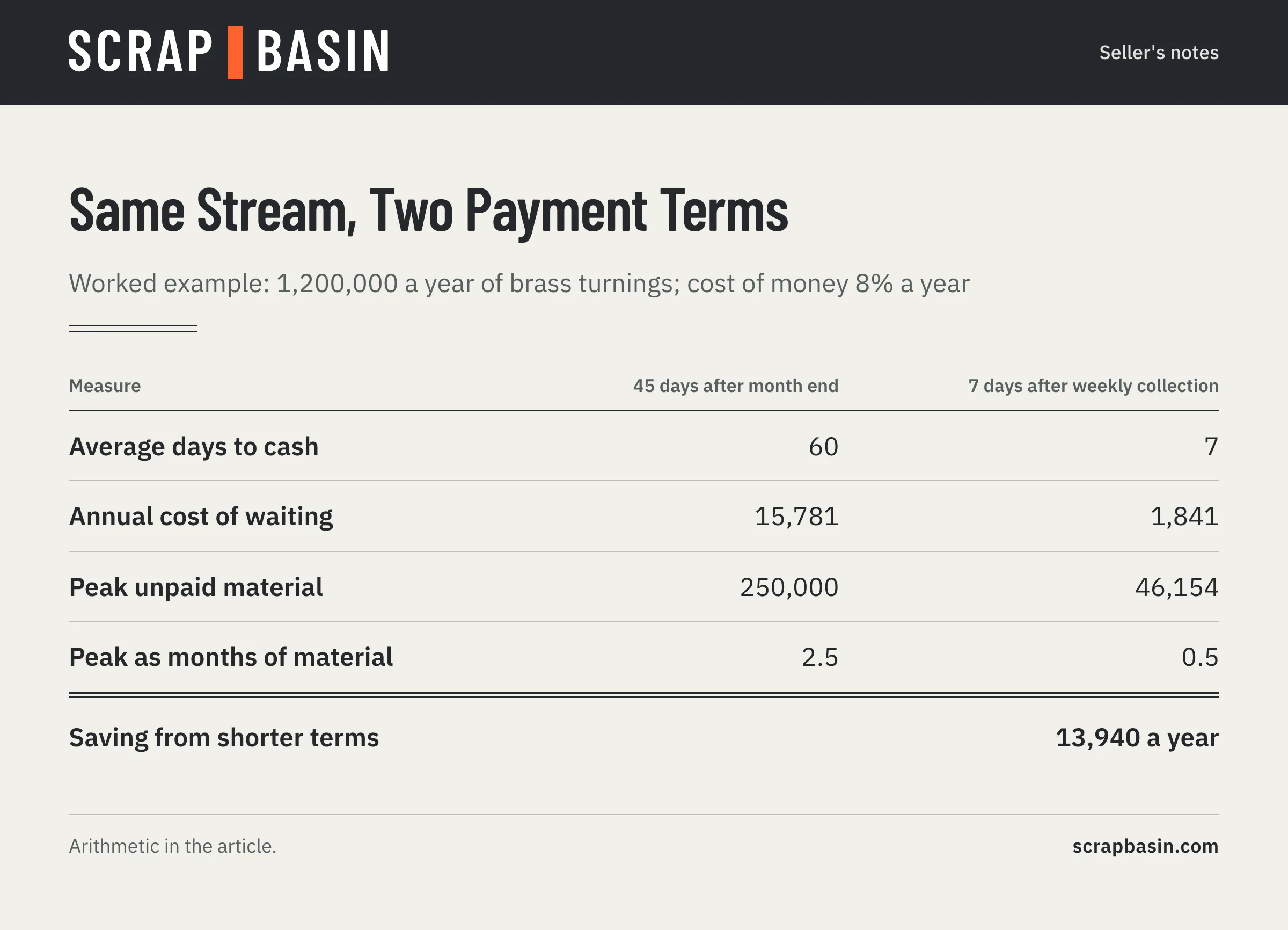
The difference, 13,940 a year, is about 1.2% of the stream's value. On copper or brass that can be larger than the gap between two buyers' headline prices, which is why payment days belong in any offer comparison. And the exposure figure is the one to put in front of whoever approves credit: would you let a customer run up 250,000 without a credit check?
Checks to Run on a Scrap Buyer
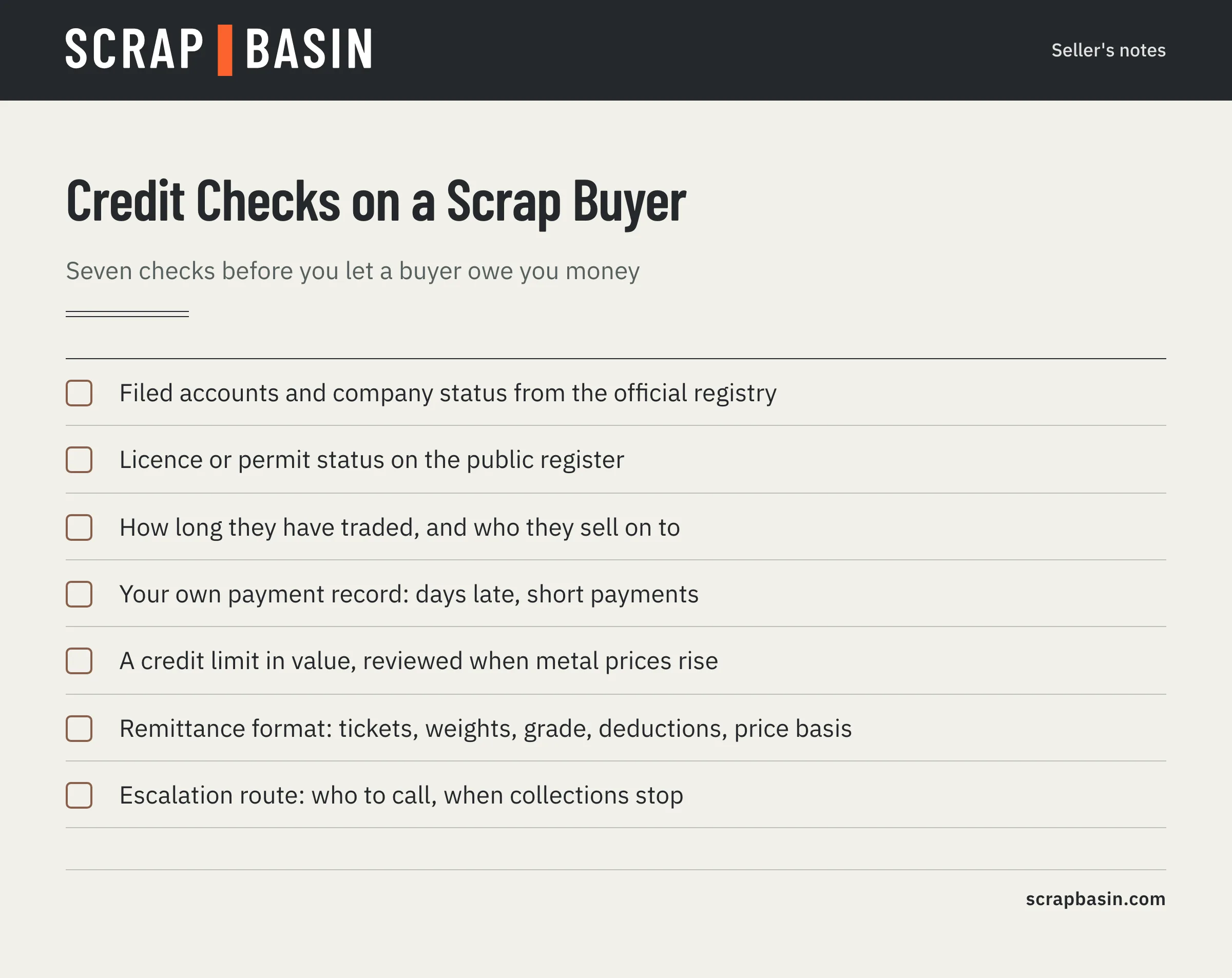
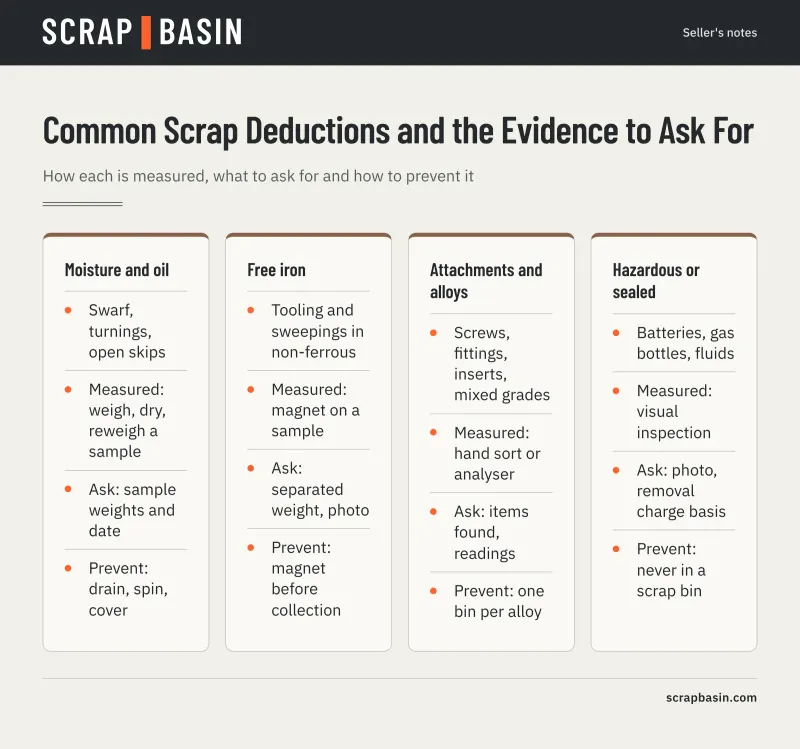
- Filed accounts and company status from the official registry (Companies House in the UK).
- Licence or permit status. In England and Wales, check the public register of scrap metal dealers; see our guide to the Scrap Metal Dealers Act 2013.
- How long they have traded and with which consumers they sell on.
- Your own payment record with them: days late, short payments, unexplained deductions.
- A credit limit in tonnes or value, reviewed when volumes or prices rise. A 40% rise in copper raises your exposure by 40% with no change in tonnage.
- What each remittance must show (below).
- An escalation route: who you call when a payment is late, and at what point collections stop.
For export sales arranged through a trader, payment before shipment or a documentary credit (a letter of credit, where a bank pays against shipping documents) is common. Ask how the buyer is paid by its own customer; if it waits, you may wait too.
What a Good Remittance Shows
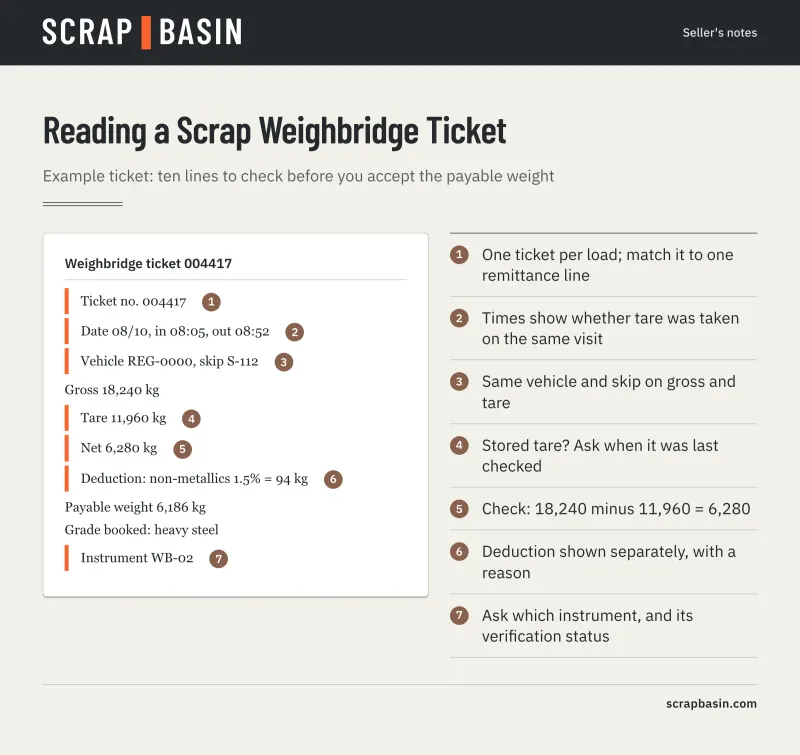
Each remittance should let you reconcile it without asking: ticket numbers and dates, gross, tare and net weights, the grade booked, any deductions with reasons, the price per tonne and how it was derived (reference and date if the price follows one), charges, the total and the payment date. If yours does not, ask for that format from the next payment. The weighbridge tickets guide covers the reconciliation itself.
The UK Rules
How a dealer may pay. In England and Wales, section 12 of the Scrap Metal Dealers Act 2013 says a scrap metal dealer must not pay for scrap metal except by a non-transferable cheque or by electronic transfer of funds. Paying in kind counts as paying. In Scotland, section 33A of the Civic Government (Scotland) Act 1982, inserted in 2015, allows only a non-transferable cheque or an electronic transfer to an account in the payee's name. A buyer offering cash in Great Britain is a buyer to avoid.
Late payment. GOV.UK's guidance on late commercial payments says an agreed payment date must usually be within 60 days for business transactions, though a longer period can be agreed if it is fair to both businesses. If no date is agreed, payment is late 30 days after the customer gets the invoice or you deliver, whichever is later. You can then claim statutory interest of 8% plus the Bank of England base rate, unless your contract sets a different rate, and a fixed sum for recovery costs: GBP 40 for debts under GBP 1,000, GBP 70 for GBP 1,000 to 9,999.99, and GBP 100 for GBP 10,000 or more.
In practice, scrap sellers rarely invoice: the buyer issues a remittance or self-bill (an invoice the buyer raises on your behalf). Agree in writing what the payment date is measured from (collection, ticket date or month end), because that decides when a payment is late.
This is commercial guidance, not legal advice. Last checked: 8 October 2026. US and Australian sellers should check their own state rules on how scrap may be paid for.
Terms Worth Asking for
- Payment days measured from collection, not month end.
- Weekly or per-collection settlement for high-value non-ferrous streams.
- A credit limit, and collections paused if it is exceeded.
- Remittances in the format above, with every ticket.
- Interest on late payment stated in the contract.
If you are setting terms with several buyers at once, include payment days in the comparison; see scrap metal tender. For the wider checklist, questions to ask a scrap metal buyer; for how payment fits into the net, scrap metal prices explained.
Put Payment Days into Every Comparison
Indicative information, not a price offer. ScrapBasin is an information service. It does not buy, sell or broker scrap.
Sources (checked 8 October 2026): Scrap Metal Dealers Act 2013, s.12, https://www.legislation.gov.uk/ukpga/2013/10/section/12; Air Weapons and Licensing (Scotland) Act 2015, s.69, https://www.legislation.gov.uk/asp/2015/10/section/69; GOV.UK, Late commercial payments, https://www.gov.uk/late-commercial-payments-interest-debt-recovery.
Public scrap price indexes for copper, brass, aluminium and steel each month, with the source on every figure.
Get Monthly Prices