Stainless 304 vs 316 Scrap: Why Nickel and Molybdenum Set the Price
Why 304 and 316 stainless scrap are priced apart: nickel, molybdenum and the ReMA 18-8 limits. Plus a worked segregation payback and UK trade data.
Contents 6
You cut both 304 and 316 stainless, the offcuts end up in one bin, and the buyer pays you one price for all of it. The question is whether keeping 316 apart would earn more than it costs. This guide explains why the two grades are worth different amounts as scrap, shows from the industry specification why 316 does not fit the standard stainless grade at all, works through a segregation payback, and explains why the UK's customs data cannot answer the price question for you.
In short
- Stainless scrap is valued mainly on its alloying elements: nickel and chromium in 304, plus molybdenum in 316.
- The standard stainless grade (Sabot) in the specifications of ReMA (the Recycled Materials Association, the US industry body) is 18-8 type material with at least 7% nickel and 16% chromium, and no more than 0.50% molybdenum. Most 316 carries several times that limit, so it falls outside the grade and has to be sold by separate agreement.
- Mixed 304 and 316 is usually paid as 304, so the 316 premium is lost.
- A magnet test separates 400-series from 300-series, but it cannot tell 304 from 316. Buyers use handheld analysers.
- US index: stainless and alloy steel scrap rose 18.8% in the year to August 2026 (preliminary), against 9.5% for ordinary iron and steel scrap.
What Separates 304 and 316
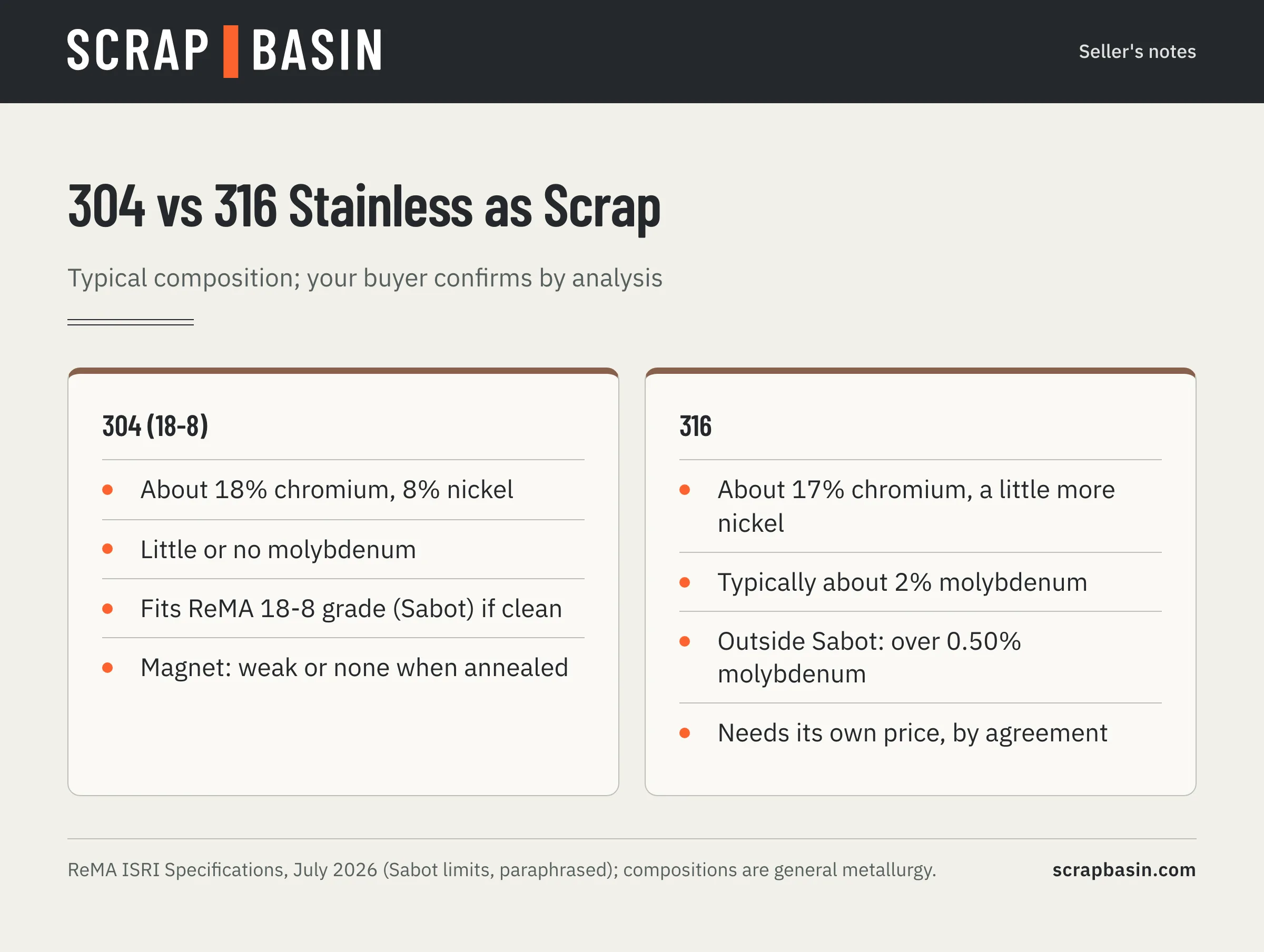
Both are austenitic stainless steels, the main family of stainless that is largely non-magnetic. 304 is the classic "18-8": roughly 18% chromium and 8% nickel. 316 adds molybdenum, typically around 2%, for corrosion resistance, and usually carries a little more nickel. For a steelmaker melting scrap, each of those elements is something it would otherwise buy as a costly alloy addition, so scrap that brings them in a known, consistent form is worth more than ordinary steel scrap, and 316's molybdenum is worth something extra to a melt that needs it.
| 304 (18-8) | 316 | |
|---|---|---|
| Chromium | About 18% | About 17% |
| Nickel | About 8% | Usually a little more than 304 |
| Molybdenum | Little or none | Typically about 2% |
| Fits ReMA's 18-8 grade (Sabot)? | Yes, if clean | No: exceeds the 0.50% molybdenum limit |
| Magnet test | Weak or none when annealed | Weak or none when annealed |
| How buyers confirm it | Handheld analyser | Handheld analyser |
Typical compositions are general metallurgy, shown to explain the logic. Your buyer will confirm grade by analysis.
What the Specification Says
ReMA's specifications (July 2026 edition) set out, in our words:
- Sabot, stainless steel scrap: clean 18-8 type clips and solids, minimum 7% nickel and 16% chromium, maximum 0.50% molybdenum and 0.50% copper, with limits on phosphorus and sulphur. Physical description and analysis are agreed between buyer and seller.
- Ultra, stainless steel turnings: clean 18-8 type turnings with the same nickel and chromium minimums, free of non-ferrous metals, non-metallics, excess iron and oil.
- Pekoe: 200-series stainless solids, with a copper limit.
The molybdenum limit is the point that matters here. 316 is not a better version of the standard grade; it is a different material that the standard grade excludes. A buyer who books mixed 304 and 316 as "18-8 solids" is either ignoring the molybdenum or diluting it, and you are not being paid for it.
Does Keeping 316 Apart Pay?
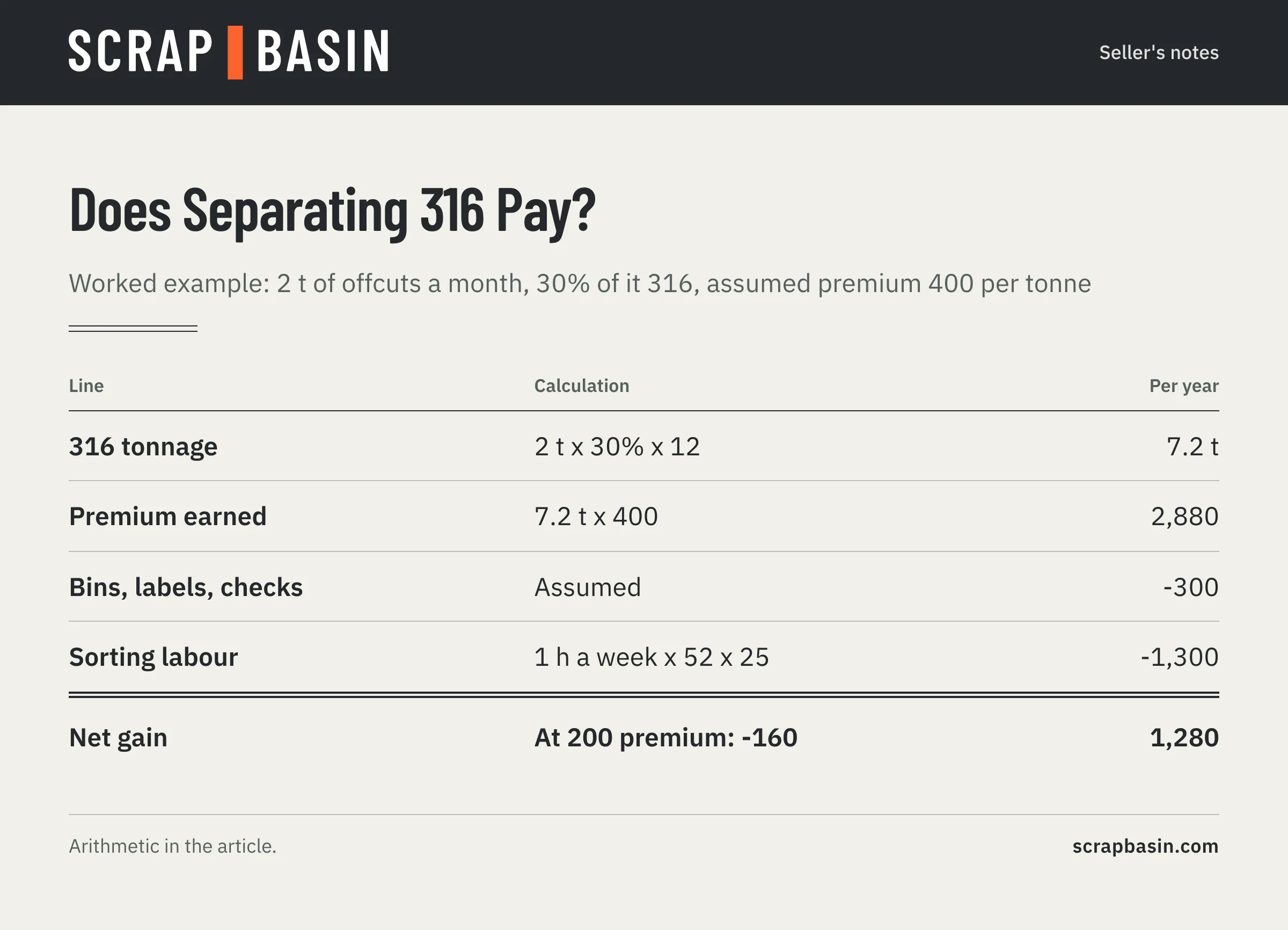
A fabricator produces 2 tonnes of stainless offcuts a month, 30% of it 316. Today all of it is paid as 304. Suppose a buyer will pay a premium of 400 per tonne for clean, separated 316 over 304.
| Line | Calculation | Per year |
|---|---|---|
| 316 tonnage | 2 t x 30% x 12 months = 7.2 t | |
| Premium earned if separated | 7.2 t x 400 | 2,880 |
| Second bin, labels, occasional analyser check by the buyer | Assumed | minus 300 |
| Sorting labour | 1 hour a week x 52 x 25 an hour | minus 1,300 |
| Net gain from segregation | 1,280 |
At a premium of 200 per tonne the gain falls to minus 160 (1,440 less 1,600), and the bin is not worth it. The decision therefore turns on one number only your buyer can give: the premium for separated 316 over 304. Ask for it in writing before you change the shop floor. If the buyer will not price 316 separately, another buyer might.
Keep turnings apart from solids too: turnings carry cutting fluid and are a different grade (Ultra rather than Sabot), so a few turnings in a solids bin can drag the whole bin down.
What UK Trade Data Can and Cannot Tell You
UK customs data splits stainless waste and scrap into two codes: 7204 21 10 for material containing 8% or more nickel, and 7204 21 90 for other stainless. Over the twelve months to July 2026, UK exporters shipped 106,633 tonnes under the first at an average declared GBP 430 per tonne, and 85,070 tonnes under the second at GBP 496 per tonne (our calculation from HMRC data, Open Government Licence).
Two things in those figures should make you cautious. The higher-nickel code averages less than the lower-nickel code, the opposite of what chemistry would suggest. And both averages sit much closer to ordinary ferrous scrap (GBP 291.5 per tonne across all of heading 7204) than an industry reader would expect for stainless. The likely explanations are a wide mix of material and declaration choices inside each code. That is why we use customs unit values as volume and direction signals, not as grade prices. Our UK ferrous scrap exports note and the scrap metal HS codes guide explain the codes.
The US producer price index is more useful for direction: stainless and other alloy steel scrap rose 18.8% between August 2025 and August 2026, against 9.5% for iron and steel scrap (August preliminary).
Questions for Your Stainless Buyer
- Will you price separated 316 above 304, and by how much per tonne?
- How do you confirm grade: analyser on arrival, sample, or visual only? Can we see the readings?
- Are turnings priced separately from solids? What oil and moisture limits apply?
- What happens to 400-series or duplex pieces found in a 300-series bin?
For the wider checklist, see questions to ask a scrap metal buyer, and for how any quoted figure is built, scrap metal prices explained.
Get the Field Guide
The free field guide includes the steel, iron and stainless grade table with US, UK and Australian names.
Indicative information, not a price offer. ScrapBasin is an information service. It does not buy, sell or broker scrap.
Sources (checked 8 October 2026): ReMA's ISRI Specifications, July 2026, https://www.isrispecs.org/ (code words cited, descriptions paraphrased); HMRC Overseas Trade Statistics API and Commodity lookup, https://api.uktradeinfo.com/OTS (contains public sector information licensed under the Open Government Licence v3.0); U.S. Bureau of Labor Statistics PPI WPU101212 and WPU1012 via FRED, https://fred.stlouisfed.org/series/WPU101212.
Public scrap price indexes for copper, brass, aluminium and steel each month, with the source on every figure.
Get Monthly Prices