Aluminium Scrap Grades: What Moves the Price?
Aluminium scrap is priced on alloy, form and metal yield. Grades from extrusion to turnings explained, with the EU yield test as a worked method.
Contents 6
You sell aluminium scrap and the offers you receive range widely, sometimes for material you think of as the same. Aluminium is less forgiving than copper: two lots of the same weight can contain very different amounts of usable metal, and they go to different furnaces. This guide sets out the three things that decide an aluminium scrap price (alloy, form and metal yield), walks through a yield calculation using the method written into EU law, and lists the preparation that moves each driver. It does not publish prices.
In short
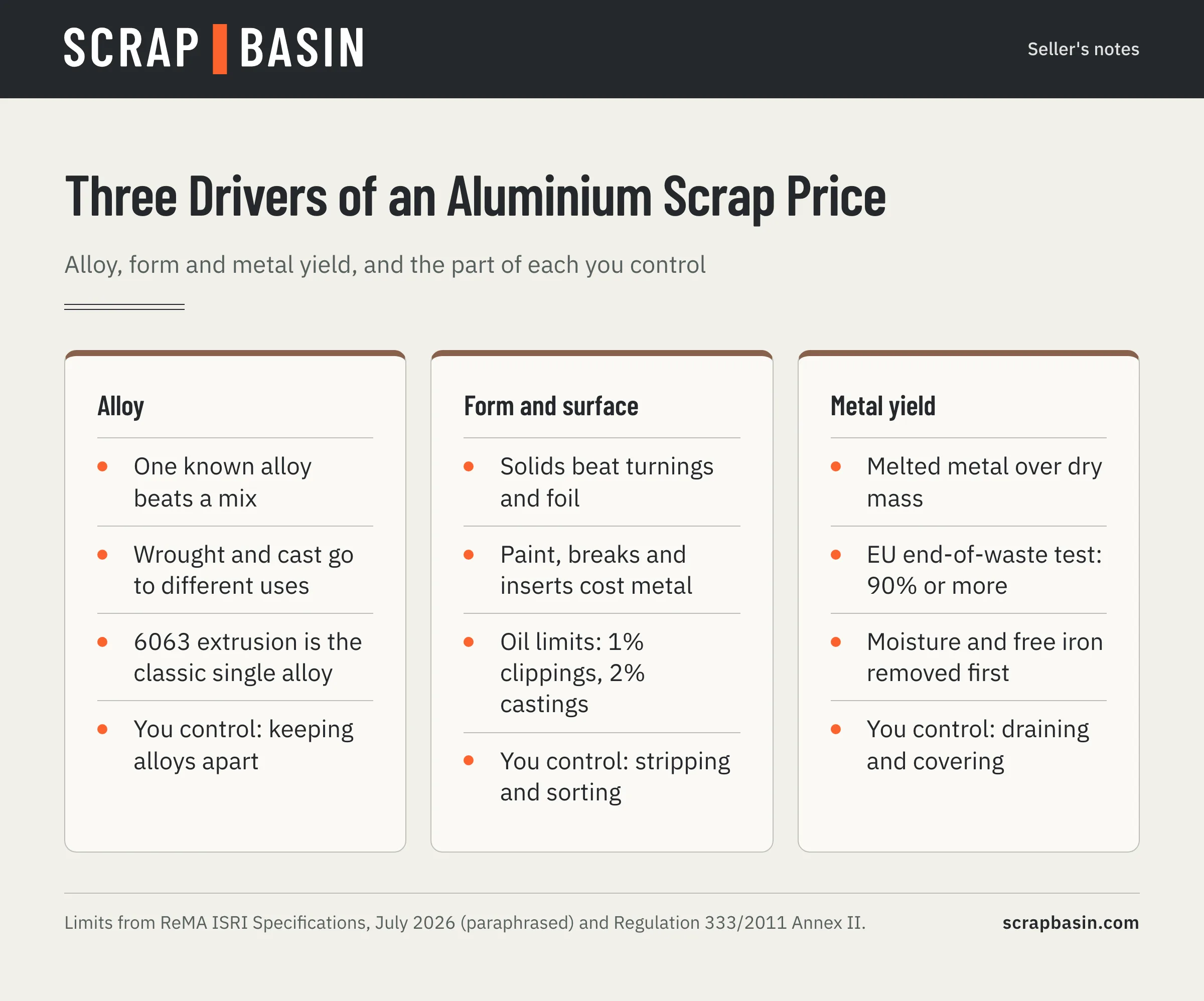
- Aluminium scrap is priced on alloy as much as on cleanliness: wrought alloys (sheet, extrusion) and cast alloys are used differently, and a single known alloy is worth more than a mix.
- Form changes how much metal survives melting. Thin foil, turnings and painted material lose more to oxidation and coatings than solid offcuts.
- Metal yield is the number that ties it together. EU end-of-waste law (the rules for when scrap legally stops being waste) defines it as the melted metal mass divided by the dry mass.
- In the specifications of ReMA (the Recycled Materials Association, the US industry body), clean new clippings allow no more than 1% oil and grease and mixed castings no more than 2%.
- Public data shows the market direction: the US index for aluminium base scrap was up 30.6% in the year to August 2026 (preliminary).
Driver 1: Alloy
Aluminium is rarely pure. Extrusions are usually a 6000-series alloy (6063 is the common one), sheet comes in several wrought alloys, and castings and wheels are cast alloys with more silicon. A remelter making a particular alloy wants scrap close to it. So:
- One alloy, known and kept apart (for example new 6063 extrusion offcuts) goes straight into a matching melt and earns the smallest gap.
- Mixed wrought alloys (old sheet of two or more alloys) need blending and sit lower.
- Cast alloys go to different consumers, often secondary smelters making casting alloy.
- Mixed wrought and cast sits lowest of the solids, because it suits neither use well.
ReMA's specifications reflect this. In our words: new production extrusions (Tata) are one alloy, typically 6063, with anodised material acceptable and painted material or other alloys by agreement; clean mixed old alloy sheet (Taint/Tabor) may contain up to 10% painted siding; mixed castings (Tense) are cast material only. The authoritative text is at isrispecs.org.
Driver 2: Form and Surface
| Form | What goes wrong in the furnace | Effect on price |
|---|---|---|
| Clean solids, offcuts, extrusion butts | Little | Highest for the alloy |
| Painted or coated sheet, thermal-break extrusion | Paint burns off; polyamide breaks and steel screws must be removed | Lower, or a separate grade |
| Turnings and borings | Cutting fluid, fines, high surface area oxidises | Lower; sold on yield |
| Foil and thin can stock | Oxidation loss, attached plastic or food | Lower; may be refused if contaminated |
| Castings with inserts | Steel inserts, bushings, oil | Deduction or lower grade |
ReMA's descriptions set some limits that show what buyers check: oil and grease not over 1% for clean new clippings (Tooth), not over 2% for mixed castings (Tense), and fines not over 3% through a 20-mesh screen for segregated borings and turnings (Teens).
Driver 3: Metal Yield
Metal yield is the share of a lot that comes out of the furnace as aluminium. It is the clearest single explanation of why aluminium turnings and extrusions are priced so far apart.
EU law gives a precise method. Regulation 333/2011, which sets when aluminium scrap stops being waste, allows a lot to qualify if foreign materials are 5% by weight or less, or if the metal yield is 90% or more. It defines metal yield as the mass of metal after melting and solidifying (m2) divided by the mass after moisture has been removed (m1), with free iron removed before melting, following EN 13920-1. You do not need to run the test to use the idea.
| Step | Turnings, 1,000 kg delivered | Extrusion offcuts, 1,000 kg delivered |
|---|---|---|
| Moisture and fluid removed | 5% = 50 kg, so m1 = 950 kg | 0%, so m1 = 1,000 kg |
| Free iron removed | 1% of 950 = 9.5 kg | None |
| Metal after melting, m2 | 836 kg | 960 kg |
| Metal yield, m2 / m1 | 836 / 950 = 88.0% | 960 / 1,000 = 96.0% |
| Metal per tonne delivered | 836 kg | 960 kg |
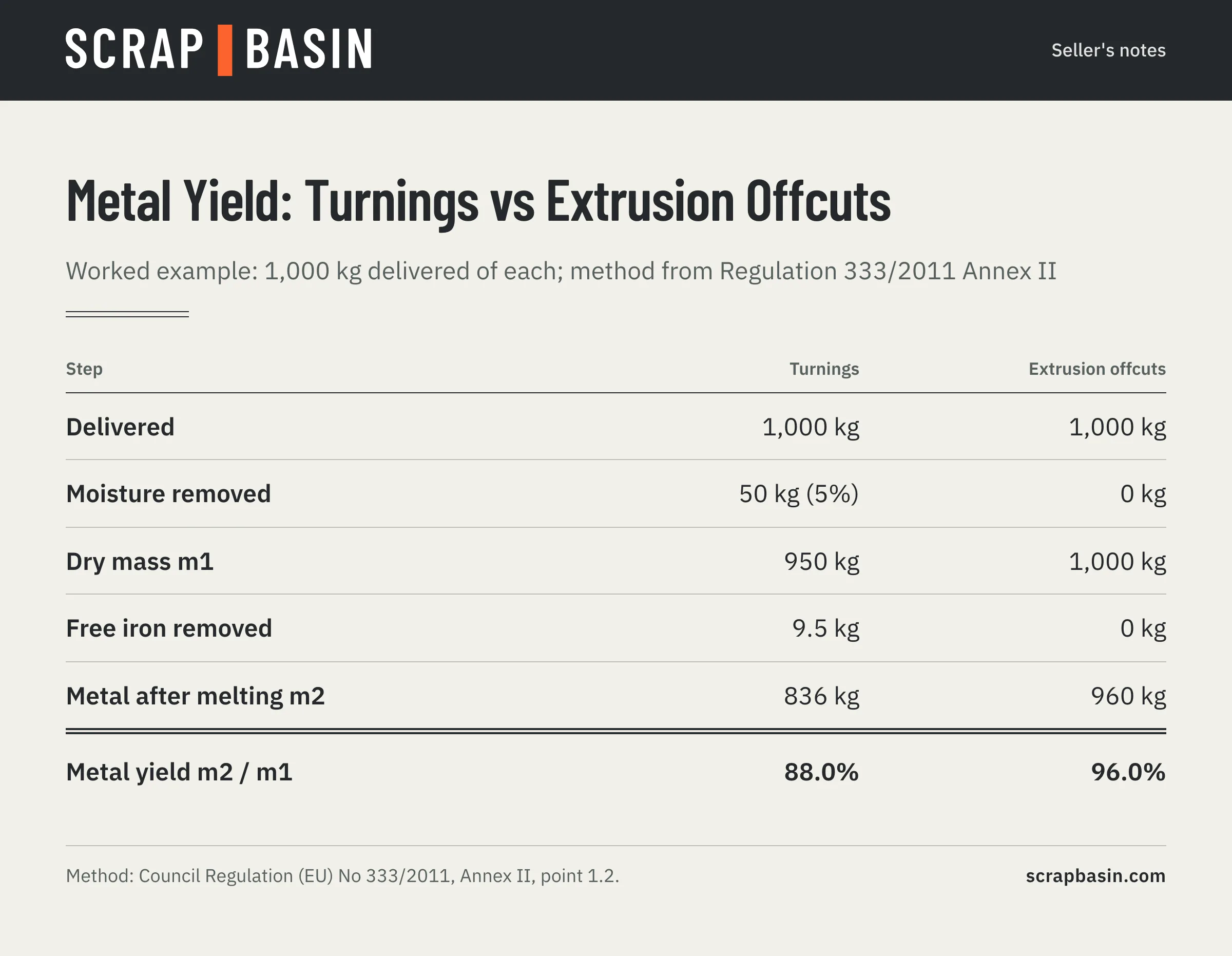
The extrusion offcuts deliver 124 kg more aluminium per tonne handed over, about 14.8% more metal than the turnings (960 / 836 = 1.148). A buyer pricing on recovered metal will reflect that, before any difference in alloy. Draining turnings, keeping them out of the rain and away from steel swarf all raise yield; so does keeping foil and painted material out of a clean solids bin.
What Public Data Shows
The US Bureau of Labor Statistics index for aluminium base scrap rose 30.6% between August 2025 and August 2026 (August preliminary; public domain, via FRED). In the UK, HMRC export statistics split aluminium waste and scrap into three commodity codes. Over the twelve months to July 2026, UK exporters shipped 416,074 tonnes of aluminium scrap (7602 00 90) at an average GBP 1,688 per tonne, 132,861 tonnes of other aluminium waste including faulty workpieces (7602 00 19) at GBP 1,829, and 91,147 tonnes of turnings and thin foil (7602 00 11) at GBP 1,704 (our calculation, Open Government Licence). The averages sit close together because each code contains a wide mix of grades; they show direction and volume, not the spread between grades. Our EU aluminium scrap exports tracker shows the European picture, and the scrap metal HS codes guide explains what each code covers.
Preparation That Pays
- Keep alloys apart where you know them: extrusion offcuts by alloy, sheet separate from castings.
- Remove thermal breaks, screws and inserts when the labour is covered by the grade difference.
- Drain and cover turnings; keep steel swarf out of aluminium bins.
- Keep foil, cans and painted material out of clean solids.
- Ask how yield or foreign material is measured if you are paid on recovery, and agree it in writing. Our guide to contamination deductions covers the dispute route.
The EU yield and foreign-material thresholds also matter if your buyer sells aluminium scrap as a product rather than as waste; see end-of-waste criteria. For how any quoted figure is built, see scrap metal prices explained.
Get the Field Guide
The free field guide includes the aluminium grade table with US, UK and Australian names and what buyers check for each.
Public scrap price indexes for copper, brass, aluminium and steel each month, with the source on every figure.
Get Monthly PricesIndicative information, not a price offer. ScrapBasin is an information service. It does not buy, sell or broker scrap.
Sources (checked 8 October 2026): Council Regulation (EU) No 333/2011, Annex II, https://eur-lex.europa.eu/eli/reg/2011/333/oj; ReMA's ISRI Specifications, July 2026, https://www.isrispecs.org/ (code words cited, descriptions paraphrased); U.S. Bureau of Labor Statistics PPI WPU102302 via FRED, https://fred.stlouisfed.org/series/WPU102302; HMRC Overseas Trade Statistics API, https://api.uktradeinfo.com/OTS (contains public sector information licensed under the Open Government Licence v3.0).