12 Questions to Ask a Scrap Metal Buyer Before You Agree Terms
Twelve questions to put to a scrap metal buyer before you agree terms, the risk each one closes, and the answers that should make you walk away.
Contents 4
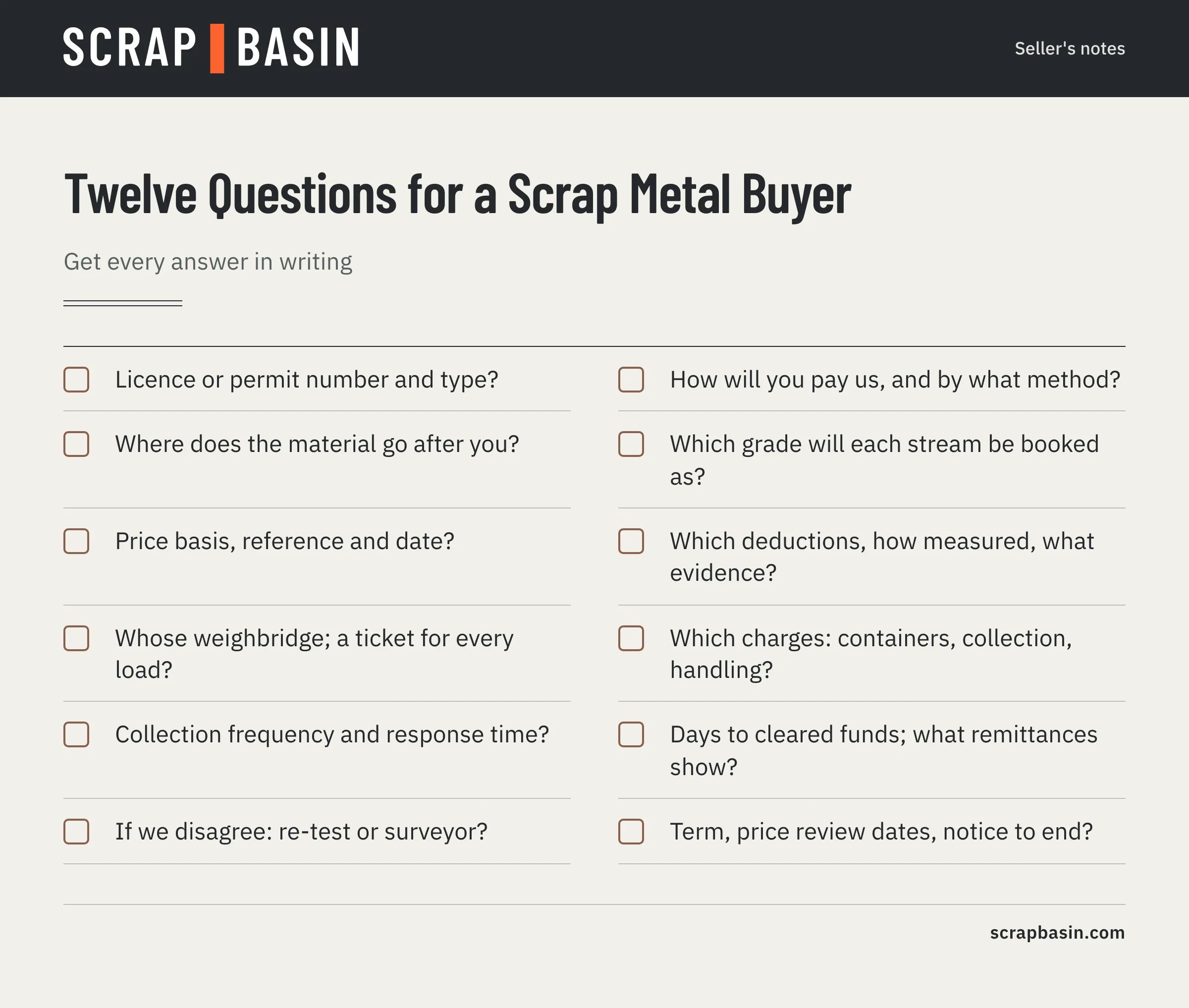
You are choosing a buyer for a recurring scrap stream, or reviewing the one you have. A quote tells you one number. The terms around it decide what you are paid, when, and with how much risk. These twelve questions turn a quote into terms you can compare and hold a buyer to. Each is paired with the risk it closes, and the guide ends with the answers that should make you look elsewhere.
In short
- Ask about compliance first: licence, how they pay, and where the material goes next.
- Then price: grade booked, price basis, reference and date.
- Then the net: deductions, weighing, charges and payment days.
- Then the relationship: remittance format, disputes, term and review.
- Get the answers in writing. A buyer who will not answer in writing is answering anyway.
The Twelve Questions
Compliance
1. What is your licence or permit number and type? In England and Wales, anyone carrying on business as a scrap metal dealer needs a council licence: a site licence or a mobile collector's licence. Site licences must be displayed at each site and collector's licences on each vehicle. The Environment Agency keeps a public register for England. Risk closed: selling to an unlicensed dealer, and the reputational and theft-related exposure that brings. See the Scrap Metal Dealers Act 2013.
2. How will you pay us? In England and Wales a dealer may pay only by non-transferable cheque or electronic transfer; in Scotland, by non-transferable cheque or electronic transfer to an account in the payee's name. Risk closed: cash offers, which are unlawful for dealers in Great Britain.
3. Where does the material go after you? A mill, a smelter, a refiner, an export buyer? If it is exported from the EU, from 21 May 2027 the exporter must ensure the receiving facility has been independently audited under the EU Waste Shipment Regulation. Risk closed: an outlet that disappears when rules tighten, and your material in a chain you cannot see.
Price
4. Which grade will each stream be booked as, and what would cause a downgrade? Risk closed: quoting on one grade and paying on another.
5. What is the price basis? Fixed, a percentage of a reference, the reference less a discount, an average-period price, or a recovery basis. If it follows a reference: which one, for which date or period, and will it appear on each remittance? See how copper scrap prices are set. Risk closed: a price you cannot check, or one that does not follow the market.
Net
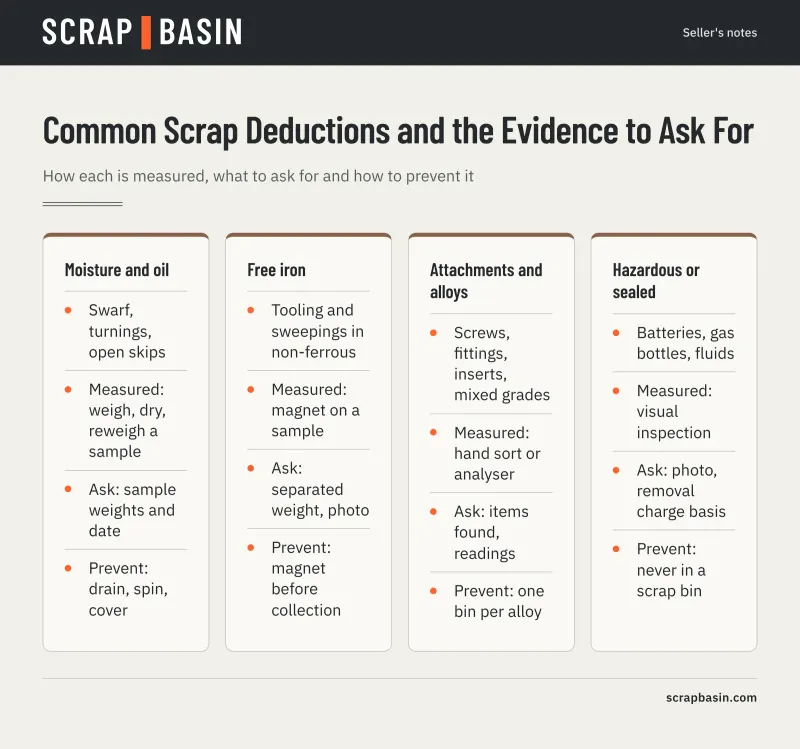
6. Which deductions can apply, how is each measured, and what evidence do we get? See contamination deductions. Risk closed: open-ended deductions.
7. Whose weighbridge, will we get a ticket for every load, and is tare (the empty-vehicle weight) weighed on the same visit? See weighbridge ticket. Risk closed: weight errors you cannot see.
8. What charges apply? Container rental, collection, handling, minimum loads, contamination removal. Ask for each per tonne or per month. Risk closed: charges that quietly reverse a price advantage.
9. How often will you collect, how quickly will you respond, and who provides containers? Risk closed: overflowing bins, site disruption and material spoiled in the rain.
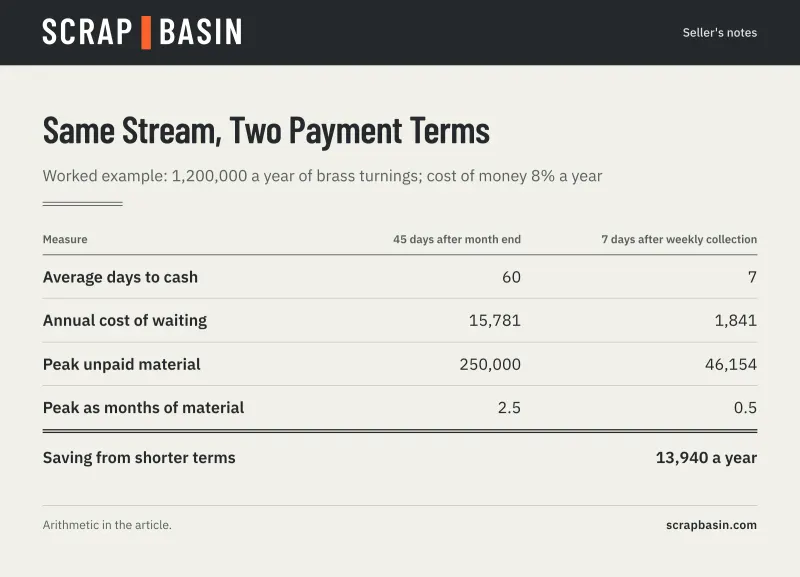
10. How many days from collection to cleared funds, and what will each remittance show? Tickets, weights, grade, deductions with reasons, price and basis, charges, date. See payment terms. Risk closed: credit exposure and remittances you cannot reconcile.
Relationship
11. If we disagree about a grade, deduction or weight, what happens? A re-test, a retained sample, an independent surveyor? Risk closed: disputes settled by whoever holds the money.
12. How long does the agreement run, when is the price reviewed, and what notice ends it? Risk closed: a price that is never reviewed, or a contract you cannot leave.
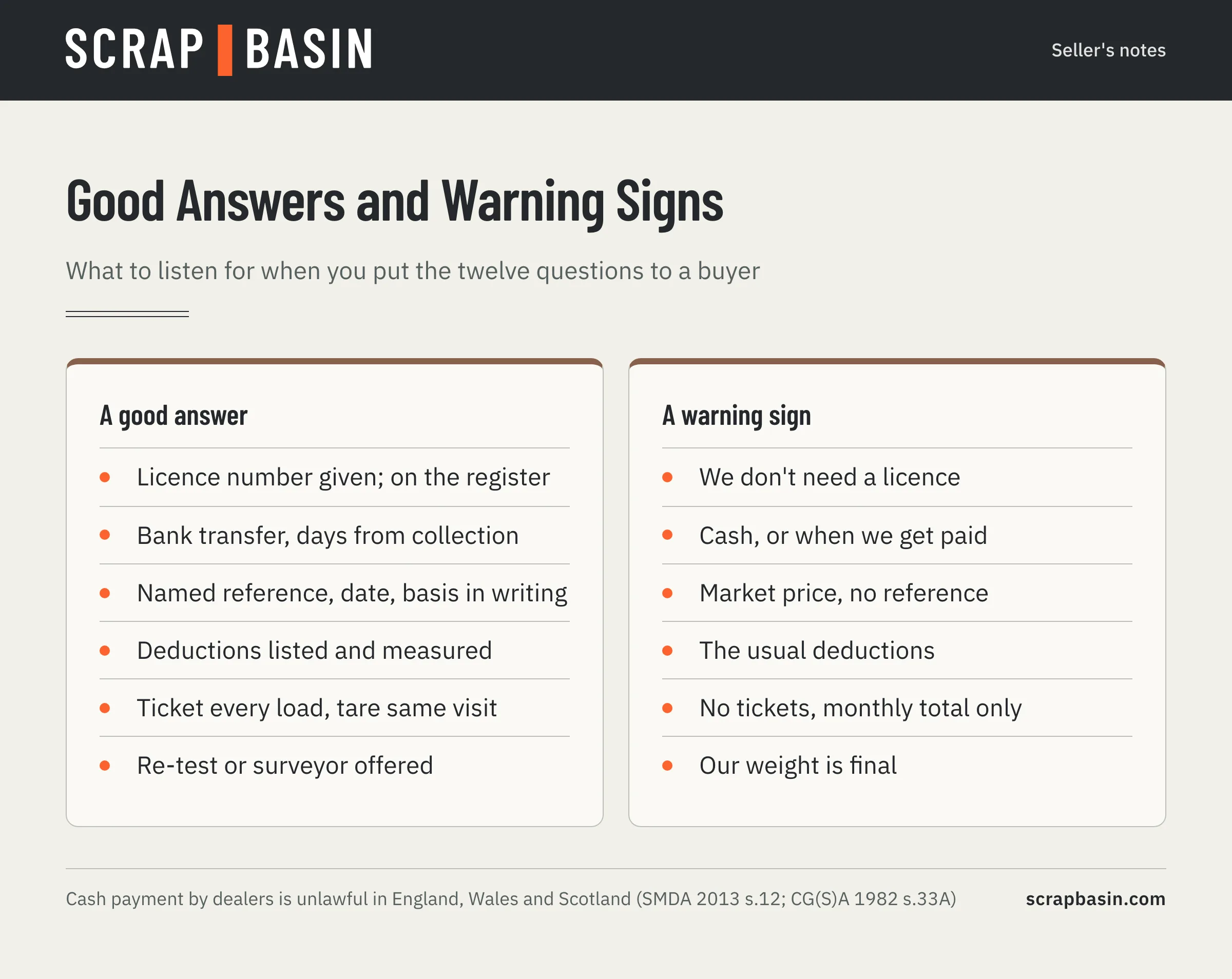
Good Answers and Warning Signs
| Question | A good answer | A warning sign |
|---|---|---|
| Licence | Number and type given; on the public register | "We don't need one" from a business that buys and sells scrap |
| Payment | Bank transfer, stated days from collection | Cash, or "when we get paid" |
| Price basis | Named reference, date, percentage or discount in writing | "Market price" with no reference |
| Deductions | Listed, measured on a sample, evidence supplied | "The usual deductions" |
| Weighing | Ticket every load, tare same visit | No tickets, or a monthly total only |
| Disputes | Re-test or surveyor offered | "Our weight is final" |
A note on the licence question: a manufacturer that sells scrap only as a by-product of its own production is not itself a scrap metal dealer under section 21(3) of the 2013 Act. The question is about the buyer, not about you.
Using the Answers
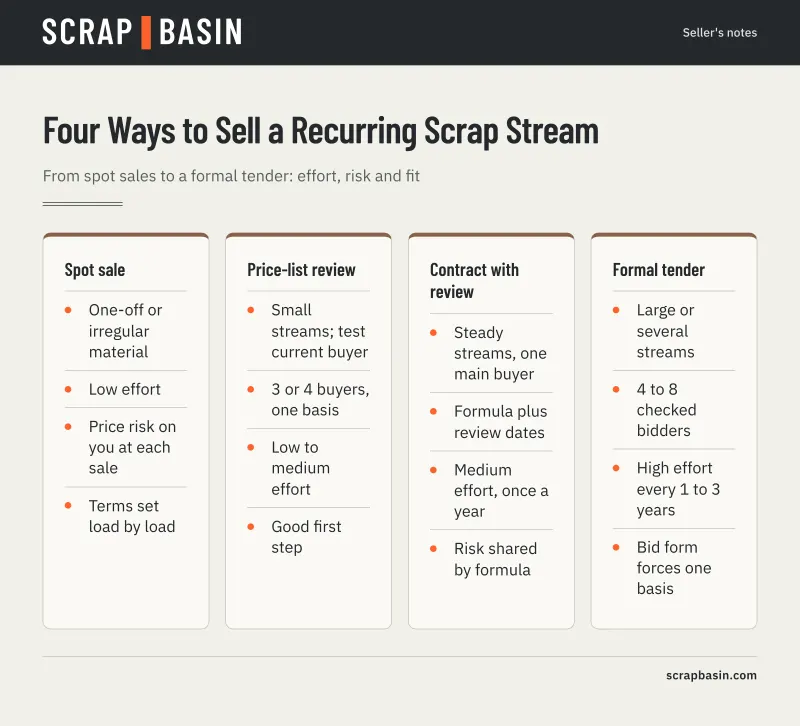
If you are asking several buyers at once, put the twelve questions into a bid form so every answer arrives in the same format; the scrap metal tender guide shows how. If you are reviewing your current buyer, ask the same questions and compare the answers with what your last twelve remittances actually show.
This is commercial guidance, not legal advice. Rules last checked: 8 October 2026.
Let the Workbook Ask for You
Indicative information, not a price offer. ScrapBasin is an information service. It does not buy, sell or broker scrap.
Sources (checked 8 October 2026): Scrap Metal Dealers Act 2013, https://www.legislation.gov.uk/ukpga/2013/10/contents; GOV.UK scrap metal dealer licence, https://www.gov.uk/scrap-metal-dealer-registration; Air Weapons and Licensing (Scotland) Act 2015 s.69, https://www.legislation.gov.uk/asp/2015/10/section/69; Regulation (EU) 2024/1157, https://eur-lex.europa.eu/eli/reg/2024/1157/oj.
Public scrap price indexes for copper, brass, aluminium and steel each month, with the source on every figure.
Get Monthly Prices