Scrap Metal Prices: What Does the Number on a Price Board Mean?
Why scrap metal prices conflict across sites, the four numbers inside every quote, unit traps, and which figure to ask a buyer for. No price lists.
Contents 7
You searched for scrap metal prices because you have metal to sell, or a quote in hand, and you want to know whether it is fair. What you found is a set of boards and tables that disagree with each other, often by a wide margin. This guide explains why they disagree, what four numbers sit inside every scrap price, and which single figure you should ask a buyer for before you compare anything. It will not give you a price list. ScrapBasin does not publish exchange or price-agency figures, and a list without a grade, a date, a unit and terms would not help you decide anything.
In short
- Every scrap price is built from four numbers: a reference metal price, a grade relationship to it, the terms (deductions, charges, payment days) and the net that reaches your bank.
- Published boards usually show only the second number for one grade, on one date, in one unit, before terms. That is why they conflict.
- A short ton is 907.18 kg, so 1,000 per short ton is 1,102 per tonne. Mixing the two units is an easy 10% error to make in a scrap quote.
- Public data (US producer price indexes, UK customs export values) tells you how far and which way the market moved. It does not tell you your price.
- The figure to ask for is the net value per tonne of material handed over, after deductions and charges, with the payment date stated.
Why Scrap Metal Prices Conflict from One Site to the Next
When we checked the top results for "scrap metal prices" on 8 October 2026, they included user-reported price apps, a single yard's board, a directory, and several copied "mirror" pages whose copper figures contradicted each other. None explained what its number included. That is the normal state of this search, and it has five causes.
Grade. "Copper" covers bright wire, tube, mixed copper and insulated cable. Each is a different grade with a different relationship to the copper price. A board that says "copper" without a grade is quoting one of them, usually the best.
Date. The underlying metal price moves daily. A board updated weekly, or a page copied months ago, shows an old market.
Unit and currency. US boards quote per pound, UK yards per kg or per tonne, and some contracts still use the long ton. A difference of 10% can be nothing more than a unit.
Side of the trade. A counter price for walk-in sellers is not the price a yard pays an industrial account on a monthly contract, and neither is the price the yard receives when it sells on.
Terms. Deductions, collection charges, container rental and payment days are never on the board, and they can move the net by more than the gap between two yards' headline prices.
1. The Reference Metal Price
Most non-ferrous scrap (metals other than iron and steel, such as copper, brass and aluminium) is priced in relation to a refined metal price: what a consumer pays for finished copper cathode or primary aluminium of a set purity, at a set place and time. Those prices come from exchanges and price-reporting agencies and are licensed. ScrapBasin does not republish them. If your contract names one, your buyer should show the figure and date used on every remittance so you can check it against your own source.
Ferrous scrap (iron and steel) is priced differently: mostly on negotiated or assessed scrap prices rather than as a share of a refined steel price. The logic below still applies, but the "reference" is usually the buyer's own grade price for the month.
2. The Grade Relationship
Scrap is a raw material for making metal again. The buyer still has to sort, melt, refine or re-alloy it, and loses metal doing so. So a scrap grade is priced below the reference, either as a percentage of it (a "payable" share) or as the reference less a fixed discount per tonne. The cleaner and purer the grade, the smaller the gap. Our guide to how copper scrap prices are set works through this for copper grade by grade.
3. The Terms
This is where most money is won or lost on a recurring stream:
- Weight deductions for moisture, oil, attachments or non-metallics. See contamination deductions.
- Downgrades, where the whole lot is booked as a lower grade.
- Charges for collection, container rental, handling or minimum loads.
- Weighing basis: whose scale, and whether you receive a weighbridge ticket for every load.
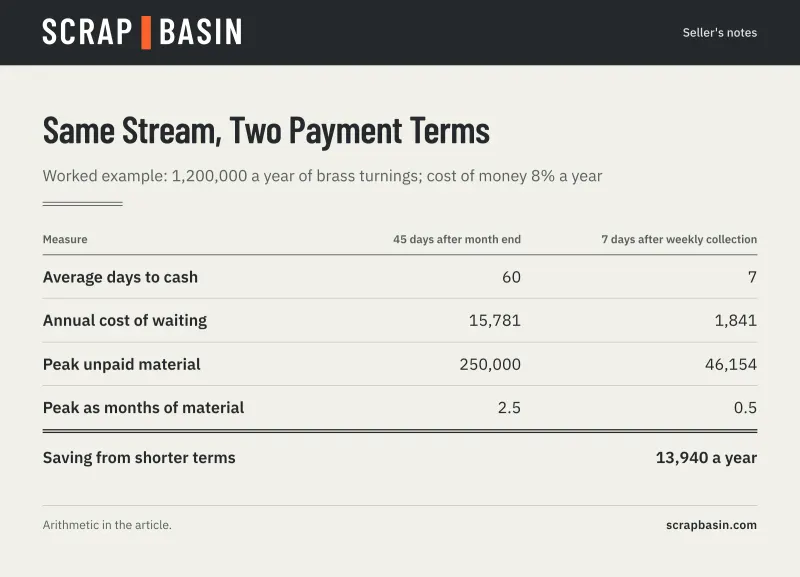
- Payment days, which are a cost to you and a source of risk. See payment terms.
4. The Net
The net is what reaches your account for the material you handed over. It is the only number that can be compared across buyers.
From Reference to Net
The arithmetic below uses a reference of 10,000 per tonne in no particular currency, because the method is identical in USD, GBP or AUD. The figures are examples to show the steps; they are not market prices.
A manufacturer hands over 10.000 tonnes of a non-ferrous grade in a month.
| Step | Basis | Amount | Running total |
|---|---|---|---|
| Reference value of 10 t | 10 t x 10,000 | 100,000 | 100,000 |
| Grade relationship | Payable 88%, so 12% of 100,000 | minus 12,000 | 88,000 |
| Moisture deduction | 2% of 10 t = 0.2 t, at 8,800 per t | minus 1,760 | 86,240 |
| Collection charge | 10 t x 35 per t | minus 350 | 85,890 |
| Container rental | Flat monthly fee | minus 120 | 85,770 |
| Payment timing | 45 days at 8% a year: 85,770 x 0.08 x 45 / 365 | minus 846 | 84,924 |
| Net, time-adjusted | 84,924 / 10 t = 8,492 per t | 84.9% of reference |
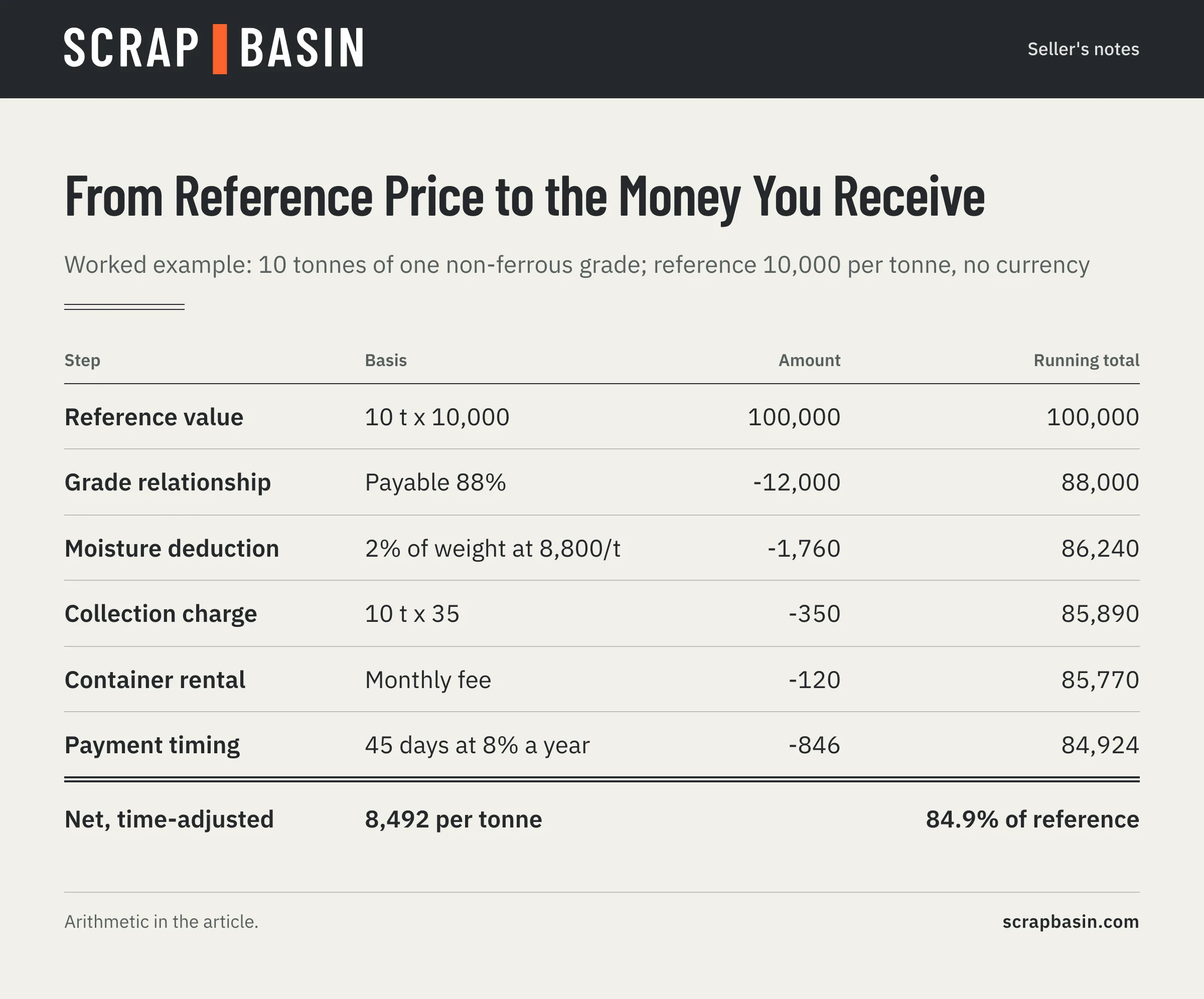
Three things stand out. The headline "88%" is not what the seller receives: the net is 84.9% of the reference once terms are counted. The terms (moisture, charges and timing) cost 3,076, which is about a quarter of the 12,000 grade discount and more than enough to reverse a ranking between two offers. And the payment line uses your own cost of money: if your business borrows at a higher rate, waiting costs more.
Units: The Quiet Source of 10% Errors
| Unit | Kilograms | Where you see it |
|---|---|---|
| Tonne (metric ton) | 1,000 | UK, Australia, EU, customs data |
| Short ton | 907.18 (2,000 lb) | US default; ReMA (Recycled Materials Association, the US industry body) nonferrous terms treat a ton as 2,000 lb unless agreed |
| Long ton | 1,016.05 (2,240 lb) | Older UK contracts, some shipping documents |
| Pound | 0.4536 | US yard boards |
Two conversions are worth keeping on a card:
- Per pound to per tonne: multiply by 2,204.62. A board figure of 4.00 per lb is 8,818 per tonne.
- Per short ton to per tonne: multiply by 1.1023. A price of 1,000 per short ton is 1,102 per tonne. Reading 1,000 per short ton as 1,000 per tonne understates what you are being offered by 9.3%; reading a per-tonne offer as per short ton overstates it by 10.2%.
What Public Data Can and Cannot Tell You
ScrapBasin builds its charts only from data we are allowed to reuse. Two public sources are useful to a seller, as long as you read them for what they are.
US producer price indexes for scrap (Bureau of Labor Statistics, public domain) track the change in prices received across many US transactions, grade by grade. The index for No. 1 copper scrap including wire stood 41.2% higher in August 2026 than a year earlier (August is preliminary). An index tells you the market moved a long way; it does not tell you what any one yard will pay, and its level is not a price.
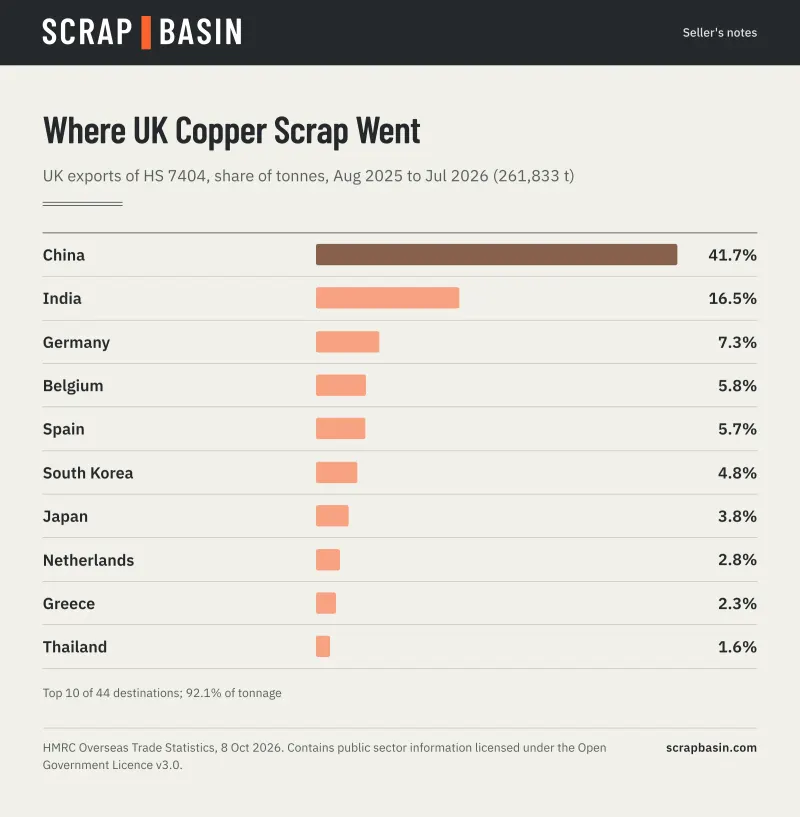
UK customs export values (HMRC Overseas Trade Statistics, Open Government Licence) give tonnes and declared value by commodity code each month. Dividing one by the other gives an average unit value. UK exports of copper waste and scrap averaged GBP 7,656 per tonne in July 2026 and GBP 6,463 per tonne over the twelve months to July 2026. UK ferrous scrap exports averaged GBP 291.5 per tonne over the same twelve months. These are export averages across every grade in the code, after the exporter's sorting, processing and margin, so they sit above what a generator is paid. They are still a public, dated check on direction. Our note on UK copper scrap exports by destination shows how wide the unit values are within a single code.
The World Bank also publishes monthly averages for refined metals (next update 3 November 2026). We show them only as an index of change, not as prices.
Which Number to Ask a Buyer for
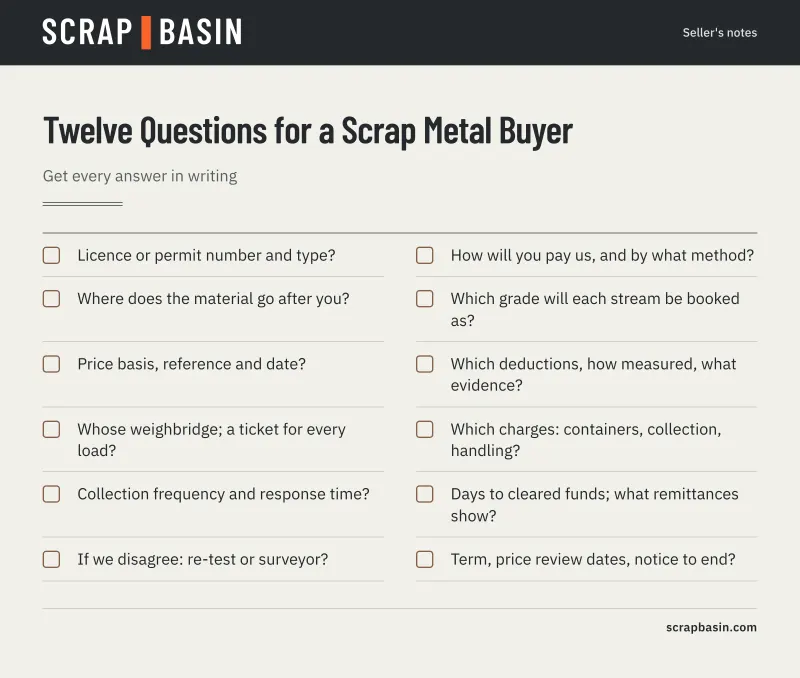
Before you compare two buyers, get each to answer the same questions in writing. The ladder below is the order we would use.
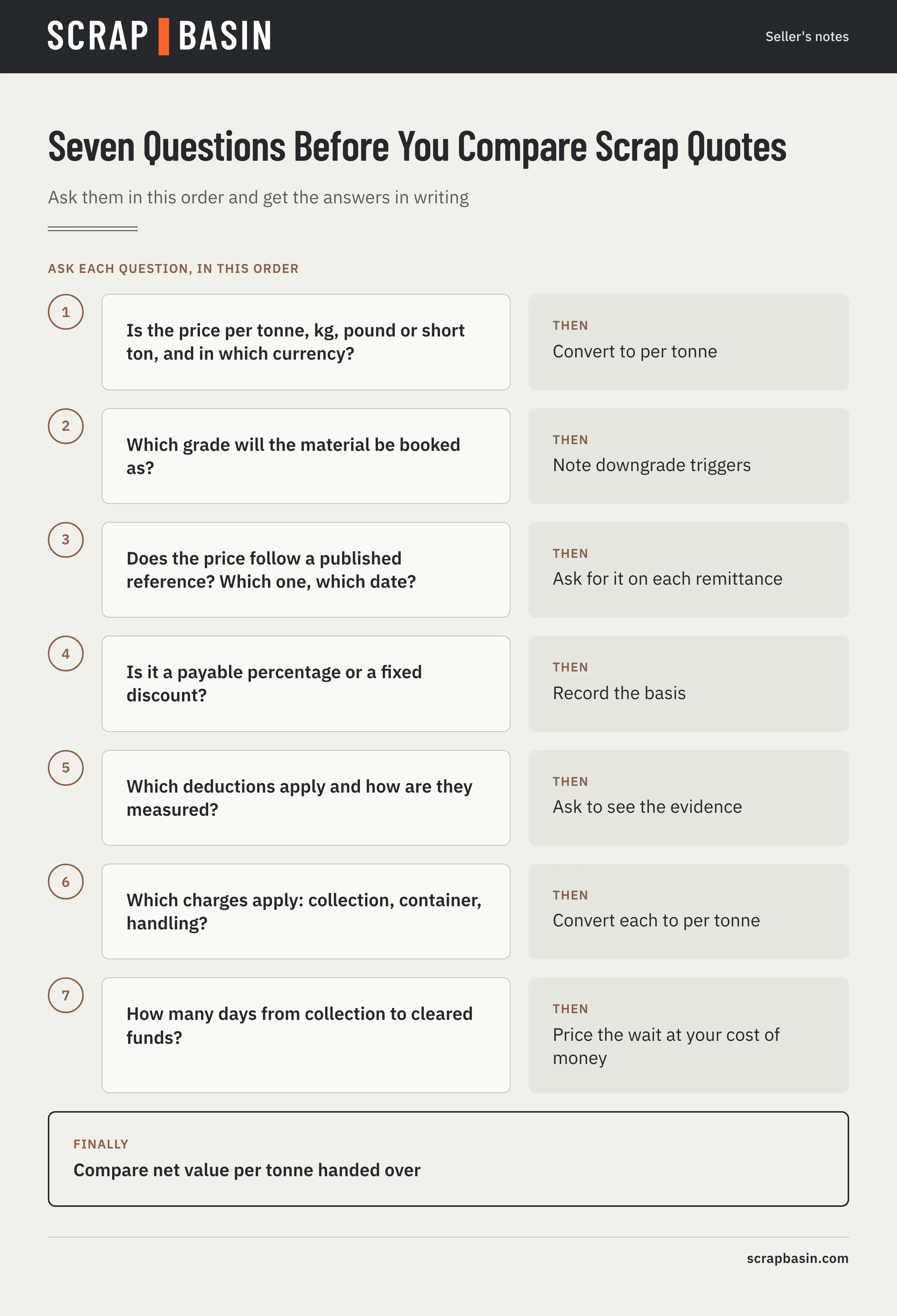
- Unit and currency. Per tonne, per kg, per pound or per short ton?
- Grade. Which grade will the material be booked as, and what would cause a downgrade?
- Reference and date. If the price follows a published figure, which one, on which date or averaging period?
- Payable share or discount. Stated as a percentage of the reference or a fixed amount below it?
- Deductions. Which apply, how are they measured, and can you see the evidence?
- Charges. Collection, container rental, handling, minimum load.
- Payment. Days from collection to cleared funds, and the method.
With those answers, the net per tonne falls out of the same arithmetic as the ledger above. If a buyer will not answer them, that is information too. Our questions to ask a scrap metal buyer extends this list to licence checks and weighing.
When a Board Price Is Still Useful
A board is a starting point for a one-off load of clean, well-identified material, where terms are simple and you are paid on the day. For a recurring industrial stream, the board matters far less than the formula, the deductions and the payment days you agree.
Get the Field Guide
The free ScrapBasin field guide covers the five price bases, grade names in US, UK and Australian usage, what buyers deduct for, how to read a weighbridge ticket and the payment and licence rules, in 12 pages.
If you want to know each month when the public indexes and UK export values move, ScrapBasin Plus sends alerts and full chart history for USD 12 a month: see Plus and Pro.
Public scrap price indexes for copper, brass, aluminium and steel each month, with the source on every figure.
Get Monthly PricesIndicative information, not a price offer. ScrapBasin is an information service. It does not buy, sell or broker scrap.
Sources (checked 8 October 2026): U.S. Bureau of Labor Statistics, PPI WPU10230101 via FRED, https://fred.stlouisfed.org/series/WPU10230101; HMRC Overseas Trade Statistics API, https://api.uktradeinfo.com/OTS (contains public sector information licensed under the Open Government Licence v3.0); ReMA's ISRI Specifications, July 2026, https://www.isrispecs.org/; World Bank commodity markets, https://www.worldbank.org/en/research/commodity-markets (Pink Sheet data licensed under CC BY 4.0).