End-of-Waste for Metal Scrap: When Does Scrap Stop Being Waste?
When iron, steel, aluminium and copper scrap stop being waste under Regulations 333/2011 and 715/2013: thresholds, inputs, statement of conformity.
Contents 6
A buyer tells you its output is "end-of-waste", or asks whether your scrap could be. Perhaps you need to know whether a shipment is waste at all before deciding which rules apply. Two regulations decide when metal scrap stops being waste in the EU, and both remain in UK law: Regulation 333/2011 for iron, steel and aluminium, and Regulation 715/2013 for copper. This guide sets out what each requires, side by side, who has to do what, and what it means for an industrial seller.
Last checked: 8 October 2026.
In short
- Scrap ceases to be waste only when every condition is met, at the moment the "producer" transfers it to another holder.
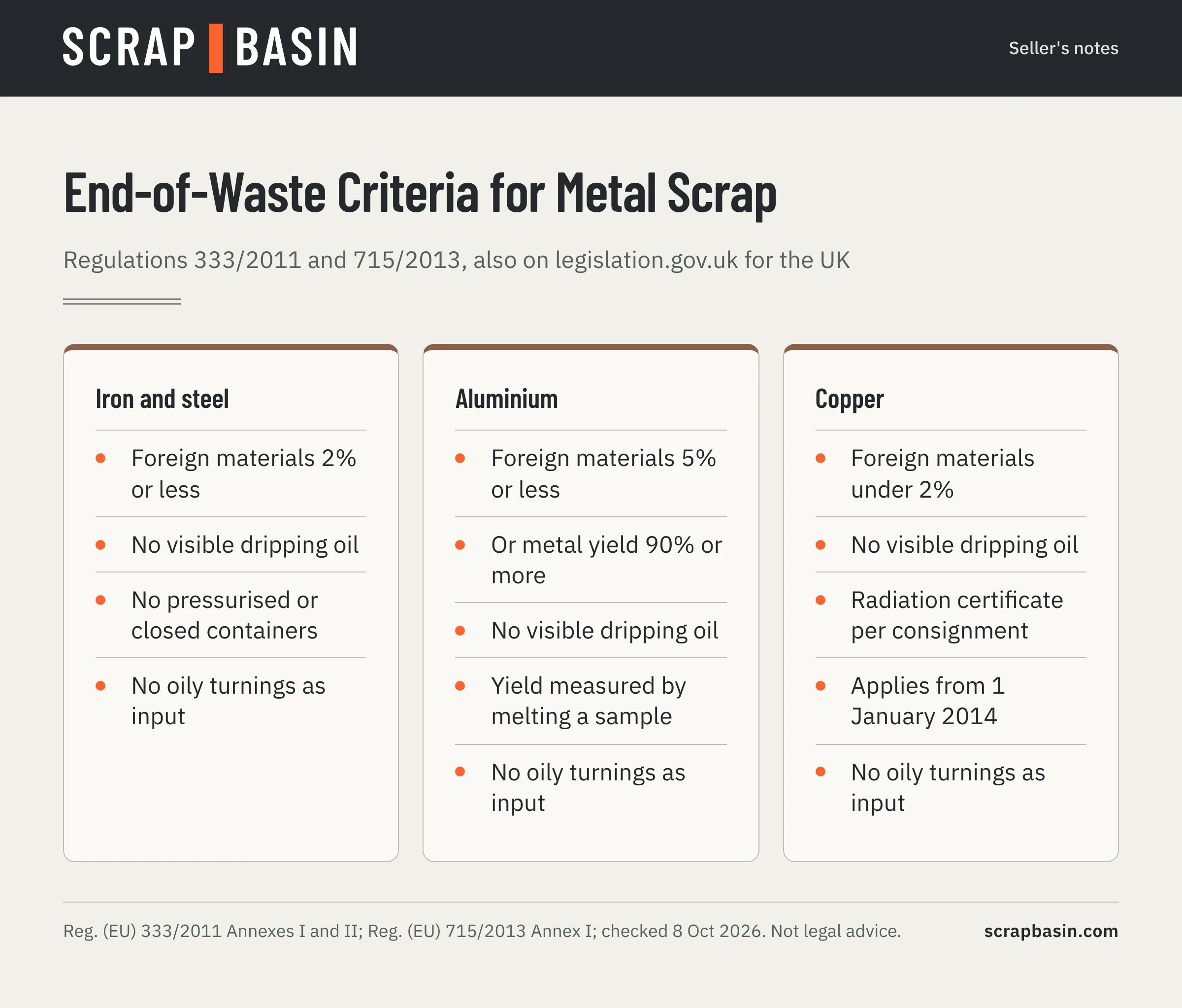
- Output thresholds: iron and steel 2% or less foreign material; aluminium 5% or less, or at least 90% metal yield; copper under 2%.
- Inputs are restricted too. For steel, aluminium and copper alike, filings and turnings that contain oil or oily emulsions may not be used as input.
- The producer must issue a statement of conformity for every consignment and run a quality management system verified every three years.
- For most industrial sellers, end-of-waste status is achieved, if at all, by the processor after treatment, not at the generator's site.
What "End-of-Waste" Means
Under EU waste law, a material that has been discarded is waste, and waste rules (carriage, permits, shipment controls) follow it until it is recovered. The end-of-waste regulations set conditions under which recovered scrap stops being waste and becomes a product. Each regulation states that the scrap ceases to be waste where, on transfer from the producer to another holder, all of the conditions are fulfilled.
"Producer" here has a specific meaning: the holder who transfers the scrap to another holder for the first time as scrap that has ceased to be waste. That is usually a processor, not the business that generated the swarf or offcuts.
The Three Regimes Side by Side
| Iron and steel (333/2011, Annex I) | Aluminium (333/2011, Annex II) | Copper (715/2013, Annex I) | |
|---|---|---|---|
| Applies from | 9 October 2011 | 9 October 2011 | 1 January 2014 |
| Grading | To a customer specification, industry specification or standard for direct use | Same, for refining or remelting | Same, for smelters, refiners and remelters |
| Foreign materials | 2% or less by weight | 5% or less by weight, or metal yield of 90% or more | Under 2% by weight |
| Oil | Free of visible oil except negligible amounts that will not drip | Same principle | Same principle |
| Radioactivity | No response action needed; certificate with each consignment | Same | Same |
| Hazardous properties | None of the Annex III (Directive 2008/98/EC) properties | Same | Same |
| Containers | No pressurised, closed or insufficiently open containers | Same | Same |
| Producer documents | Statement of conformity per consignment; quality management system | Same | Statement of conformity; management system |
"Foreign materials" means, broadly, everything that is not the metal: other metals, earth, dust, insulation, glass, rubber, plastic, wood, and residues such as slag and dust. For aluminium, the regulation also allows the producer to show compliance through metal yield, measured on a sample by melting; our guide to aluminium scrap grades works through that calculation.
Inputs and Treatment
The criteria do not only look at the finished scrap. They restrict what can go in and how it must be treated.
- Only waste containing recoverable metal may be used as input.
- Hazardous waste may be used only with proof that the treatment removes all hazardous properties.
- For all three metals, filings and turnings that contain fluids such as oil or oily emulsions may not be used as input, nor barrels and containers that contain or have contained oil or paints (end-of-life vehicle equipment excepted).
- Segregation: the scrap must have been segregated at source or during collection and kept separate, or the input must have been treated to separate the metal from non-metal and other components.
- Mechanical treatment (cutting, shearing, shredding, sorting, cleaning, de-polluting) needed to prepare the scrap for direct use must be complete.
The oily-turnings rule explains a commercial reality: a processor that wants to sell end-of-waste steel, aluminium or copper cannot simply pass your oily swarf through. That is one reason oily material is deducted, downgraded or refused. See contamination deductions.
What the Producer Must Do
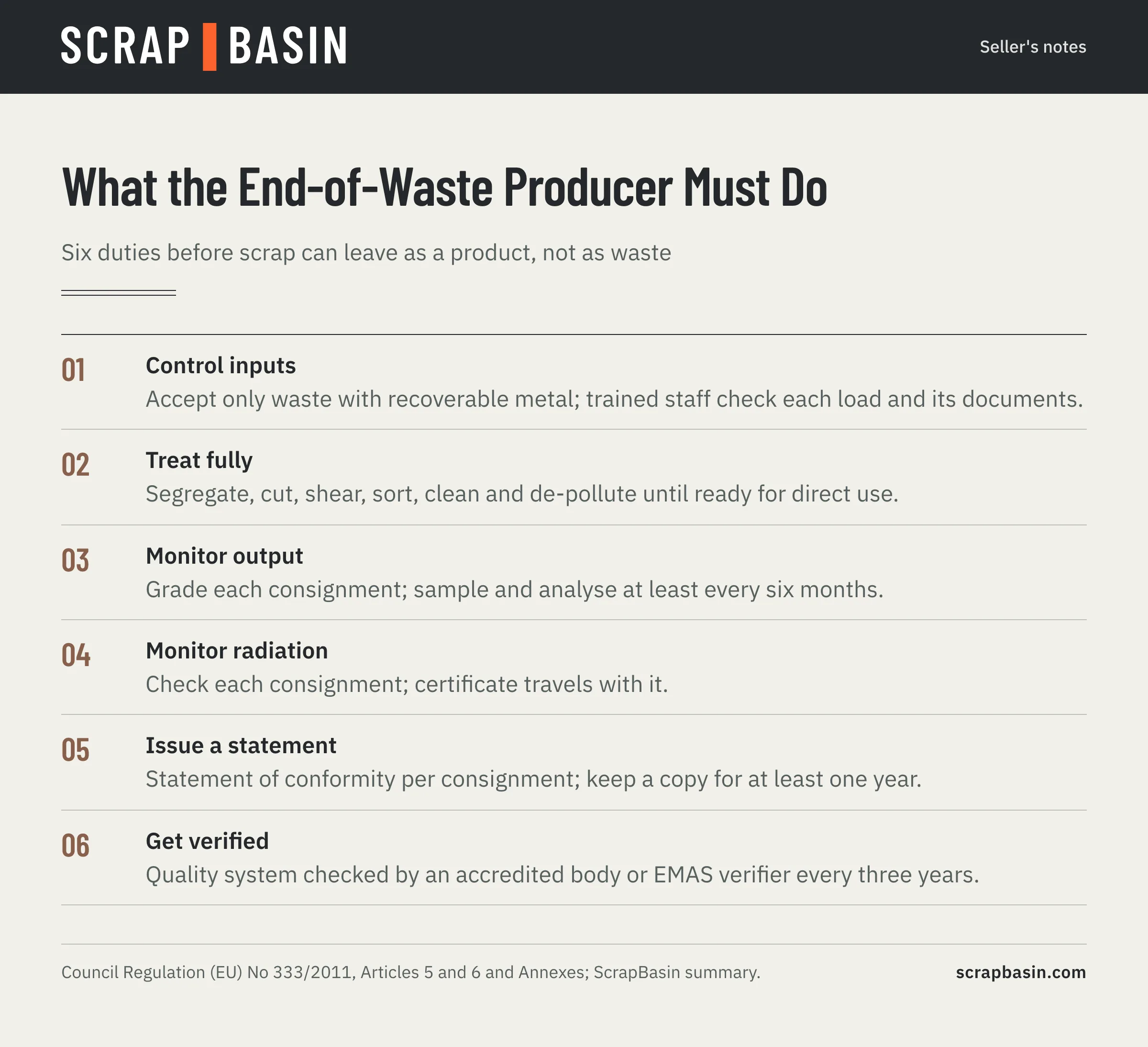
- Statement of conformity. For each consignment, the producer (or an importer) issues a statement in the model form annexed to the regulation, passes it to the next holder, and keeps a copy for at least one year.
- Quality management system. Documented procedures for acceptance control of inputs, monitoring of treatment, monitoring of output quality including sampling and analysis, radiation monitoring, customer feedback, record keeping, review and staff training.
- Sampling. Representative samples analysed at appropriate intervals, and at least every six months, with frequency based on variability and how close results run to the limits.
- External verification. An accredited conformity assessment body or an environmental verifier under EMAS (the EU Eco-Management and Audit Scheme) checks the quality management system, with verification every three years under both regulations.
What This Means If You Sell Scrap
Your scrap is probably waste when it leaves you. Unless you are yourself treating it to these criteria, running the quality system and issuing statements of conformity, your offcuts and swarf leave your site as waste, and waste rules apply to collection and carriage. Our material status guide sets out the questions to settle with a specialist.
A buyer's end-of-waste claim is checkable. If a buyer or trader says the material it sells on is end-of-waste, it should be able to show statements of conformity and evidence of an externally verified quality system.
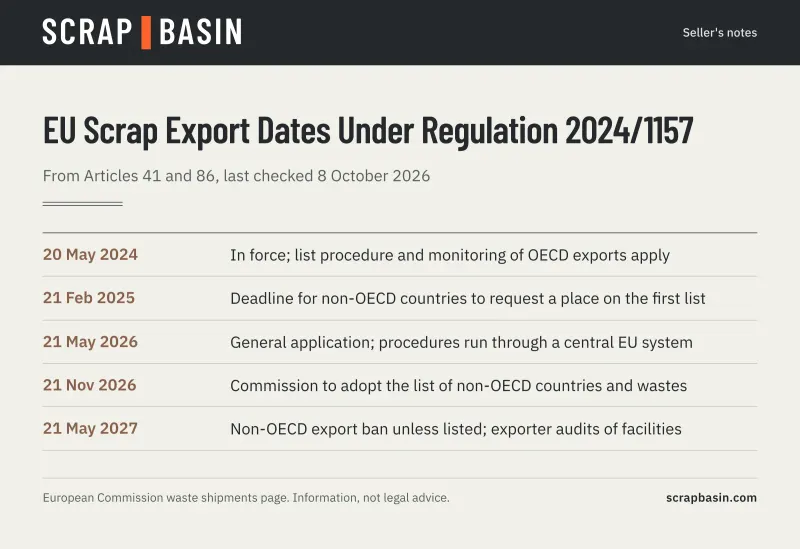
End-of-waste changes the export rules. Scrap that has ceased to be waste is no longer subject to waste shipment controls. Material that has not, including clean green-listed scrap, is. From 21 May 2027 that distinction matters for exports from the EU to non-OECD countries; see the EU Waste Shipment Regulation.
The thresholds are useful even if you never use them. They are a published, precise definition of clean scrap, worth quoting when you agree deduction terms with a buyer.
In the UK, both regulations appear on legislation.gov.uk with UK extent, so the same criteria are the reference point in Great Britain. Check the current version before relying on it.
This is commercial guidance, not legal advice.
Get the Field Guide
The free field guide's preparation and deductions page turns these criteria into a working checklist for your shop floor.
ScrapBasin Plus sends alerts when a tracked rule changes, for USD 12 a month: see Plus and Pro.
Public scrap price indexes for copper, brass, aluminium and steel each month, with the source on every figure.
Get Monthly PricesScrapBasin is an information service. It does not buy, sell or broker scrap.
Sources (checked 8 October 2026): Council Regulation (EU) No 333/2011, https://eur-lex.europa.eu/eli/reg/2011/333/oj; Commission Regulation (EU) No 715/2013, https://eur-lex.europa.eu/eli/reg/2013/715/oj; UK versions at https://www.legislation.gov.uk/eur/2011/333/article/3 and https://www.legislation.gov.uk/eur/2013/715/article/3.