Types of Scrap Metal Buyers: Who Pays Most for What?
Yards, processors, shredders, traders, mills, foundries and smelters: what each scrap buyer does, what it needs from you and when it can pay more.
Contents 8
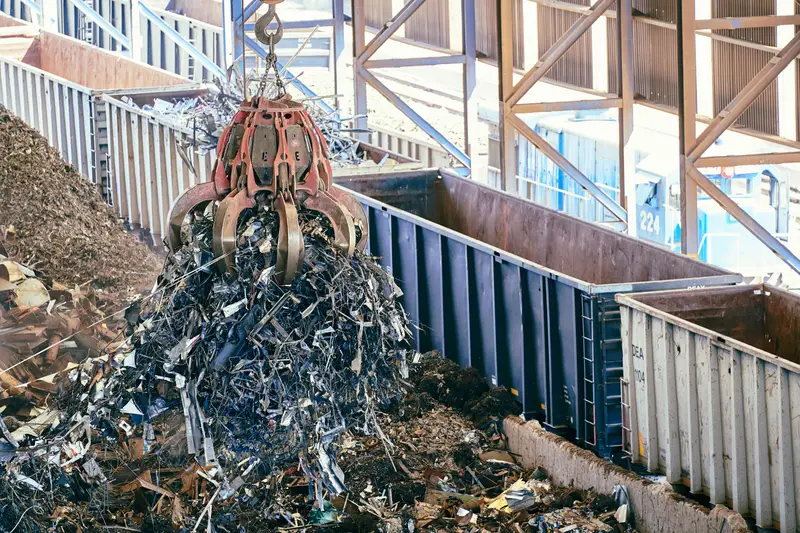
Every scrap offer you receive comes from a business sitting somewhere in a chain that ends at a furnace. The further that business sits from the furnace, the more steps (and margins, and lorry journeys) stand between your price and the price the metal finally fetches. This guide maps the buyer types, what each one actually does to the metal, what it needs from you before it can pay more, and which one is likely to be the strongest bidder for your material and volume. Use it to decide who belongs on your shortlist before you ask anyone for a price.
In short
- Scrap buyers differ by what they do to the metal: collect, sort, size, shred, trade, export or melt. Each step costs money and earns a margin.
- The consumers at the end of the chain are steel mills, foundries and secondary smelters. They pay for metal that is ready to charge, in volume, to their specification.
- A trader or wholesaler resells without transforming the material; a processor changes it (shears, bales, shreds, granulates). That distinction is how official classifications split the trade.
- Selling one step closer to the consumer pays only if your material already meets that buyer's specification and your volume covers the freight.
- For most industrial sellers the realistic best bidder is a processor or a well-placed yard with its own outlet. Small, mixed or irregular amounts of scrap rarely reach a mill directly.
The Chain, End to End
Official statistics draw a useful line. Under NACE, the EU's statistical classification of economic activities, wholesale of waste and scrap covers collecting, sorting, separating, storing and reselling scrap "without a real transformation process". Recovery of sorted materials covers mechanical or chemical conversion into secondary raw material, which explicitly includes crushing and shredding metal scrap. Remelting ferrous scrap belongs to steelmaking itself. In plain terms: traders move metal, processors change it, consumers melt it.
Where each buyer type sits, and what it adds before the metal reaches a furnace.
The Buyer Types
| Buyer type | What it does to the metal | What it needs from you | Where it tends to pay well |
|---|---|---|---|
| Collector (mobile) | Collects and resells, little or no processing | Accessible loads, small quantities | Convenience for very small or irregular arisings; rarely the top price |
| Local yard | Weighs, buys, sorts by hand or magnet, stockpiles until a lot is large enough to sell on | A weighable load and a grade it recognises | Mixed and small industrial loads; quick payment; local collection |
| Processor | Shears, bales, bundles or cuts to charging size; sorts by grade and alloy | Regular volume, consistent stream, a contract | Recurring industrial streams it can sell on as a prepared grade |
| Shredder operator | Fragments end-of-life vehicles, white goods and light mixed scrap; separates ferrous and nonferrous fractions | Light, bulky, mixed ferrous feed | Light iron, vehicles, appliances; mixed material other buyers discount |
| Specialist processor | Cable granulating, motor dismantling, stainless and alloy sorting, turnings handling | A defined stream of its specialism | Insulated cable, electric motors and transformers, high-alloy material |
| Trader or wholesaler | Buys and resells without transforming; aggregates lots, arranges freight and finance | Volume, known grade, documents | Large prepared lots where its outlets beat local ones |
| Exporter | Assembles shipment lots, containers or bulk cargoes for overseas consumers | Export-grade preparation, volume, export paperwork | Grades with strong overseas demand: see where UK ferrous scrap went |
| Steel mill (EAF, electric arc furnace) | Melts ferrous scrap into new steel | Charge-ready grades, low residuals, large regular tonnage | Prepared, specified ferrous grades: see ferrous scrap grades |
| Foundry | Melts scrap and pig iron into castings | Specific clean grades (often low-residual steel or cast iron) | Clean, analysed material in modest but regular volume |
| Secondary smelter or refiner | Melts and refines copper, aluminium, lead or precious metals | Assay or sampling arrangements; alloy-sorted material | Sorted nonferrous grades in volume |
A broker usually arranges a sale between two parties for a fee or spread without taking the material into a yard. Brokers can open outlets you could not reach alone, but they add a step. Ask whether you are dealing with the buyer or an intermediary, and who weighs the material.
What the Industry Structure Looks Like
Public data gives a sense of scale, mainly for the United States and for steel:
- The US Geological Survey reports more than 280 car shredders in North America, and that in 2023 the five leading US steel scrap processors handled 26 million tonnes across 354 facilities. Large processors operate many sites; a local yard may belong to one of them.
- USGS counts 102 US minimills (electric arc furnace steelmakers) run by 47 companies, and notes that the ferrous castings industry consumes most of the scrap that steelmakers do not.
- In the UK the balance is different. The World Steel Association reports UK crude steel output of 2.6 million tonnes in 2025, against UK ferrous scrap exports of 8.0 million tonnes. Most UK ferrous scrap is therefore sold to exporters or overseas consumers rather than melted at home. That may change: Tata Steel UK states that its Port Talbot electric arc furnace, rated at 3.2 million tonnes a year and due to be commissioned late in 2027 or early in 2028, will melt predominantly scrap. Our guide to electric arc furnaces sets out what that could mean for sellers.
Who Pays Most for What
The consumer at the end of the chain can, in principle, pay the most because nobody else's margin or freight sits between you. In practice it pays that price only for material it can charge straight into a furnace, delivered in the quantities it plans around. Every gap between your material and that specification is work someone else will do, and charge for.
| Your material and volume | Likely strongest bidders | Why |
|---|---|---|
| Small, mixed, irregular (under a skip a month) | Local yard, collector | Volume does not justify a processor's collection or a contract |
| Recurring clean ferrous offcuts or plate | Processor; yard with its own mill or export outlet | Already near a prepared grade; regular tonnage supports a contract |
| Heavy structural from demolition | Processor or exporter; occasionally a mill on large jobs | Needs cutting to charging size; volume can be large |
| Light mixed ferrous, appliances, vehicles | Shredder operator | Only a shredder turns this into a high-value grade |
| Turnings and swarf | Processor that handles turnings; foundry for clean, single-alloy lots | Oil, moisture and alloy mix decide the buyer |
| Copper wire, cable, motors | Specialist processor; secondary refiner for large sorted lots | Value depends on recovered metal, which needs specialist assessment |
| Aluminium, sorted by alloy | Processor; secondary smelter for large consistent lots | Alloy separation is what the smelter pays for |
| Stainless and high-alloy | Specialist alloy processor | Nickel, chromium and molybdenum content must be verified |
When Selling One Step Closer Pays
A fabricator produces 60 tonnes a month of clean steel plate offcuts. Two routes are open.
Route A, local yard. The yard pays 250 per tonne, collects at no charge and pays in 14 days. Net: 60 x 250 = 15,000 a month.
Route B, processor with a mill contract. The processor pays 280 per tonne but the fabricator must cut pieces to a maximum length and pay 900 a month for a dedicated container service. Cutting takes 20 labour hours a month at 35 an hour, so 700. Net: (60 x 280) minus 900 minus 700 = 16,800 minus 1,600 = 15,200 a month.
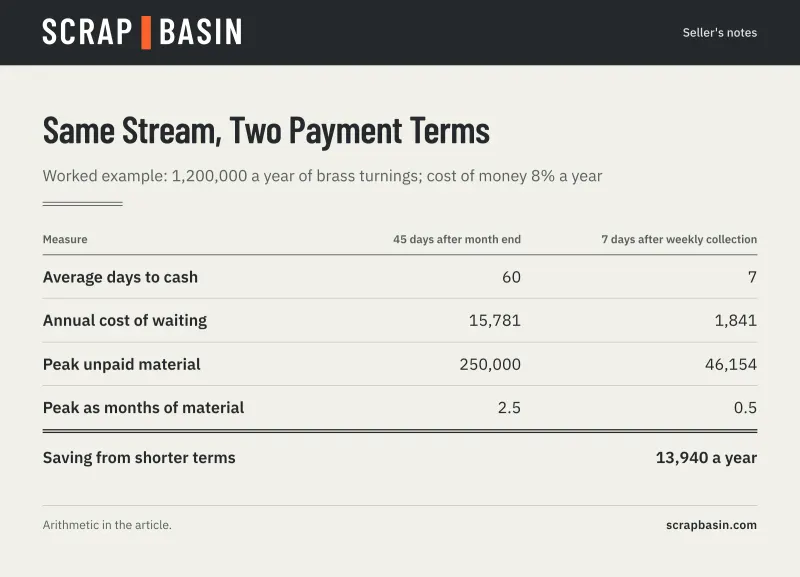
Route B pays 200 a month more, or 2,400 a year, before payment terms. If the processor pays in 45 days instead of 14, the fabricator funds an extra 31 days of 16,800 of revenue; at 8% a year that costs about 16,800 x 0.08 x 31 / 365 = 114 a month. The advantage shrinks to about 86 a month. If the fabricator's volume fell to 40 tonnes, Route B would pay (40 x 280) minus 1,600 = 9,600 against Route A's 40 x 250 = 10,000, and the yard would win.
The lesson is general: a higher headline price from a buyer nearer the furnace is worth having only after preparation, container, freight and payment time are counted, and only at the volume where those fixed costs are spread thinly enough.
How to Tell Which Type You Are Talking to
Business names do not tell you much. Four checks do:
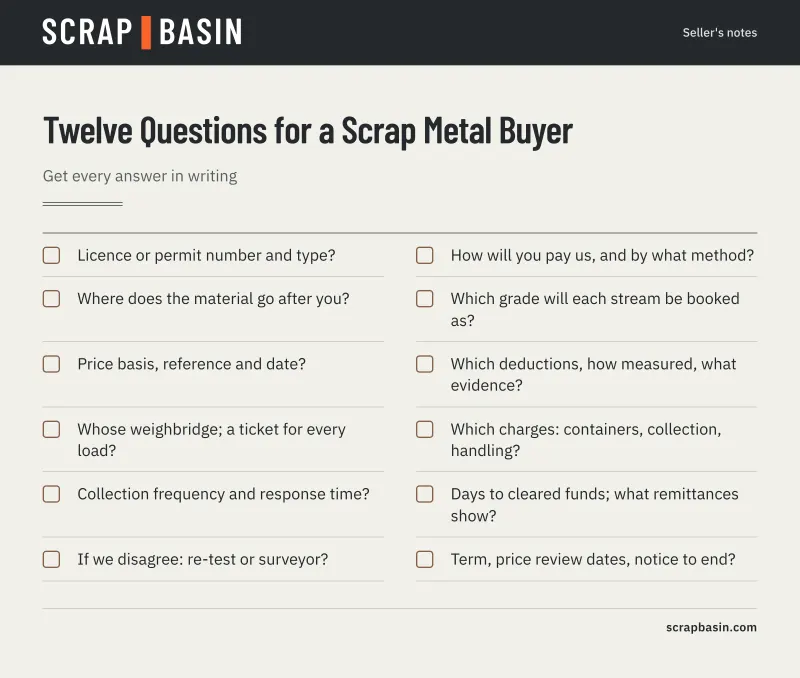
- Licence type. In England and Wales a scrap metal dealer holds either a site licence or a mobile collector's licence from the local council; the public register shows which. A collector cannot run a yard. Our guide to the Scrap Metal Dealers Act 2013 explains the two licences and the cashless rule.
- Environmental permit. A processor that shears, shreds or stores significant tonnage normally operates under a waste permit, listed on the Environment Agency's public register for permitted waste operations.
- Equipment. Ask what the site has: weighbridge, shear, baler, shredder, granulator. Equipment is the difference between a yard that sells your material on as it is and a processor that adds value.
- Outlet. Ask where your grade goes next. A buyer that sells straight to a mill, foundry or smelter, or exports its own cargoes, has fewer margins above it than one selling to another trader.
These answers belong in your shortlist alongside price. Our list of questions to ask a scrap metal buyer covers terms, weights and payment.
What This Means for Your Shortlist
For a recurring industrial stream, a sound shortlist usually holds one or two processors that handle your material, one local yard as a benchmark and for small overflow, and, where your volume is large and well prepared, one buyer closer to the consumer (a mill's own supply arm, a foundry or a smelter). Ask each for a price on the same basis and compare the net. If you have several streams, it is often worth splitting them between specialists rather than giving everything to one generalist. The method for finding and checking candidates is in how to find scrap metal buyers, and if you want a formal process, run a tender.
When a quality or weight dispute arises, remember that the guidelines of ReMA (the Recycled Materials Association, the US industry body) for metals transactions envisage either party appointing an independent surveyor to re-check weight or quality. Agreeing that right in advance costs nothing.
Find the Right Buyers for Your Material
The ScrapBasin directory lists scrap yards, processors, specialist recyclers and consumers, and shows where each fact in a record came from. Filter by material and buyer type to build a shortlist of businesses that actually handle your stream.
Search the directory by material and buyer type
To follow what public price indexes and trade data are doing each month, get the free monthly scrap price index report.
ScrapBasin publishes information. It never buys, sells or brokers metal.
Public scrap price indexes for copper, brass, aluminium and steel each month, with the source on every figure.
Get Monthly PricesSources (checked 9 October 2026)
- Statistics Finland, TOL 2008 class 4677 Wholesale of waste and scrap: https://stat.fi/en/luokitukset/toimiala/toimiala_1_20080101/code/4677/
- Statistics Finland, TOL 2008 class 3832 Recovery of sorted materials: https://stat.fi/en/luokitukset/toimiala/toimiala_1_20080101/code/3832/
- U.S. Geological Survey, Mineral Commodity Summaries 2026, Iron and Steel Scrap: https://pubs.usgs.gov/periodicals/mcs2026/mcs2026-iron-steel-scrap.pdf
- U.S. Geological Survey, Mineral Commodity Summaries 2026, Iron and Steel: https://pubs.usgs.gov/periodicals/mcs2026/mcs2026-iron-steel.pdf
- World Steel Association, World Steel in Figures 2026: https://worldsteel.org/wp-content/uploads/World-Steel-in-Figures-2026.pdf
- Tata Steel Limited, filing of 18 February 2025 (Port Talbot EAF planning approval): https://nsearchives.nseindia.com/corporate/SAKSHIKAPUR_18022025211110_BSENSE.pdf
- Environment Agency, Public Registers Online: https://environment.data.gov.uk/public-register/view/index
- ReMA's ISRI Specifications, July 2026: https://www.isrispecs.org/wp-content/uploads/2026/09/2026-July-ReMA_ISRI_Specifications.pdf