Scrap Metal Dealers Act 2013: What Sellers Need to Know About Licences and Cash
The Scrap Metal Dealers Act 2013 for sellers: site and collector licences, the public register, no cash, ID checks and records. Checked Oct 2026.
Contents 7
Most guides to the Scrap Metal Dealers Act 2013 are written for dealers applying for a licence. This one is for the other side of the counter: a business or contractor in England or Wales that sells scrap and wants to know what its buyer is required to do, what it can check, and what the Act means for itself. It covers the two licence types, the public register, the ban on cash, identity checks and record keeping, section by section, with links to the text.
This is commercial guidance, not legal advice. Last checked: 8 October 2026.
In short
- Anyone carrying on business as a scrap metal dealer in England or Wales needs a licence from the local council: a site licence or a mobile collector's licence. Licences last three years.
- The Environment Agency (England) and Natural Resources Wales keep public registers of licences. You can check a buyer's name, licence type, sites and expiry date.
- Dealers must not pay for scrap in cash. Payment must be by non-transferable cheque or electronic transfer. Scotland has its own equivalent rule.
- Dealers must verify your full name and address before receiving metal, and record what they receive. Being asked for identification is a sign of a compliant buyer.
- A manufacturer that sells scrap only as a by-product of making things is not, for that reason, a scrap metal dealer.
Who Needs a Licence
Section 1 says no person may carry on business as a scrap metal dealer unless authorised by a licence. Section 21 defines that business: one that consists wholly or partly in buying or selling scrap metal, whether or not the metal is sold in the form it was bought, or carrying on business as a motor salvage operator.
Two parts of section 21 matter to sellers.
- The manufacturer exemption. Under section 21(3), a person who manufactures articles is not regarded as selling scrap metal if it sells scrap only as a by-product of manufacturing, or as surplus materials not required for manufacturing. A machine shop selling its own swarf does not need a licence for that reason. A business that buys scrap from others to sell on is a different matter: read section 21 and take advice.
- What counts as scrap. The definition is wide: any old, waste or discarded metal or metallic material, and any product or article made from or containing metal that is broken, worn out or regarded by its last holder as having reached the end of its useful life. Gold, silver and alloys that are 2% or more gold or silver by weight are excluded.
Carrying on business without a licence is an offence with a fine not exceeding level 5 on the standard scale. GOV.UK's licence page states a fine of GBP 5,000, but section 85 of the Legal Aid, Sentencing and Punishment of Offenders Act 2012 made summary fines of GBP 5,000 or more unlimited in England and Wales, so the maximum is now higher than that figure.
Two Licence Types
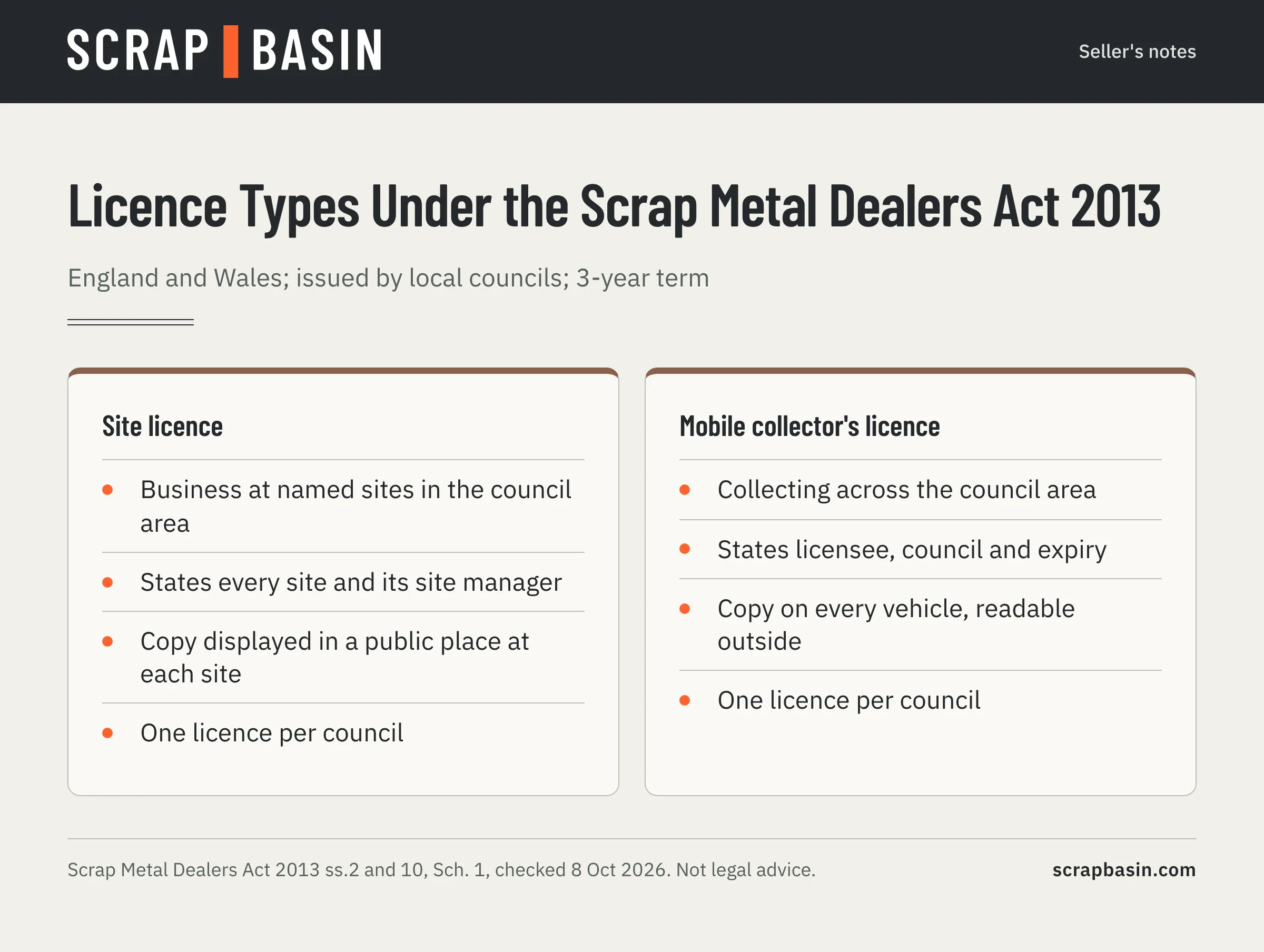
Under section 2, licences are issued by local authorities and are one of two types:
| Site licence | Mobile collector's licence | |
|---|---|---|
| Authorises | Business at the sites named in the licence, in that council's area | Business as a mobile collector in that council's area |
| Must state | Licensee, council, every site, the site manager for each site, expiry date | Licensee, council, expiry date |
| Display (section 10) | A copy in a prominent public place at each site | A copy on every vehicle used, readable from outside |
| More than one? | A dealer can hold licences from different councils, but only one from each | Same |
A licence expires three years after it is issued (Schedule 1). Since 4 April 2022, renewing a licence requires the dealer to complete a tax check with HMRC, according to GOV.UK; the Finance Act 2021 inserted the related timing rules into Schedule 1. If the applicant or a site manager has been convicted of a relevant offence, the council may add one or both of two conditions (section 3(8)): receiving scrap only between 9am and 5pm, and keeping metal in the form received for a stated period of up to 72 hours.
Checking a Buyer on the Register
Section 7 requires the Environment Agency to keep a register of licences issued by councils in England, and Natural Resources Wales to keep one for Wales. Each entry records the issuing council, the licensee's name and any trading name, the address of each licensed site, the licence type and the expiry date. The registers are open to the public; the Environment Agency's is searchable online.
What a register check tells you: that the name you are dealing with holds a licence of a stated type, for stated sites, until a stated date. What it does not tell you: whether the business is financially sound, how it measures deductions or whether it pays on time. For those, see questions to ask a scrap metal buyer.
No Cash
Section 12 says a scrap metal dealer must not pay for scrap metal except by a cheque that is not transferable, or by an electronic transfer of funds. Paying in kind, with goods or services, counts as paying. The dealer, the site manager and the person making the payment can each commit an offence.
In Scotland, the Civic Government (Scotland) Act 1982, as amended in 2015, has a parallel rule: a metal dealer may pay only by non-transferable cheque or by electronic transfer to a bank or building society account in the payee's name.
For a seller the practical point is simple: a buyer offering cash in Great Britain is breaking the law, and a business that sells to it takes on that buyer's risks. For how payment terms should work, see payment terms.
Identity Checks and Records
Section 11 says a dealer must not receive scrap metal from a person without verifying that person's full name and address, by reference to documents, data or information from a reliable and independent source. Section 13 requires the dealer to record a description of the metal (type, form, condition, weight and identifying marks), the date and time of receipt, the registration of any delivery vehicle, the name and address of the person it came from and the name of the person who paid. Copies of identity documents and payment records must be kept. Section 15 requires all of this to be kept for three years.
If your drivers deliver scrap to a yard, expect the yard to record the vehicle registration and to ask who the material is from. That is the Act working as intended.
A Seller's Check List
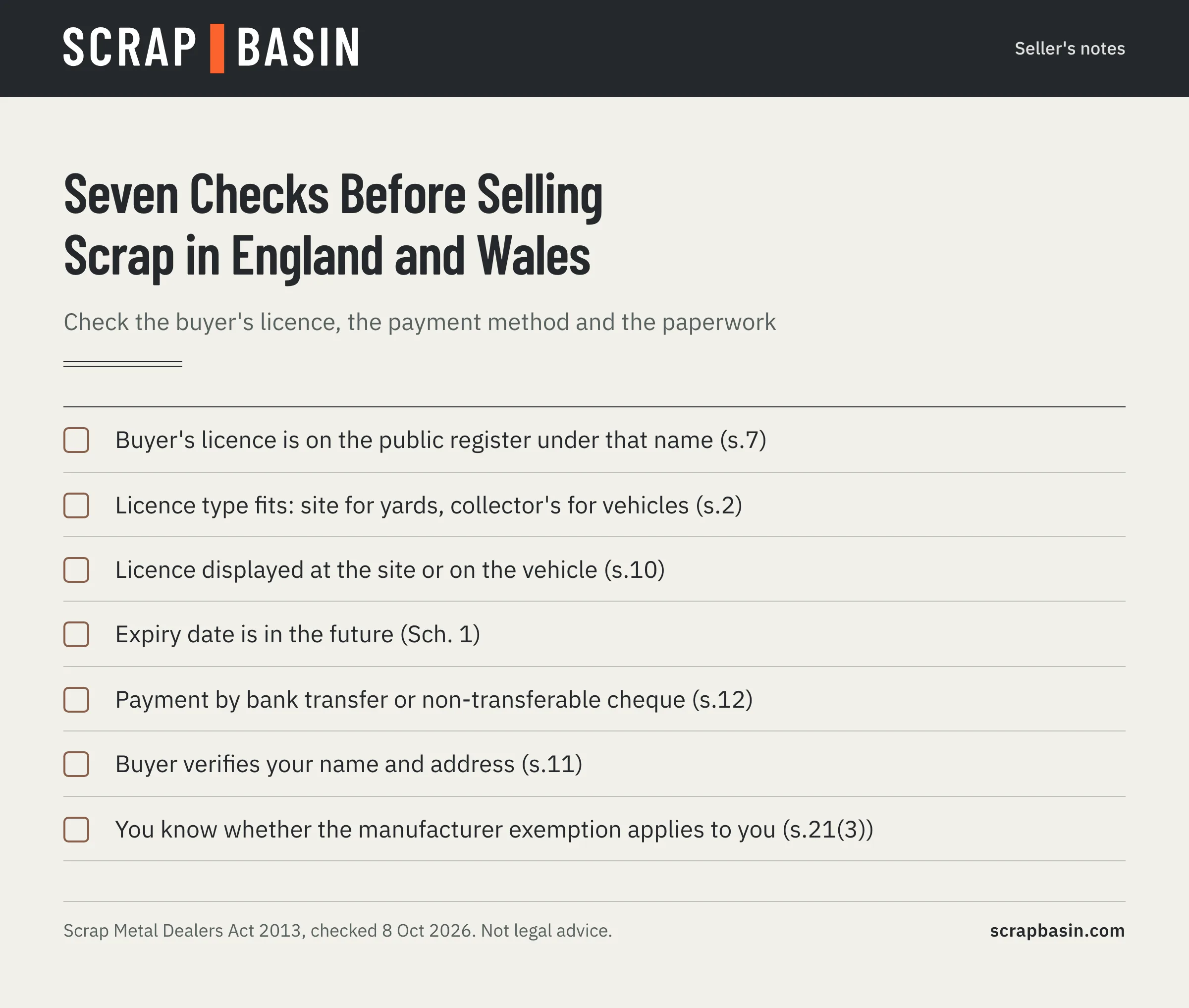
- The buyer's licence is on the public register, in the name you are dealing with (s.7).
- The licence type fits: a site licence for the yard you deliver to, a collector's licence for a vehicle that collects (s.2).
- The licence is displayed at the site or on the vehicle (s.10).
- The expiry date is in the future (Sch. 1).
- Payment will be by bank transfer or non-transferable cheque (s.12).
- The buyer asks to verify your business name and address (s.11).
- You know whether your own business falls within the manufacturer exemption (s.21(3)).
If you are inviting several buyers to bid for a recurring stream, put the licence number and type in the bid form; see scrap metal tender. Questions about whether your material is waste at all belong to a separate review: see material status.
Northern Ireland is outside the 2013 Act; we have not yet checked its rules, so we make no statement about them here.
Keep It Current
The free field guide summarises payment and licence rules for England and Wales, Scotland, Washington State and New South Wales on one page.
ScrapBasin Plus includes alerts when a tracked rule changes, for USD 12 a month: see Plus and Pro.
Public scrap price indexes for copper, brass, aluminium and steel each month, with the source on every figure.
Get Monthly PricesScrapBasin is an information service. It does not buy, sell or broker scrap.
Sources (checked 8 October 2026): Scrap Metal Dealers Act 2013, https://www.legislation.gov.uk/ukpga/2013/10/contents (sections 1, 2, 7, 10, 11, 12, 13, 15, 21 and Schedule 1); GOV.UK, Scrap metal dealer licence, https://www.gov.uk/scrap-metal-dealer-registration; Air Weapons and Licensing (Scotland) Act 2015 s.69, https://www.legislation.gov.uk/asp/2015/10/section/69; Environment Agency public register, https://environment.data.gov.uk/public-register/view/search-scrap-metal-dealers; Legal Aid, Sentencing and Punishment of Offenders Act 2012 s.85, https://www.legislation.gov.uk/ukpga/2012/10/section/85.